
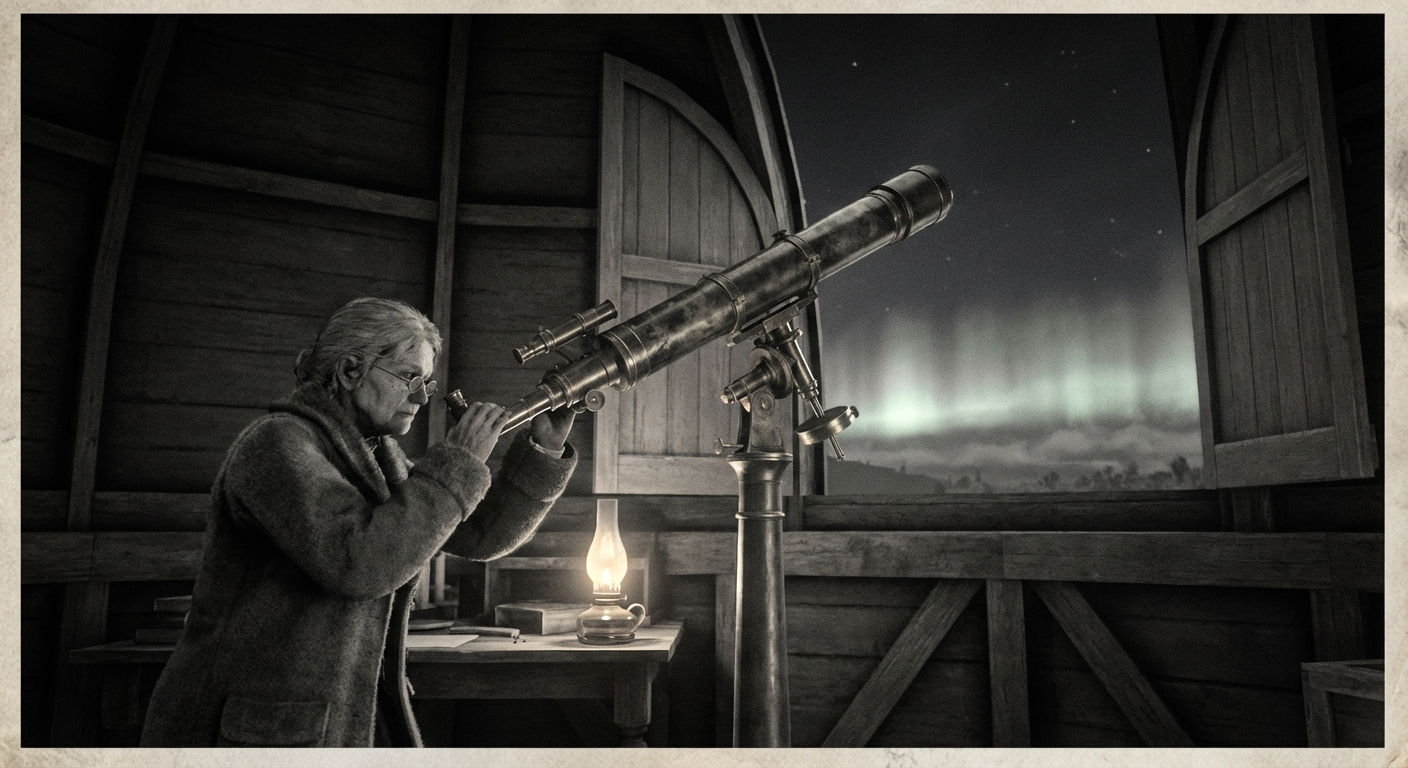
The notebook is the kind you can buy at any stationer’s for sixty centimes — ruled, cloth-bound, unremarkable. Dr. Odette Collis has filled forty-three of them.
Each page records a night: the date, the time, the sky conditions, the objects observed, and any anomalies. The handwriting is small and steady — the hand of a woman who spent thirty-one years teaching mathematics at Bramblegate Grammar School and never quite stopped grading her own work.
On the page dated 3 February 2026, in the same careful script, there is an entry that Collis has underlined twice:
“Diffuse luminous band, bearing NNW, approx. 2° above Highland ridge. Greenish-white. Not previously observed. Duration: 10:14 PM to cessation of observations 1:40 AM. No catalogued explanation.”
The entry has appeared, in one form or another, on every clear night since.
“I have looked at that stretch of sky on approximately eight hundred clear nights,” Collis told The Bobington Times in the Observatory’s reading room on Friday, a cup of black tea growing cold beside her. She is 64, slight, with the particular alertness of someone who has spent decades noticing things other people overlook. “This is not something I have seen before.”
What She Sees
The phenomenon — visible on clear nights along the northern horizon — presents as a faint, diffuse glow above the Greymoor Highlands. To the naked eye, it is subtle: a greenish-white luminescence occupying a band roughly two degrees wide, most visible between 10 PM and 2 AM. On hazy nights, it disappears entirely. Under ideal conditions, Collis describes it as unmistakable.
Through the Cartwright Observatory’s 36-inch refractor — the largest telescope in Bobington, housed in its hilltop dome in the Marches district since 1881 — the glow resolves into something more structured.
“A curtain of faint vertical striations,” Collis said, choosing her words with the precision of someone accustomed to exact language. “Not unlike aurora, but far more localised. Aurora extends across the sky. This is fixed above the Highland ridge. It does not move.”
Collis has taken spectral measurements using the Observatory’s portable spectrograph, an instrument she learned to operate specifically for this purpose over the past two weeks. The results, neatly tabulated across six pages of her current notebook, are what prompted her to bring the matter to the Observatory’s director.
“The spectral signature doesn’t match known industrial sources,” Collis said. “It doesn’t match any standard atmospheric optical phenomenon I can find in the literature. I checked. I checked again. I checked a third time, because I am the sort of person who checks a third time.”
A Director Pays Attention
Dr. Sable Nightingale, director of the Cartwright Observatory, initially attributed the phenomenon to light pollution from mining operations in the Greymoor district. The Miners’ Cooperative runs a small number of active mines in the Highlands, and industrial lighting is a persistent nuisance for observational astronomy.
But Collis’s data changed her mind.
“I’ve worked with professional astronomers who are less rigorous than Odette,” Nightingale said. “She presented me with three weeks of continuous observations, spectral data, cross-referenced weather records, and a summary that would not have been out of place in a Royal Institute proceedings volume. When she says something is unusual, I pay attention.”
The Observatory has formally logged the phenomenon and submitted a request to the Royal Institute of Natural Philosophy for time on its larger spectroscopic equipment — instruments capable of more detailed analysis than the Observatory’s portable unit can provide.
Nightingale cautioned against premature speculation.
“We have an unexplained optical phenomenon above a geologically active area,” she said. “That is interesting. It is not, at this stage, anything more than interesting.”
The geological activity she refers to is the seismic tremor recorded in the Greymoor Highlands on 23 February — the first in eleven years — which Nils Haversten of the Miners’ Cooperative disclosed during Monday’s Copper Review Commission hearing. Whether the tremor and the luminous phenomenon are connected is, at present, entirely speculative.
Collis herself is cautious on the point.
“I am a mathematician, not a geologist,” she said. “I will observe that the two events coincide in location and roughly in time. I will not observe anything further until someone with appropriate expertise examines the data.”
The Institute Watches
Professor Elara Whitstone, president of the Royal Institute and a specialist in geological phenomena, said she was “aware of Dr. Collis’s observations” but declined to comment substantively until more data was available.
“I will say this,” Whitstone added, in the manner of someone who was going to say it whether asked or not. “The Greymoor Highlands have a habit of surprising us. The geology is complex, the history is deep, and the number of things we do not yet understand about what happens beneath those hills is larger than most people appreciate.”
Whitstone noted that luminous atmospheric phenomena associated with seismic activity have been reported in various geological contexts throughout the world, though the mechanisms remain poorly understood and the subject is, she said, “not without its controversies in the scientific literature.”
The Royal Institute’s Wednesday lecture — “Copper in the Earth,” presented by Whitstone herself — sold out within three hours of its announcement. Whether the Institute’s interest in the Greymoor Highlands will extend beyond copper to the lights above them remains to be seen.
A Woman With a Telescope
Collis, who retired from Bramblegate Grammar in 2020 and began volunteering at the Cartwright Observatory in 2015, said she had no interest in sensationalism. She simply wanted an answer.
“I am not a professional astronomer,” she said. “I am a retired schoolteacher with a telescope and a notebook. But I have been looking at the sky from this observatory for eleven years, and I know what I see, and I know what I don’t see.”
She closed the notebook and placed it in her satchel, alongside forty-two others.
“This is something I have never seen. I would like to know what it is.”
The Cartwright Observatory is open to the public on the first and third Fridays of each month. Dr. Collis volunteers on both evenings.