
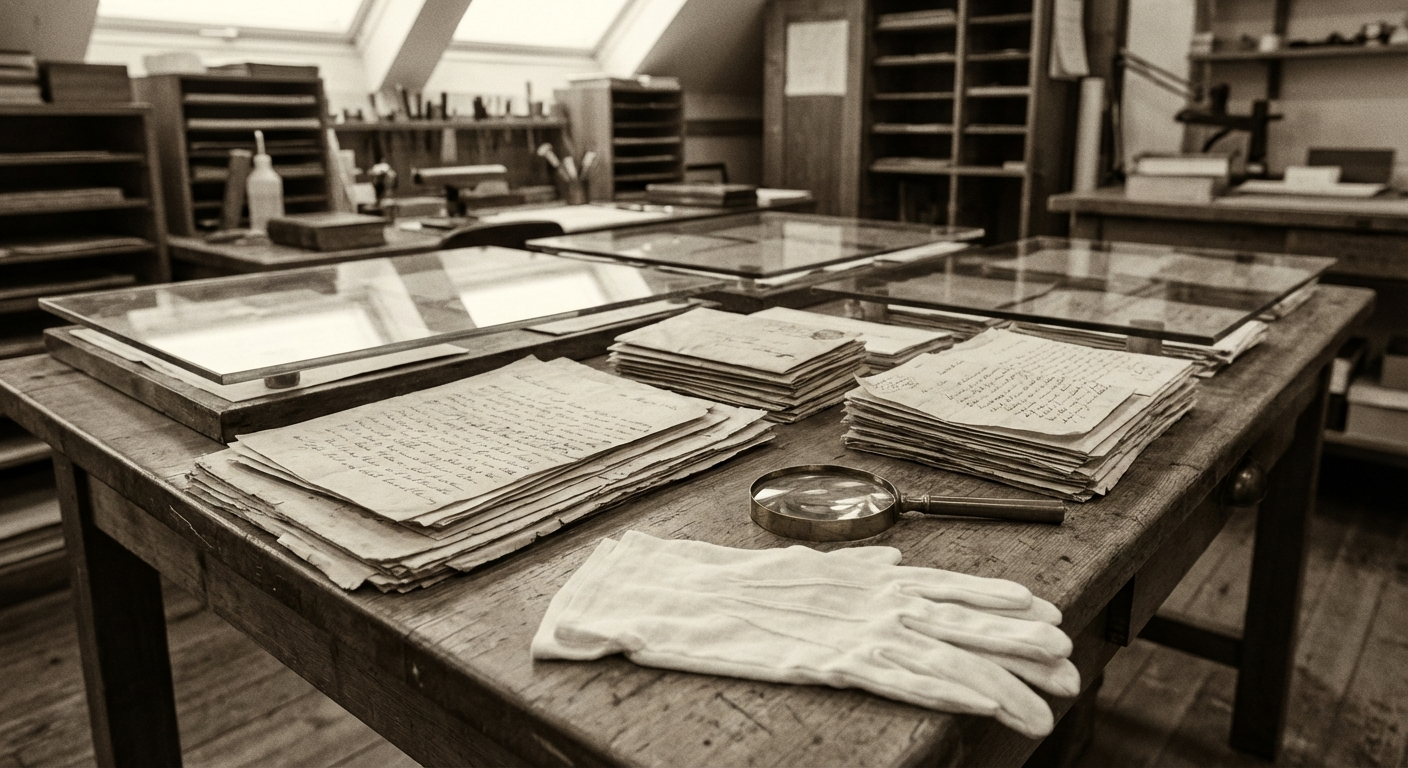
The letters are written in iron gall ink on cotton rag paper, folded in thirds, and sealed — when sealed at all — with plain brown wax. They smell, according to Dr. Emmeline Furness, of dust, mildew, and the particular dry sweetness of paper that has been undisturbed for a very long time.
“One hundred and sixty years,” Furness said on Tuesday, working at a broad table in the Polytechnic’s document conservation room, where the first twelve of approximately forty letters and documents recovered from the Meredith & Blackwell warehouse are laid out under weighted glass. “These pages have been behind a wall for longer than anyone alive has been breathing.”
The cache was discovered on 10 March by demolition foreman Milo Garrett, who found a false panel in the rear wall of the condemned warehouse on Harker Street. Behind it: a bundle of correspondence wrapped in oilcloth, tied with cord. The building was constructed in 1856 by the textile merchant Josiah Meredith, who operated from it until his death in 1871. It was scheduled for demolition by its current owner, Greystone Development Ltd. That demolition has been suspended.
Furness, a lecturer in urban history at the Polytechnic who specialises in nineteenth-century commercial Bobington, was called to the site on Monday and transported the documents to the Polytechnic by hand in a padded crate. She has spent the past two days on the first twelve items — a process that involves careful unfolding, photographic documentation, and a preliminary transcription.
“The dates range from 1858 to 1862,” Furness said. “Most are personal letters from Josiah Meredith to his brother Edwin, who was based in Caldwell. Three are business documents — invoices, a contract for textile storage. But it is the personal letters that are remarkable."
"A Ward for the Sick Among the Piling Crews”
The most significant finding so far is contained in a letter dated 14 September 1859, in which Meredith describes to his brother the construction of the new Ashwater quays — a project that was reshaping the Docklands waterfront during that period.
The letter includes a passage that Furness read aloud on Tuesday with the careful precision of someone who understood its weight:
“The works at the quayside proceed, though at a cost beyond copper and timber. A fever has taken hold among the piling crews and I am told that upwards of thirty men are confined to a ward erected behind the old grain sheds. The nature of the illness is unknown to the surgeon — some manner of ague carried, he believes, from the river mud disturbed by the driving of the piles. Two men have died this week. The air in the lower streets is foul.”
The 1859 dockworkers’ fever is known to historians — municipal death registers record between sixty and eighty deaths from an unspecified “waterborne ague” between August and November of that year. But no eyewitness account has previously been found. The fever ward behind the grain sheds has never appeared in any known document.
“We knew the numbers,” Furness said. “We knew the dates. We did not know there was a fever ward, or where it was, or that a private citizen three streets away was watching it happen and writing it down. These aren’t just business letters. They are eyewitness accounts of a city being built.”
Two additional letters contain detailed descriptions of quay construction methods, including materials costs — Meredith quotes granite at eight florins per cubic yard, delivered by barge from Greymoor — and references to labour disputes that are otherwise undocumented. A fourth letter, dated December 1860, describes a fire at a timber yard near what is now Harbourfront Parade.
The Building’s Future
The discovery has complicated Greystone Development’s plans for the Harker Street site. The building, which was condemned following a structural assessment in November 2025, was to have been demolished to make way for new commercial premises.
Louisa Marchbank, chairwoman of the Bobington Historical Preservation Society, has formally requested a full heritage listing for the warehouse — a process that, if granted, would prevent demolition indefinitely.
“This is the most significant private archive discovered in Bobington in decades,” Marchbank said. “The building that preserved it deserves the same consideration.”
Greystone Development Ltd has not commented on the heritage listing request. The company’s registered office on Harbourfront Parade did not respond to two written inquiries on Tuesday.
Furness expects the full assessment of all forty documents to take several weeks. She intends to present preliminary findings at the Polytechnic’s spring exhibition in April.
The remaining twenty-eight documents are stored in the Polytechnic’s climate-controlled archive, awaiting their turn under the glass.
“Each one is a window,” Furness said. “You unfold it, and you see something nobody has seen for a hundred and sixty years. There is no feeling quite like it.”