
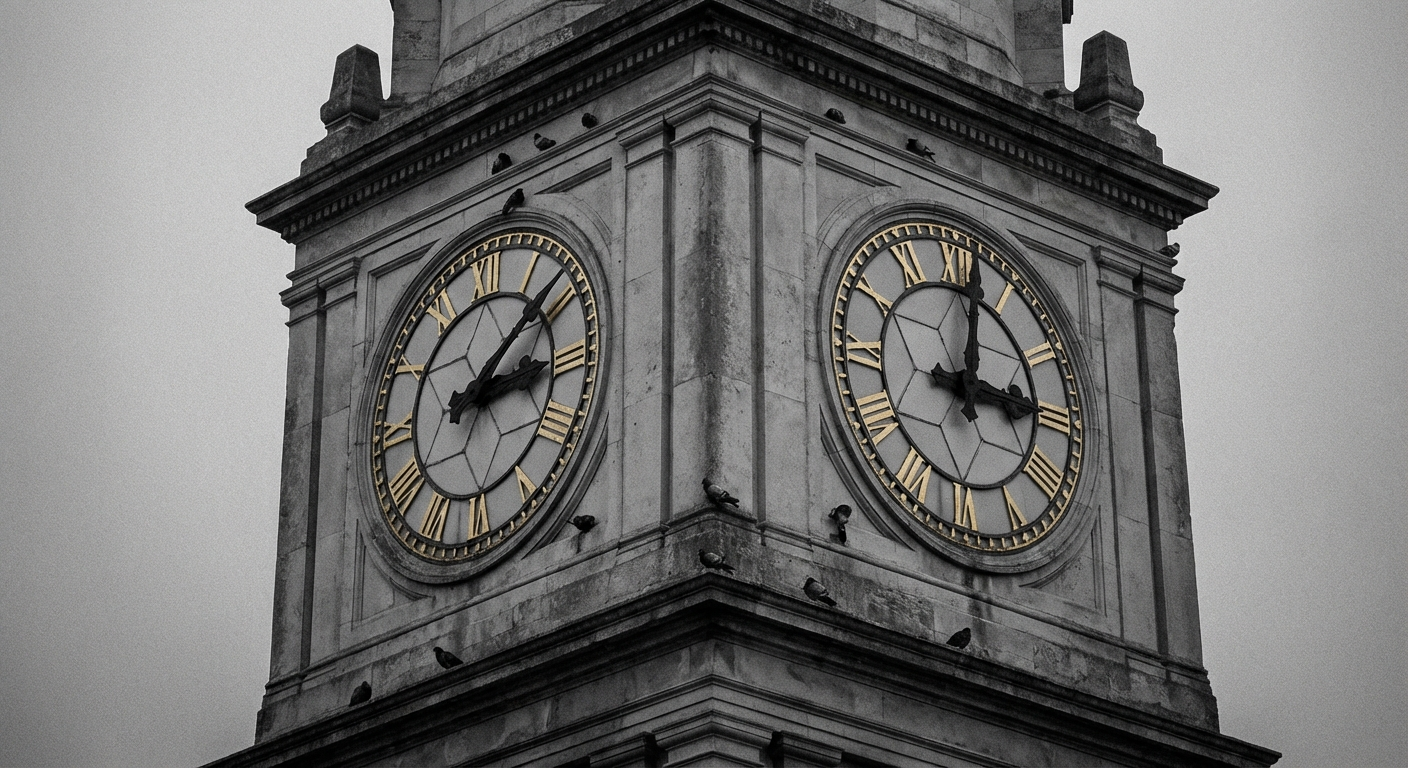
At 2:47 PM on Wednesday, in the middle of a perfectly ordinary afternoon, the great clock above the Municipal Chamber stopped.
Nora Dalton, Deputy Clerk of the Municipal Chamber, was the first to notice. She was filing committee minutes in the Speaker’s anteroom when the silence registered — not a sound, but the absence of one. The clock’s pendulum, which has marked the seconds in that building since Ulysses Grant was an unfashionable memory and the city’s trams were still drawn by horses, had ceased its swing.
“I didn’t hear it stop,” Mrs Dalton said. “I heard that it had stopped. There’s a difference. You don’t notice the ticking until it isn’t there.”
The twin-faced clock was installed in 1873 by Quirke & Bramley Clockworks, a firm that operated from premises on Grayling Street until 1962. Its mechanism — a weight-driven, deadbeat escapement with a compensating pendulum — has been wound weekly by a succession of Municipal Chamber custodians without interruption for one hundred and fifty-three years. It survived the fire of 1911, two wars, the great storm of 1947, and a pigeon that nested in the eastern face in 1983.
It has not survived Wednesday.
The Last Man Who Knows
The Municipal Works Office spent Thursday morning consulting its records and making telephone calls. The clock’s mechanism was last overhauled in 2003 by Desmond Quirke, then sixty-seven, a master clockmaker and the grandson of Aldous Quirke, who co-founded the original firm.
Quirke retired to Millhaven in 2014. He is now seventy-nine. He is, by all available evidence, the only living person who has worked inside the clock’s housing and understands its particular temperament.
“It’s not a standard mechanism,” said Edgar Lowe, the current Municipal Chamber custodian, who has wound the clock every Monday morning for eleven years. “Mr Quirke told me once that his grandfather made the escapement by hand and that no two parts are interchangeable with anything else ever manufactured. He said it with some pride.”
Quirke was reached by telephone on Thursday morning. He listened, asked two questions — “Which face?” and “Did it stop suddenly or slow first?” — and agreed to come to the city on Friday.
“I’ll come and have a look,” he said. “I haven’t seen the old girl in twelve years. She’s probably cross with me.”
A Small Silence
The Municipal Chamber clock is not, in the grand scheme of Bobington’s current preoccupations, an urgent matter. The city is negotiating the reopening of an international strait. Its tramway is about to break ground. A theatre is fighting for its life. The clock above the council chamber is a civic ornament, not a piece of critical infrastructure.
And yet. Mrs Dalton reported that four separate members of staff mentioned the silence to her before the end of the working day on Wednesday. Speaker Falk, who was not in the building, telephoned to ask whether something had happened to the clock when he noticed the time on the eastern face had not changed between two glances from his motorcar.
The clock has two faces — one looking east toward Threadneedle Street, one looking west toward the river. Both are stopped at 2:47. The hands are iron, the numerals are gilded, and the faces are Portland stone, each seven feet in diameter.
“It’s the kind of thing you forget is there,” said Councillor Pryce, whose office window faces the western dial. “Until it isn’t.”
Quirke is expected at the Municipal Chamber on Friday morning. He has requested that no one touch the mechanism before he arrives.
The clock remains at 2:47.