
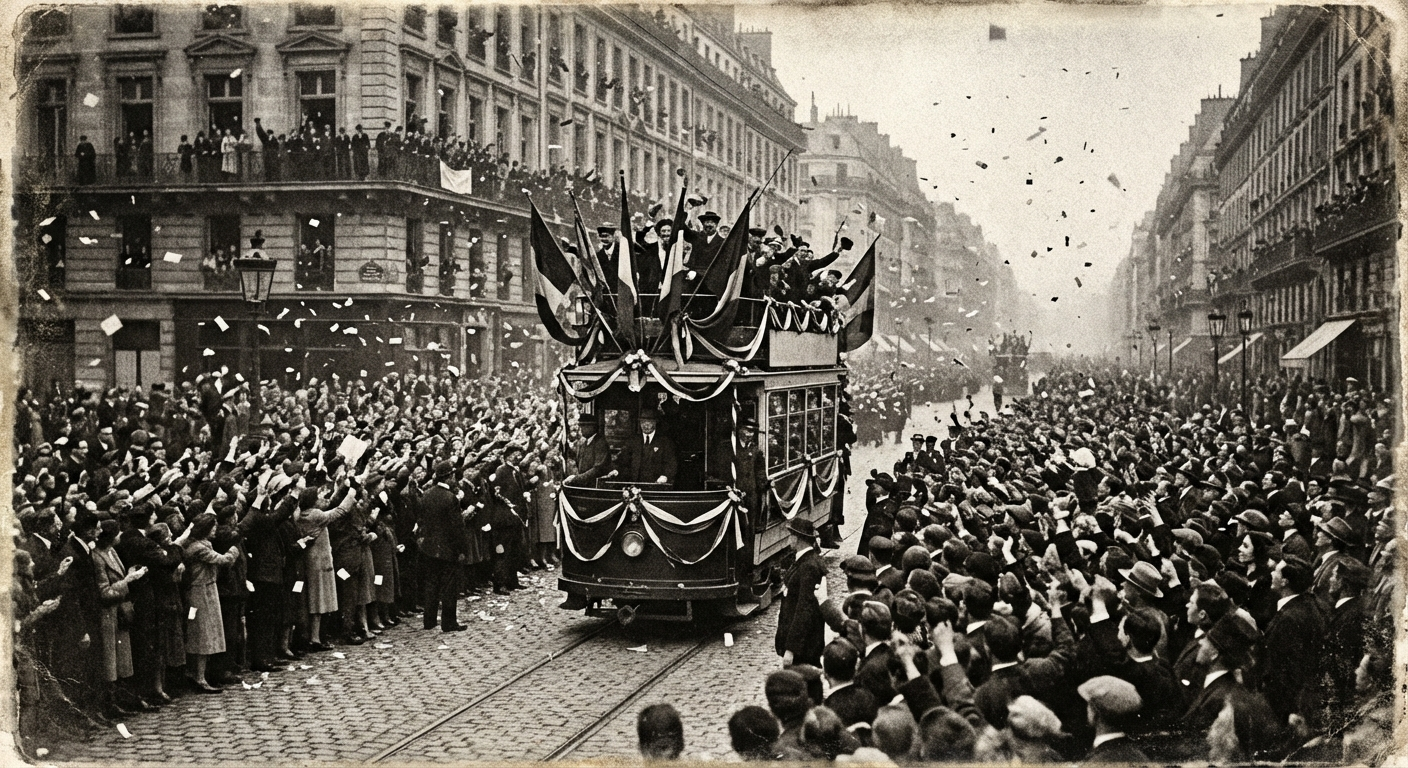
They came from the Docklands and from Upper Fernwich, from Thornhill and East Palisade, from the Greymoor Highlands and from villages whose names rarely trouble the pages of this newspaper. They came in scarlet and gold, in homemade banners and battered scarves, in work boots and Sunday best. They came, two hundred thousand strong by the Constabulary’s estimate, and for one glorious afternoon the great, quarrelsome, copper-anxious city of Bobington remembered what it felt like to be happy.
The Rovers’ cup parade — the first since 2015, when the squad was ferried through rather more modest crowds in an open-topped motorcar — began at half past one at Bridgewater Stadium, where the players emerged onto the forecourt to a roar that could be heard, several witnesses insisted, from the far side of the Docklands. The squad boarded a specially commissioned open-top tram, painted in the club’s scarlet and gold and lent by the Transit Authority for the occasion, which wound its way through the Docklands along Harbourfront Parade, up through Midtown via Threadneedle Street, and into Caldecott Square for the Freedom of the City ceremony.
The mood was, by turns, euphoric and tender. Along Harbourfront Parade, dockworkers who had come off the morning shift still in their overalls leaned from warehouse balconies, waving flags fashioned from bedsheets. Children sat on parents’ shoulders, many clutching hand-drawn portraits of Kael Dunmore — whose 35-yard thunderbolt in the 118th minute of Saturday’s final has already entered the city’s mythology. The man himself stood at the front of the tram for the duration, grinning broadly, conducting the crowd’s singing with the cup itself.
“I keep thinking I’ll wake up,” Dunmore told reporters at the post-parade reception. “The noise on Threadneedle Street — I’ve never heard anything like it. You could feel it in your chest.”
Orin Blackshaw, the centre-back whose headed equaliser changed the course of the final, appeared on the tram with his right knee heavily bandaged, waving gamely but unable to stand for long stretches. Manager Phillipa Corbett, seated beside him for much of the route, was seen speaking intently with club physiotherapist Dr. Lena Sorrens, though both declined to comment on the nature of the injury beyond what has already been disclosed.
Nadia Osei, whose darting run created the space for Dunmore’s winner, was more mobile but visibly careful, her hamstring evidently still a concern. When asked by a supporter whether she would be fit for Saturday’s league match against Haverford Town, she laughed and said: “Ask me Thursday.”
Freedom of the City
The ceremony at Caldecott Square was the emotional centrepiece of the day. Mayor Harriet Blackthorne, standing before an estimated forty thousand people packed into the square and the surrounding streets, presented the Freedom of the City to the club in a brief but warm address.
“The Merchants’ Cup belongs to the players who won it,” the Mayor said. “But the joy it has brought belongs to all of Bobington. In a week when this city has had much to worry about, you have reminded us what we are capable of when we pull together.”
The remark — widely interpreted as a reference to the Greystone Wharf investigation and the looming copper crisis — drew murmurs and then applause.
Captain Sully Marsh, the longest-serving player in the squad at nine years, stepped forward to accept the honour on behalf of the team. The goalkeeper, known for his stoic composure between the posts, was visibly overcome.
“I came to this club when I was twenty-three and didn’t know a soul in the city,” Marsh said, his voice breaking. “Bobington took me in. This is my home. And to stand here, in this square, with this cup — I don’t have the words.” He paused, wiped his eyes with the back of his glove, and added: “But I’ll tell you this: we’re not going down. Not this year.”
The crowd’s response was thunderous.
The Business of Survival
Marsh’s defiant pledge will be tested soon enough. The Rovers sit fifteenth in the Premier Division with 26 points from 24 matches, three points above Millwall Athletic in the final relegation place. Fourteen matches remain, beginning with Saturday’s visit from Haverford Town — a side sitting thirteenth on 29 points and with their own anxieties about the wrong end of the table.
Corbett confirmed after the ceremony that the club would assess both Blackshaw and Osei in training on Wednesday and Thursday before making a decision. “Today is for celebrating,” she said. “Tomorrow we get back to work.”
The match is expected to be the first league sellout at Bridgewater Stadium this season, with the club reporting that fewer than two thousand of the ground’s forty-eight thousand seats remained available as of Tuesday evening.
Corbett herself, whose contract expires at the end of the season and whose position was the subject of intense speculation before the cup run, fielded the question with characteristic bluntness when a reporter raised it at the reception.
“I’ve got fourteen league matches to manage and a relegation battle to win,” she said. “Contracts are for the summer. The Rovers are all I think about.”
The Streets After
Long after the tram had returned to the depot and the last official speech had been made, the streets of Bobington remained full. Threadneedle Street, normally emptied by evening, was thick with revellers past eight o’clock. Felix Rensler, proprietor of the celebrated coffee house, reported serving more cups in a single afternoon than on any day in his thirty-one years of business.
“I ran out of milk at half past four,” Rensler said, beaming. “Started doing black coffee only. Nobody complained.”
Inspector Helena Greaves, who coordinated the Constabulary’s security operation, reported four arrests — two for disorderly conduct, one for pickpocketing, and one for scaling the Caldecott Square fountain — and described the day as “remarkably good-natured, all things considered.”
The Transit Authority, which had offered a flat fifty-centime fare for the day, reported carrying an estimated three hundred and eighty thousand passengers across the network, more than double the daily average.
Tomorrow, the city returns to its other business. The emergency council session on copper prices and the tramway budget convenes at ten o’clock in the Municipal Chamber. The Greystone Wharf investigation continues to gather pace. The Kaelmar Strait shows no signs of calming.
But for one afternoon, at least, the city belonged to the Rovers.