
When Phillipa Corbett spent three days this week drilling her players on set-piece defence, she was thinking about Marcus Dunbar’s forehead. She had studied the Duncastle centre-forward’s seven headed goals — all from deliveries within twelve yards of the near post, all from Alfie Crewe’s curving left-footed corners. She had her defenders practising zonal marking until the floodlights came on at the Thornhill training ground.
What she had not anticipated — what no one at the Coalfield Ground anticipated — was that her preparations would bear fruit at both ends of the pitch.
Duncastle 1, Bobington Rovers 2. And the winning goal, in the eighty-fourth minute, was a header from a corner kick, scored by a twenty-year-old centre-back making his third league start.
Dunbar Strikes First
The Coalfield Ground is not a pleasant place to visit. Compact, hemmed in by terraced housing on three sides, loud with a crowd of 11,400 who regard every away point as a personal affront. Duncastle, sixteenth and desperate, had won three of their last four at home, all via set pieces, and the pattern repeated itself with grim precision in the twenty-third minute.
Crewe won a corner on the right. He shaped to deliver inswinging, as he always does, and Dunbar began his run from the edge of the six-yard box. Harwick, stationed at the near post in Corbett’s zonal system, tracked the run. But Dunbar is six foot two and has been heading footballs since before Harwick was in secondary school. The delivery was perfect — dipping, paced, arriving at forehead height — and Dunbar met it with the full authority of a man who has made a career of exactly this.
Rovers goalkeeper Sully Marsh got a hand to it. Not enough. The ball crossed the line by inches, and the Coalfield Ground shook.
“You can prepare for Dunbar all week,” Corbett said afterwards. “He’s still going to win some. He’s that good at what he does.”
The Response
Rovers have lost enough matches this season to know what losing feels like, and to their considerable credit, they did not accept the sensation. The first half had been attritional — Duncastle pressing, Rovers absorbing — but after the interval, Corbett’s side emerged with purpose.
Kael Dunmore, who has been quieter in the league than his cup exploits might have suggested, began to find space between Duncastle’s midfield and back line. His through ball in the fifty-eighth minute sent Nadia Osei racing clear down the left channel, and though the chance came to nothing — a heavy touch, a sliding Duncastle challenge — it signalled a shift.
Three minutes later, Osei would not be denied. A swift passing sequence involving Dunmore and the impressive Liam Harte worked the ball wide right. The cross was low and hard, driven across the six-yard box. Osei, arriving at the far post with the timing of someone who has scored goals her entire life, side-footed it past the Duncastle keeper.
One-all. The away end — perhaps fifteen hundred Rovers supporters, crammed behind the north goal — erupted. The Coalfield Ground fell briefly, resentfully silent.
The Boy from the Academy
The winning goal will be talked about in Bobington for some time.
In the eighty-fourth minute, Rovers won a corner on the right — taken by Dunmore, swinging outward. Harwick, who had spent the entire match at centre-back defending against Dunbar’s aerial threat, found himself advancing into the box. It was instinct, he would say later. Or possibly something Corbett had mentioned at half-time about Duncastle’s vulnerability to far-post deliveries.
Dunmore’s corner was whipped high and deep. Three Duncastle defenders converged at the near post, where Dunbar had been winning headers all afternoon. But the ball sailed over them, into the space behind, where Harwick — unmarked, rising, eyes fixed on the ball — met it with a header that crashed off the underside of the crossbar and in.
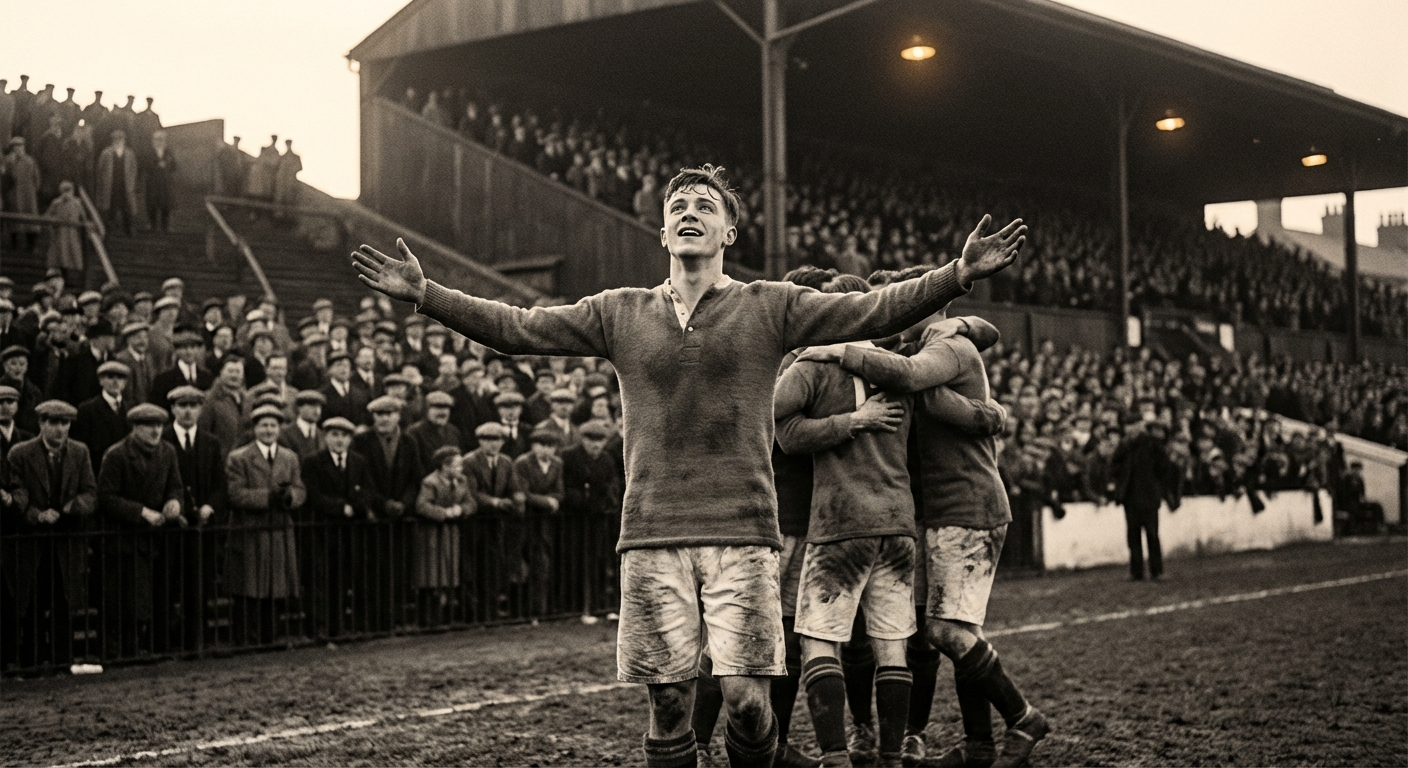
He stood there for a moment, disbelieving, before Harte and Osei buried him. In the stands, Rovers supporters who had been clenching their teeth for sixty-one minutes since Dunbar’s opener found their voices.
“I couldn’t tell you what I was thinking,” Harwick said afterwards, with the slightly dazed expression of a young man whose life has just changed velocity. “I saw the ball and I went. Orin would’ve been proud.”
Orin Blackshaw, nursing his knee at home in Thornhill, was watching on the wireless. He is understood to have telephoned the dressing room.
The Table
Rovers’ victory lifts them to 32 points from 26 matches, still fourteenth but now nine points clear of Millwall in the final relegation place. Duncastle remain sixteenth on 26 points, their home form insufficient to disguise a side in deep trouble.
“Three points at the Coalfield Ground,” Corbett said, allowing herself the smallest of smiles. “I’ll take that any day of the week.”
Next Saturday: Caravel City at Bridgewater Stadium. The league leaders. A different kind of test entirely.