
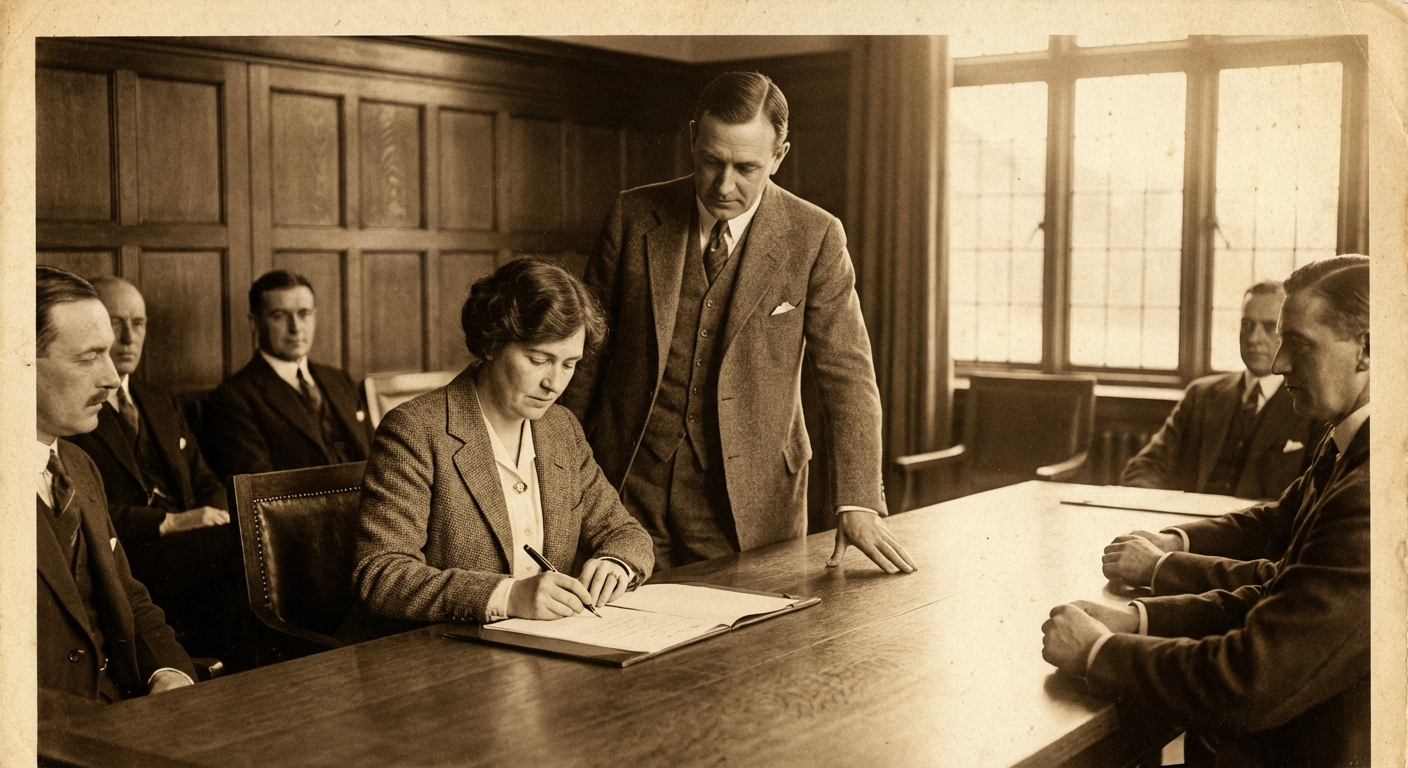
She took forty-six hours. She was offered forty-eight. Phillipa Corbett has always been ahead of schedule.
The call came at 7:14 PM on Saturday — two hours before the board’s informal deadline. Conrad Vickers was at home. He answered on the second ring. Corbett said three words: “I’ll take it.”
Vickers says he said something gracious and measured. His wife, who was in the next room, says he shouted.
The signing took place Monday morning in the Bridgewater boardroom — the same room where, three months ago, Vickers is reliably understood to have discussed Corbett’s replacement with at least two board members. The contract runs through the end of the 2027-28 season on improved terms, including a modest transfer budget for the summer window and a development fund for the youth academy.
“I didn’t need forty-eight hours to decide,” Corbett told reporters afterwards, sitting in the press room beneath the West Stand. “I needed forty-six hours to be certain I was deciding for the right reasons.”
Asked what those reasons were, she was characteristically precise.
“This group of players. This ground. This city. In that order.”
She paused.
“And the fact that nobody else would have me.”
The room laughed. Corbett did not. It was unclear whether she was joking.
The numbers make the case. When Corbett took charge in July, the Rovers were tipped for a bottom-four finish after losing their best centre-back to Caravel City and their top scorer to a cruciate injury. In January, after a run of one win in nine, she was booed off the pitch at Bridgewater following a 3-0 defeat to Haverford Town. A banner in the South Stand read: “Corbett Out.”
Since then: a Merchants’ Cup triumph, the first in eleven years. Eight consecutive league matches unbeaten. Forty-six points and safety secured with five matches still to play. Nadia Osei scoring fourteen league goals. Kael Dunmore’s thirty-yard curl at Millhaven. Orin Blackshaw heading goals at grounds where he was once carried off on a stretcher.
Vickers was asked about the January conversations.
“I will say that the board’s confidence in Phillipa wavered,” he said. “I will also say that she restored it in the most emphatic way possible. The cup final was the turning point. Everything since has confirmed it.”
The players were informed before the press conference. Osei, speaking in the corridor afterwards: “She’s the reason I’m still at this club. I mean that literally — she convinced me to stay when Thornbury came asking in August. I owe her two more years at least.”
Blackshaw, more economical: “Right decision.”
Dunmore, leaning against the door frame with his arms folded, offered a single sentence: “She’s the best manager I’ve played under. I don’t say that lightly.”
Sully Marsh, the longest-serving player in the squad at nine years, was asked whether the signing changed the mood in the dressing room.
“The mood in the dressing room hasn’t changed since February,” Marsh said. “We’ve been winning. That tends to help.”
Corbett’s immediate priorities are clear. Five matches remain: away to Haverford Town on Saturday, then Port Caravel at home, Duncastle away, Millwall at home, and Ashwick Borough on the final day. The league position is secure — fourteenth, twelve points clear of relegation — and there is nothing to play for except momentum and the manager’s peace of mind.
The summer will be different. The transfer budget is described as “modest but meaningful” — enough for two or three signings, not a transformation. Corbett has already indicated she wants a left-sided centre-back and a creative midfielder. The youth academy investment is a longer play: Corbett believes the club’s future depends on producing its own players rather than buying them.
“I’ve spent this season proving I can keep a club alive,” she said. “Next season, I want to prove I can make one grow.”
Asked whether she had considered saying no, Corbett offered the closest thing to a personal revelation that reporters have ever extracted from her.
“For about four hours on Friday night, I thought about walking away,” she said. “Not because I didn’t want this job. Because I wasn’t sure the job wanted me. And then I watched the video of the cup final goal — Dunmore’s goal, the one from thirty-five yards — and I thought: I was the person who put him in a position to do that. That’s enough.”
She stood up. The press conference was over. She had a training session to run.
Five matches remain.