
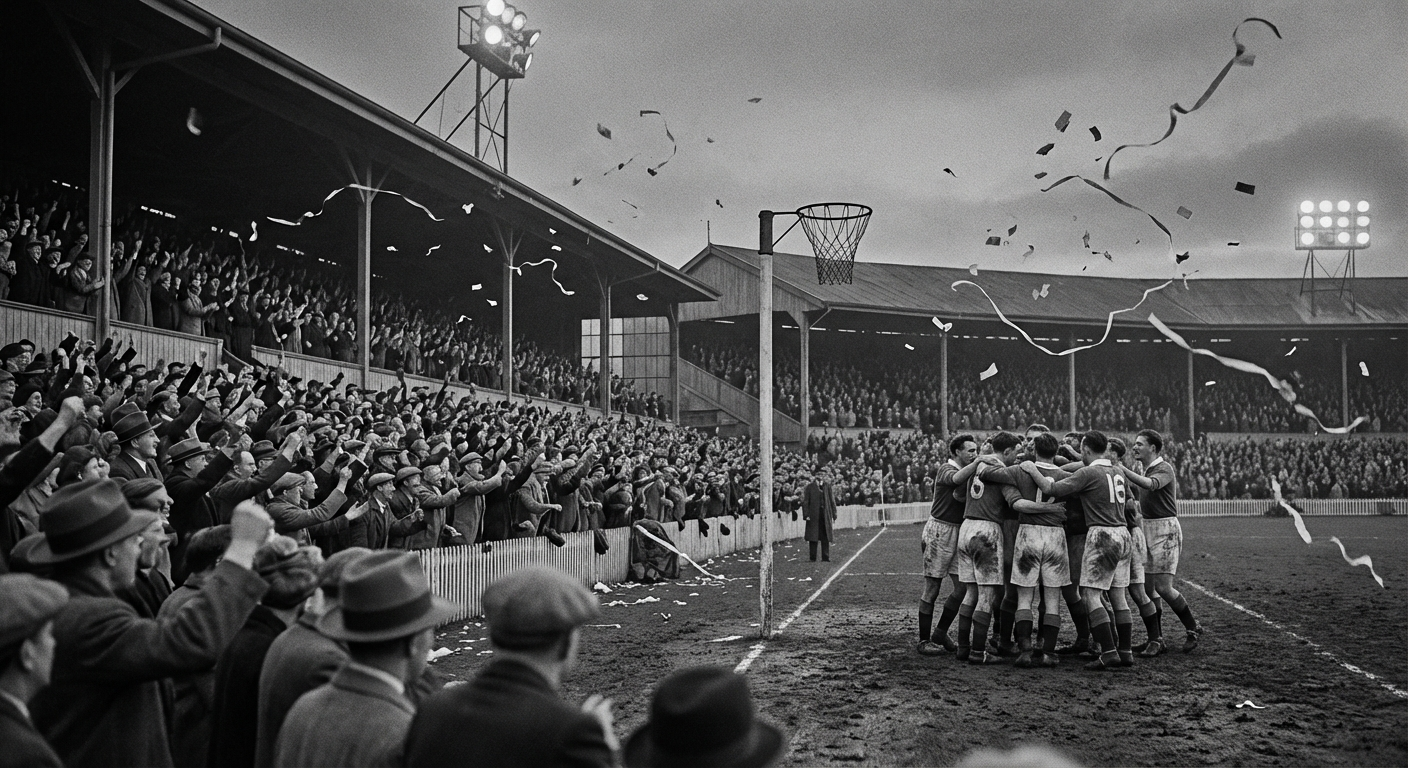
Dov Marsden collapsed to his knees at the final whistle. His teammates did not immediately reach him. They were watching the scoreboard.
Then the numbers changed. First: Fernwich Falcons 27, Caravel Harriers 25. A murmur. Then: Dunmore Eagles 26, Thornbury Lancers 24. A roar that could be heard across the valley.
The Ashwick Stoneflies are ringball champions.
They had done their part — beaten Millhaven 31-18 in front of a capacity fourteen thousand at Ashwick Oval, Fen Barlow scoring three rings and Marsden one, the old centrist threading passes through gaps that exist only in his imagination and in the nightmares of opposing markers. But the championship was not in their hands. It was in Caravel and Dunmore, where the defending champions and the methodical Lancers were both expected to win comfortably.
Neither did.
At Caravel, the Harriers started as if the title were already engraved. Oska Dain scored twice in the opening quarter and the home crowd settled into something approaching complacency. Then Fernwich did what Fernwich do at their best — they defended with a discipline bordering on obstinacy, their markers rotating with metronomic precision, their keeper blocking four attempts in the second quarter alone. Dain’s third ring, a sweeping arc from the centreline that drew gasps from both ends of the ground, pulled Caravel to 25 in the final quarter. But Fernwich’s Leona Burgess — a lock who has played in relative obscurity all season — scored the decisive ring with ninety seconds remaining, wrong-footing the Caravel keeper with a flat, low arc that barely cleared the rim. Final: 27-25. Wil Sørensen sat motionless on the Caravel bench.
At Dunmore, the story was different but the outcome the same. The Eagles have finished mid-table for seven consecutive seasons. They were supposed to provide the soft landing for the Lancers’ title charge. Instead, Tomas Albrecht — Dunmore’s unheralded centrist, who has spent the season conducting attacks that few neutrals bothered to notice — produced the performance of his career. Two rings in the third quarter turned the match. Jens Aldric, the finest passer in the league, scored twice himself but could not conjure a third when it mattered. With two minutes remaining and the Lancers trailing by two points, Aldric’s final arc clipped the ring and bounced away. Final: 26-24. Aldric shook Albrecht’s hand at the whistle and held it for a long time.
At Ashwick Oval, the mathematics were simple. Stoneflies had finished their match with 52 points. Both Caravel and the Lancers were stuck on 51. For the first time since 2010, the championship belongs to Ashwick.
Marsden was the last to leave the pitch. He is thirty-six years old. He has played for the Stoneflies since he was twenty. He has been a centrist in a league dominated by Caravel’s wealth and Thornbury’s method. He has lost in the final round before — twice. He was on his knees at Ashwick Oval last Saturday, too, after Barlow’s decisive ring against Caravel, when the three-way race was confirmed.
On Saturday evening, he was on his knees again. But this time, he was holding the trophy.
“I don’t know what to say,” Marsden told this newspaper, his voice thick. “Sixteen years. I’ve thought about this moment every day for sixteen years, and now it’s here, and I don’t know what to say.”
Barlow, who is twenty-two and has been thinking about it for considerably fewer years, said: “I scored three. That’s what I was supposed to do. But the old man won this.” He pointed at Marsden. “Everything else was noise.”
It is the phrase Barlow has used all season. In his case, it may actually be true.
Coach Regan Hollister, who has rebuilt the Stoneflies over three patient seasons, permitted herself a rare smile. “We prepared for Millhaven. We could not prepare for the other results. So we didn’t try. We just played our match.” She paused. “And then the scoreboard played its match.”
Maren Thatch, the Stoneflies’ imperturbable keeper, recorded eight clearances — including a remarkable fourth-quarter save that preserved the lead at 27-18. She was asked whether she had been aware of the other scores during the match. “No,” she said. “I was aware of Millhaven. That was enough.”
Petra Venn, the lock whose quiet consistency has anchored the Stoneflies’ attack all season, scored one ring and set up two others. She embraced Marsden at the final whistle and said nothing for some time.
The final table reads: Ashwick Stoneflies 52, Thornbury Lancers 51, Caravel Harriers 51. The three-way title race, which Fairfax of this newspaper described last week as the most dramatic final round in forty-two years of the modern league, has delivered a result that exceeds even that billing.
Two teams came into Saturday on 51 points. Both lost. The team on 50 won. That is not a statistic. It is a story, and it belongs to Marsden, to Barlow, to Thatch and Venn and Hollister, and to every one of the fourteen thousand at Ashwick Oval who will tell their grandchildren they were there.
The Stoneflies’ last championship was in 2010. Marsden was not yet on the team. He arrived the following year, a twenty-one-year-old centrist from the reserves, too slow to play on the wing and too stubborn to accept it. He has been the heartbeat of this side for a decade and a half. On Saturday, the heart beat loud enough for the whole league to hear.
“Sixteen years,” Marsden said again, and this time he smiled. “Sixteen years.”