
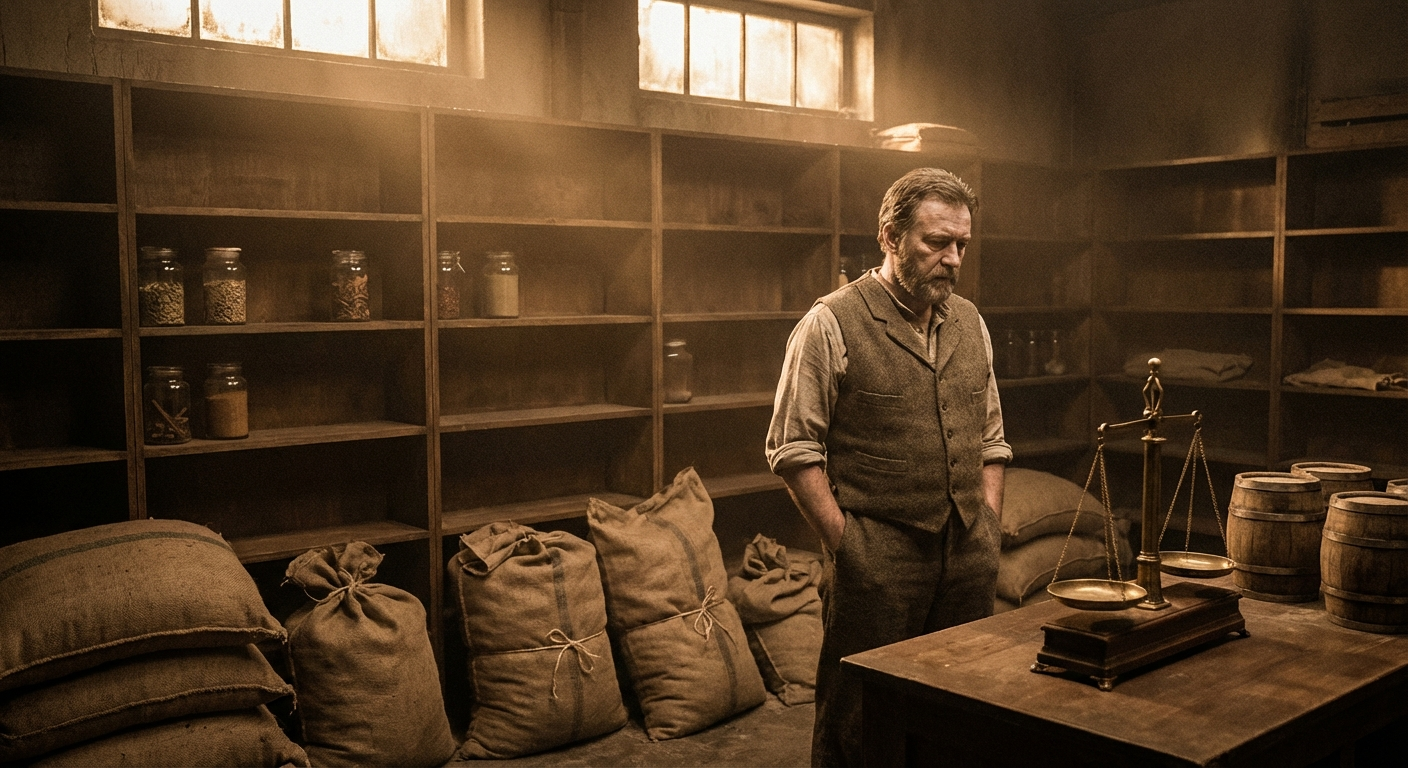
Haroun Nazari’s warehouse on Ashbury Lane smells, as it has for the better part of sixty years, of black cardamon and dried saffron bark and something deeper and older that he calls “the breath of the east.” But for the first time in his career, it is also conspicuously quiet.
The warehouse, a handsome brick building behind the family shopfront that his grandfather Tarek established in 1962, normally holds upward of thirty varieties of eastern spice in quantities sufficient to supply half the restaurants and provisions merchants in Midtown. On Saturday morning, Nazari counted twelve. The velveroot bins are empty. The long shelf of saffron bark jars is half bare. The enormous burlap sacks of black cardamon that normally line the eastern wall — four deep, ceiling high — stand two deep, and the ones that remain are noticeably lighter than they should be.
“My grandfather survived the Fenmouth blockade,” Nazari said, standing in the centre of his diminished kingdom with his hands in his apron pockets. “He told me that the spice trade is like water — you can dam it, divert it, but you cannot stop it forever. I believe him. But I also believe that our customers may not recognise their dinner plates by month’s end.”
The Numbers
The arithmetic of the Kaelmar crisis, viewed from the spice trade, is unforgiving. Approximately half of Bobington’s eastern spice imports pass through the strait. Since the Delvarian naval buildup began in mid-February, the disruption to commercial shipping has been severe: vessels are diverting via the Cape of Sarenne, a route that adds twelve to fifteen days and approximately twenty-two per cent to the landed cost of goods.
For perishable or time-sensitive commodities, the delay is more than an inconvenience — it is an existential threat to the supply chain. Velveroot, which loses its potency within weeks of harvesting, cannot survive the extended voyage. Stocks that were in transit via the strait when the crisis began have arrived; nothing behind them is coming by the usual route.
The price consequences are already visible in the Merchants’ Quarter:
- Black cardamon: up 15 per cent since 14 February
- Dried saffron bark: up 12 per cent
- Velveroot: effectively unavailable; last quoted at 340 florins per hundredweight, up from 210 a fortnight ago
- Eastern peppercorn blend: up 9 per cent
- Sea fennel (dried): up 11 per cent
“These are not speculative prices,” said Guildmaster Hadrian Voss of the Merchants’ Guild, whose written submission to the Copper Review Commission included a detailed assessment of the broader trade impact. “These are the prices our members are paying today. If the strait remains closed to normal traffic for another fortnight, we will see further increases of ten to fifteen per cent across the board.”
Downstream
The impact ripples outward from the warehouses into every kitchen, restaurant, and provisions shop in the city. Simeon Kade, proprietor of The Willow Table on Threadneedle Street — one of Midtown’s most respected dining establishments — told this newspaper that he has already reformulated three dishes on his evening menu.
“Velveroot is gone,” Kade said bluntly. “I’m not going to serve a substitute and pretend it’s the same thing. We’ve pulled the braised lamb shoulder entirely. The cardamon crème has doubled in cost to produce. My customers understand — most of them read the newspaper — but understanding doesn’t change the flavour.”
Smaller establishments are less sanguine. A provisions merchant in the Docklands, who asked not to be named, said that several of his regular restaurant clients had begun requesting extended credit terms. “Everyone’s waiting for the crisis to end,” he said. “But the bills don’t wait.”
The Rerouting
The Merchants’ Guild reports that eleven Bobington-registered cargo vessels have now been rerouted via the Cape of Sarenne. The longer route not only adds time and fuel costs but exposes vessels to the rougher waters of the southern passage, where insurance premiums have risen commensurately.
Nazari’s own shipment — a consignment of cardamon and saffron bark from the eastern port of Kerathi — was among the first to be rerouted. He expects it to arrive in approximately ten days, assuming no further disruptions. The same shipment, via the strait, would have been in his warehouse last Thursday.
“Ten days is a long time when your shelves are empty,” he said. “My father used to say that a spice merchant’s greatest enemy is not the weather or the pirates or the taxman. It is the empty shelf. An empty shelf is a broken promise.”
Looking Ahead
The spice trade’s difficulties are, in the broader scheme of the Kaelmar crisis, a secondary concern — less dramatic than copper futures, less politically charged than the tramway overrun, less dangerous than naval confrontations in the strait. But they are the crisis made tangible: the flavour that is missing from a familiar dish, the price that has quietly risen at the corner shop, the warehouse that smells the same but sounds too quiet.
Nazari will be at his shopfront on Monday morning, as his father was, and his grandfather before him. The shelves will be thinner than he would like. The prices will be higher. But the door will be open.
“People still need to eat,” he said, with the equanimity of a man whose family has weathered worse. “And Bobington will always need its spice.”