
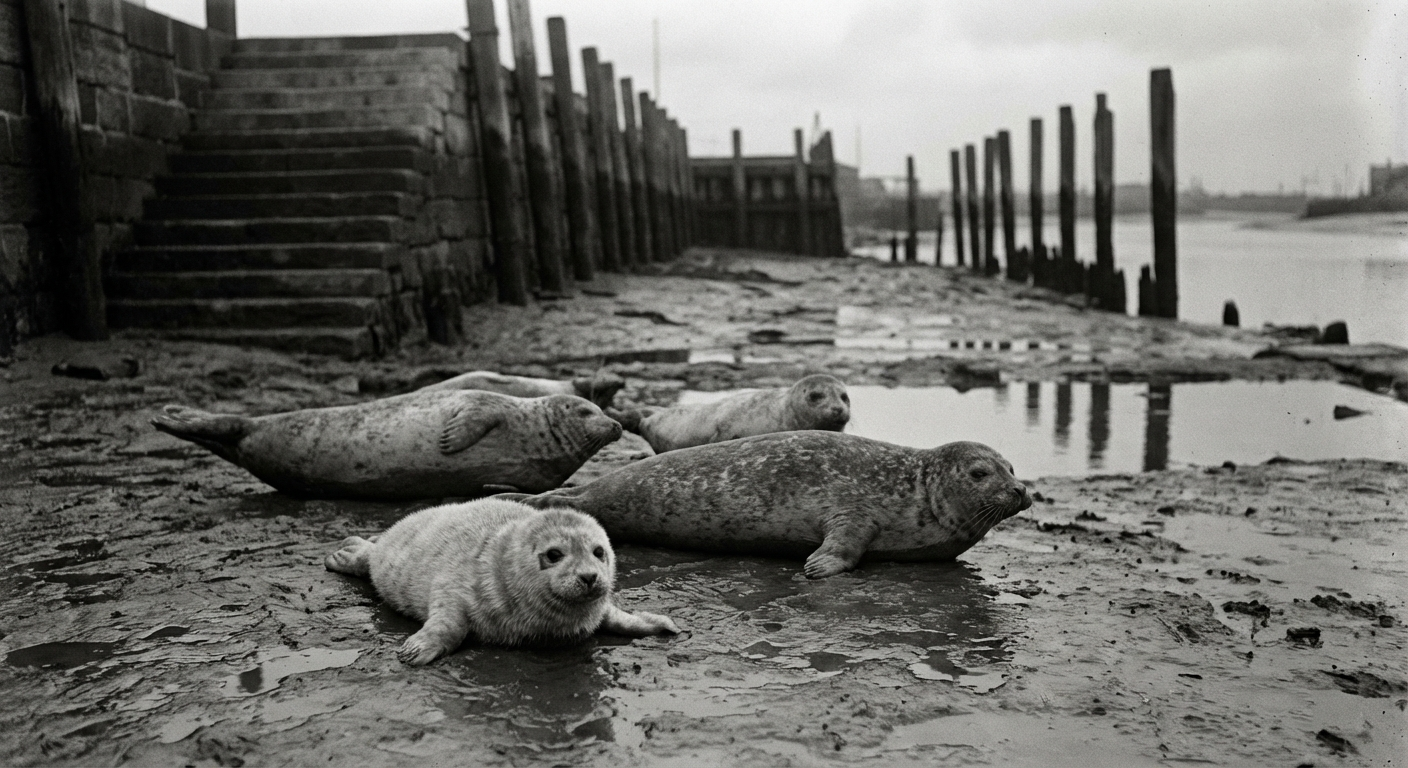
There are ten.
Dr Annalise Fenn-Coulthard, marine biologist at the Bobington Institute of Natural Sciences, confirmed on Wednesday that the harbour seal colony on the mudflats below Bramblegate Steps has grown by one. A third juvenile, noticeably smaller than the two previously identified, was observed at the dawn survey on Tuesday and again at dusk.
“The animal is approximately sixty centimetres in length,” Dr Fenn-Coulthard said, consulting the waterproof field notebook she carries on every visit to the mudflats. “The other two juveniles are in the range of eighty to ninety centimetres. This one is appreciably smaller. I am not yet prepared to say it was born here — but it was not in my survey on Friday, and it was there on Tuesday. That is a narrow window for an animal that small to have arrived from elsewhere.”
If the juvenile was born on the Lower Ashwater mudflats, it would be the first harbour seal birth recorded in Bobington waters since the naturalist Clement Birch documented “a company of harbour seals, eight or ten in number” in 1891.
“We are being careful with the language,” Dr Fenn-Coulthard said. “A birth would be nationally significant. I want to be certain before I make that claim.”
Week Two
The formal population survey is now in its second week. Dr Fenn-Coulthard has been visiting the colony at dawn and dusk every day since 16 March, photographing individual animals and cataloguing their distinctive markings — scars, spots, muzzle patterns — to build a reliable identification register.
The colony now comprises seven adults and three juveniles. Of the adults, Dr Fenn-Coulthard has identified five as female and two as male, based on size and behaviour. The largest adult, a male she has designated “Bull One” in her notes (she declines to name them), weighs an estimated ninety kilograms and occupies the highest point on the mudflat at low tide.
Water temperature and salinity samples continue to confirm the micro-habitat hypothesis: the Lower Conduit outfall below the old Bramblegate Steps wharf creates a cooler, fresher zone that appears to attract and sustain the colony.
“The conduit is the key,” she said. “Without that freshwater flow, these mudflats are just mud. With it, they are habitat.”
The Protection Question
The Harbour Authority has been “considering” a temporary wildlife protection zone since Dr Fenn-Coulthard’s initial request on 13 March. Two weeks later, the consideration continues.
Dr Fenn-Coulthard has not raised her voice about the delay, but her patience is acquiring an edge.
“I have asked for one thing,” she said. “Reduced ferry speed past the mudflats at low tide. That is not an unreasonable request. The ferry operates at six knots through that stretch. I am asking for four. The difference in transit time is approximately forty-five seconds.”
Harbour Master Cornelius Ashby’s office said the matter was “under active review” and that the Authority wished to balance conservation with operational requirements.
Reg Garside, the retired harbour pilot who first spotted the colony from his bench on Harbourfront Parade, offered a less diplomatic assessment.
“Ten seals,” he said. “First time in a hundred and thirty-five years. And we’re debating forty-five seconds.”