
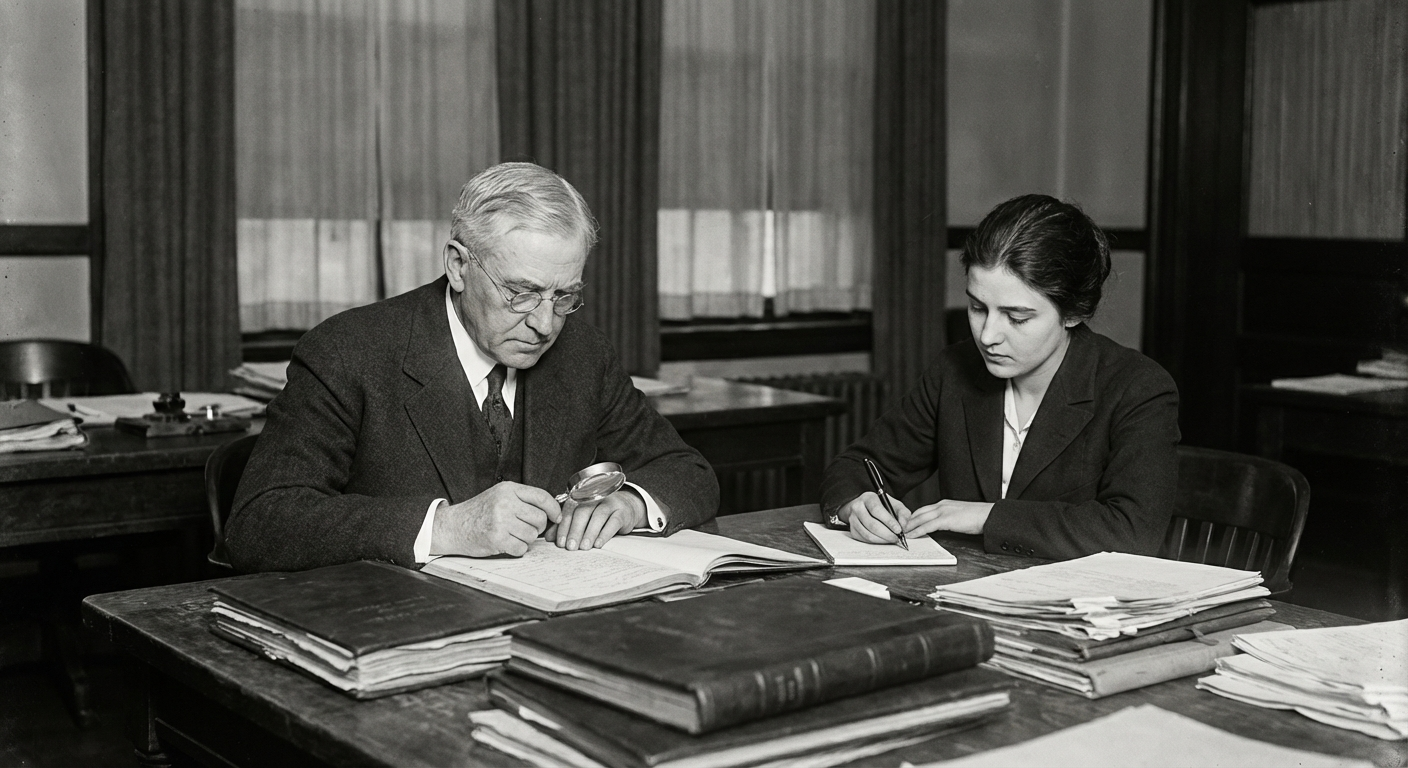
Cedric Haughton arrived at the Municipal Treasury at 8:45 on Tuesday morning, precisely on schedule and without visible enthusiasm. He carried a single leather briefcase, from which he produced, over the course of the next six hours, a series of requests that Deputy Treasurer Annabel Whitford later described as “thorough” and, after a pause, “extremely thorough.”
The senior assessor wished to see the city’s capital expenditure ledger for the years 2011 through 2025, inclusive. He wished to see the debt service schedule for all outstanding municipal bonds, including the 2019 water infrastructure issue and the 2022 fire brigade modernisation loan. He wished to see the amortisation tables for city-owned property. He wished, and here Ms Whitford paused again in her summary, to see the contingency reserve drawdown history — every withdrawal from the 142-million-florin reserve fund for the past decade, with authorisation records.
“It is a standard review,” Ms Whitford said. She did not look as though it felt standard.
Adelaide Lark, the junior assessor, arrived separately, twelve minutes after her senior colleague. Miss Lark, who is twenty-four and on her first field assignment, had spent the previous evening at the Municipal Records Office reviewing the published tramway cost projections. She arrived with a notebook full of questions and a disposition that suggested she had not been sent to Bobington to observe.
“Does the city maintain a commodity hedging position against copper price fluctuation?” Miss Lark asked at approximately 10:15, according to Treasury staff present.
The answer is no. Bobington does not hedge copper. The tramway’s copper budget of 380 million florins was set at a baseline of 740 florins per tonne, and the council has relied on phased procurement and market timing to manage cost exposure. Copper closed Monday at 802 florins per tonne — the fourteenth consecutive daily decline and, at present trajectory, approaching the baseline assumption. But it has been as high as 891 during the crisis, and the question of what would have happened had the city locked in a forward purchase at, say, 850 is not one the Treasury has publicly addressed.
“It is a reasonable question,” Ms Whitford said afterwards. “We have answered it.”
Mr Haughton, for his part, said nothing to the press. He has said nothing to the press since arriving on Sunday evening. His colleague has also said nothing, though staff noted that she writes continuously and has, on at least two occasions, asked follow-up questions to her own follow-up questions.
The Continental Rating Agency review is significant because the city must circulate a bond prospectus by the end of March to finance Phase 1 of the Veridan Corridor Tramway. The agency’s assessment — expected as a preliminary report to the Treasury before the 31 March deadline, with a formal rating decision within a fortnight — will determine the interest rate the city pays on what could be the largest municipal bond issuance in Bobington’s history.
A favourable rating holds borrowing costs at current levels, approximately 3.9 per cent on twenty-year bonds. A downgrade of even one notch would add an estimated 40 to 60 basis points, translating to 8 to 12 million florins in additional debt service over the life of the bond.
The assessors’ five-day visit, which runs through Friday, will include meetings with the Chief Transit Engineer’s office, the Geological Survey Commission, and, sources indicate, a private briefing from the Miners’ Cooperative of Greymoor on domestic copper production capacity. Mr Haughton led the Edgeminster water utility bond downgrade in 2023 — a review that resulted in a two-notch reduction and added 14 million florins to Edgeminster’s borrowing costs over seven years.
“I would not read too much into the choice of assessor,” said Clement Varga, senior analyst at Fernwich Trading House, when asked about Mr Haughton’s track record. “The agency sends its most experienced people when the numbers are large. That is all it means.”
He paused. “On the other hand, it is worth noting that Mr Haughton has never, to my knowledge, completed a municipal review without recommending at least a change of outlook.”
Copper opened Tuesday at 795 florins per tonne — the fifteenth consecutive decline and the first close below 800 since late January. If the price holds at or near current levels through the bond issuance, the tramway’s copper budget may prove sufficient. If it does not — if Kaelmar delays, or the Strait agreement falters, or the market reverses — the bond prospectus will need to account for considerably wider cost scenarios.
Mr Haughton and Miss Lark are expected at the Treasury again tomorrow. Ms Whitford has cleared her schedule through Friday.
“We are cooperating fully,” she said. “We have nothing to hide and a great deal to show. The city’s finances are sound.”
She gathered the capital expenditure ledgers from her desk — seven bound volumes, the oldest dating to 2011 — and carried them personally to the review room.