The human remains discovered at the Dunvale memorial construction site on Wednesday have been provisionally dated to the late seventeenth or early eighteenth century, according to Dr Maren Huxley of Bobington Polytechnic’s archaeology department.
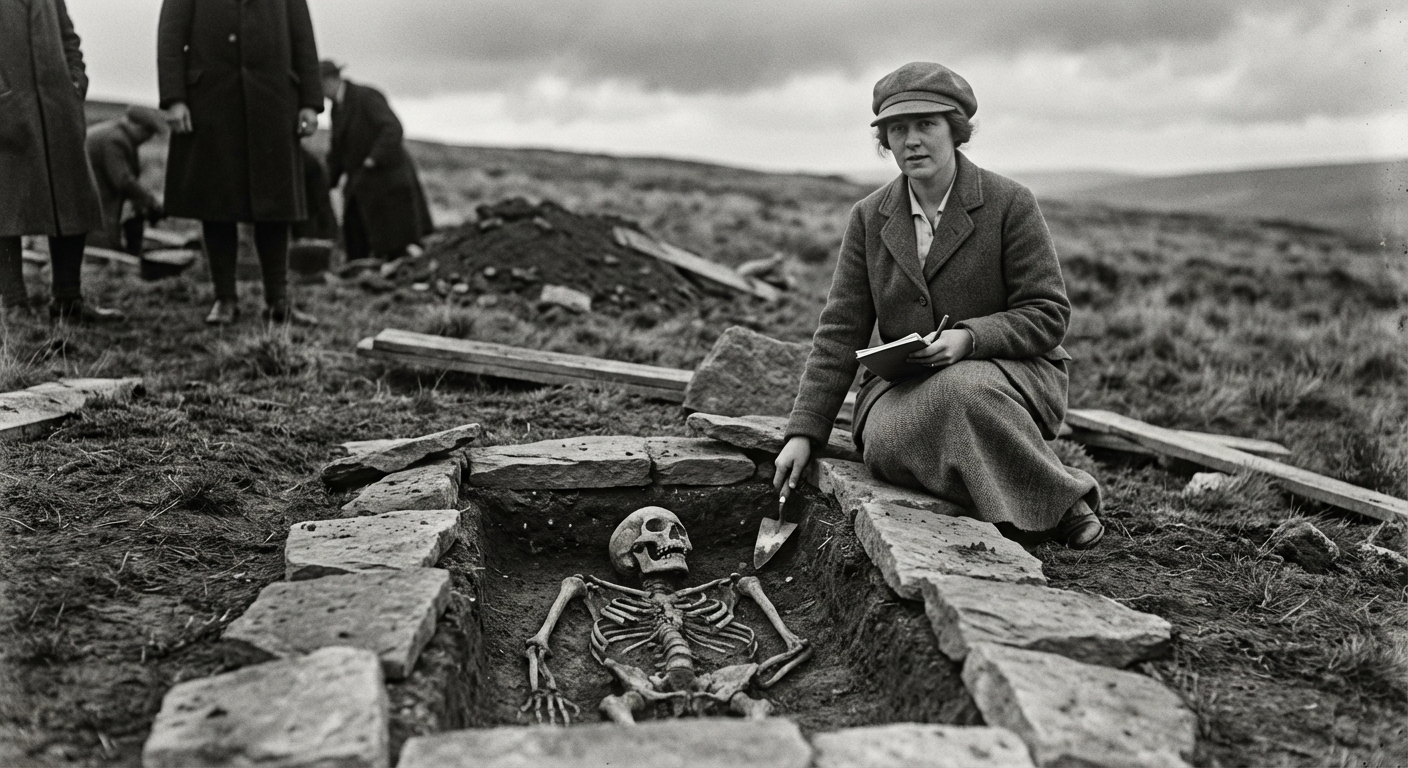
The skeleton is that of an adult male, mid-thirties to early forties, approximately five feet seven inches in height. The bones show no evidence of violent trauma. The east-west burial orientation — head to the west, feet to the east — is consistent with Christian practice of the period. The grave was shallow, roughly three feet deep, lined with flat stones but containing no coffin.
“This was not a hasty burial,” Dr Huxley said on Friday, standing at the edge of the excavation trench in a wind that carried the particular cold of the Greymoor uplands. “Someone took care. The stone lining is deliberate. But it is also modest — no coffin, no marker that has survived. This is a person of ordinary means, buried with respect but without ceremony.”
The remains were found on Wednesday approximately twelve metres east of the sealed mine entrance, during excavation of a drainage trench for the memorial’s foundation. Foreman Callum Sayer halted work immediately. The drainage trench has been rerouted and memorial construction continues on the western side of the site.
The dating places the burial at least a century before the Dunvale copper mine opened in 1847. The Greymoor uplands were sparsely populated in the eighteenth century — sheep farming, some charcoal burning, a handful of smallholdings. What brought a man to this hillside, and why he was buried here rather than in consecrated ground, remains unknown.
But there may be a record.
The Reverend Edith Blackwood, vicar of St Cuthbert’s Church in Dunvale village — a small stone building two miles from the memorial site, with a congregation of thirty-one and a churchyard that dates to at least 1640 — has begun searching the parish burial ledgers.
“We have records going back to 1683,” Reverend Blackwood said on Friday afternoon, seated at a table in the vestry with three leather-bound ledgers open before her. “They are not complete — there are gaps, especially in the 1690s, when I suspect the parish was without a regular clergyman. But if this person was buried with Christian rites in this parish, there should be an entry.”
Blackwood, 62, has served St Cuthbert’s for nine years. She is methodical and unhurried, and she approached the ledgers with the same care she applies to her sermons. “The handwriting is difficult,” she said. “The ink has faded. Some pages are water-damaged. But the names are here.”
She has so far examined entries from 1680 to 1710. No clear match has emerged, though she noted several burials recorded without precise location — simply “in the parish” or “on the hill.” One entry from 1703 records the burial of “a traveller, name not known, found upon the ridge road.” Another from 1698 notes “Thos. Garland, shepherd, bur. at the high ground by his own request.”
“Either of these could be our person,” Blackwood said. “Or neither. The ledgers tell us who was recorded. They do not tell us who was missed.”
Dr Huxley’s team will continue excavation through the coming week. Soil samples have been taken for analysis at the Polytechnic’s laboratory. A more precise dating, based on bone composition and associated soil chemistry, is expected within ten to fourteen days.
Bess Holloway, 81, who has campaigned for the Dunvale memorial since 1968 and who was present when the memorial’s foundation work began this spring, visited the site on Thursday. She stood at the edge of the trench for some time, leaning on her son Michael’s arm.
“We came here to remember forty-one miners,” she said. “Now there is someone older. Someone from before the mine, before the copper, before any of it. This hill has always known the dead.”
She paused. “Let them rest. But if Reverend Blackwood can find a name, I should like to know it.”
The memorial construction, which will run through autumn 2026, is not affected by the excavation. Ines Cavallo’s forty-one bronze figures continue to be cast in Port Caravel. The drainage trench has been successfully rerouted. Sayer’s crew will resume full operations on Monday.
“We build around them,” Sayer said. “That’s what you do. You build around what was there before.”