
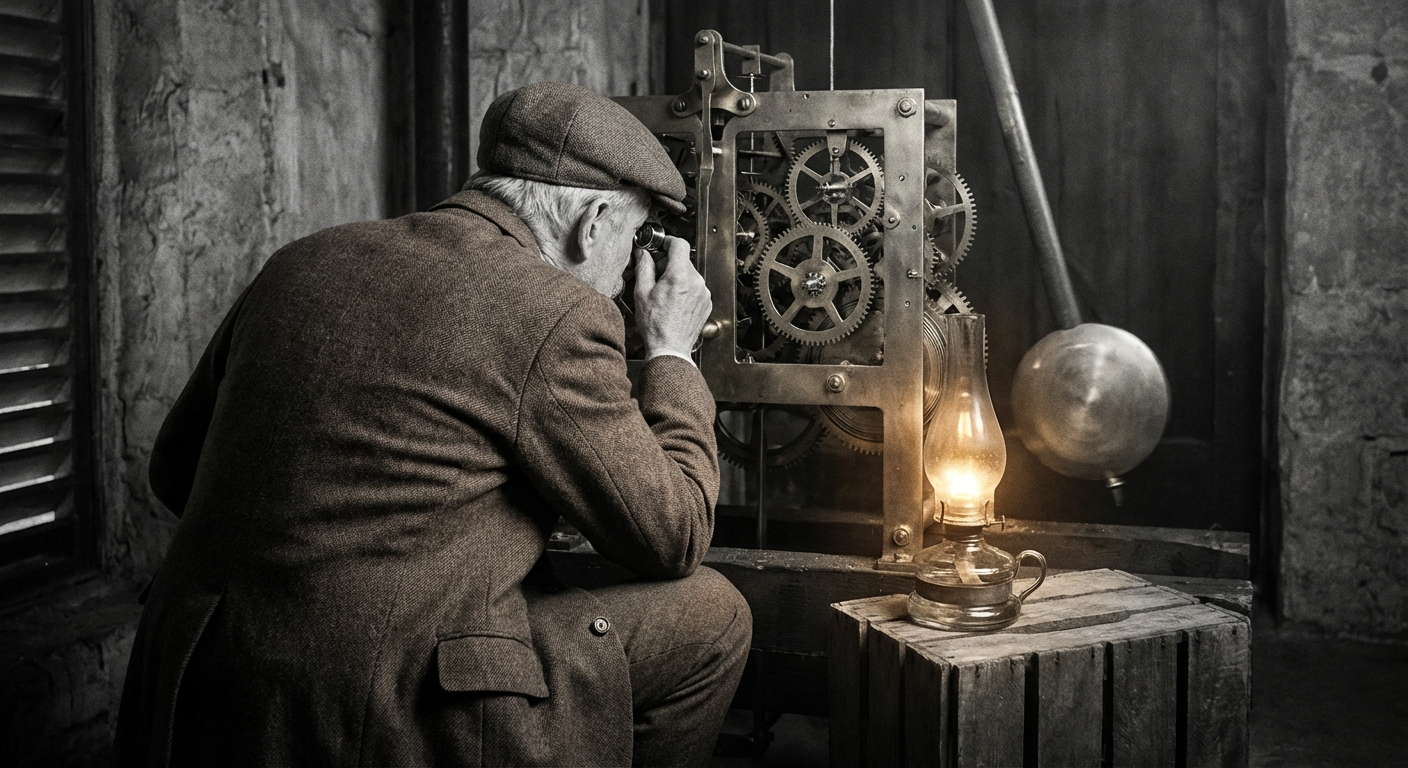
He arrived by the 8:14 bus from Millhaven, wearing a brown tweed jacket and carrying a canvas bag that clinked faintly with each step. Desmond Quirke, seventy-nine years old, retired master clockmaker and grandson of the man who built the Municipal Chamber clock, walked through the east entrance at ten minutes past nine on Friday morning and said, to no one in particular, “Right, then.”
Edgar Lowe, the custodian who has wound the great clock every Monday morning for eleven years, was waiting in the vestibule. He had swept the tower staircase at dawn.
“Mr Quirke,” Lowe said. “Thank you for coming.”
“Don’t thank me yet,” Quirke said. “I haven’t been up those stairs in twelve years and I’m not entirely confident about my knees.”
The Ascent
The tower staircase is ninety-four steps, narrow and unlit above the second landing, winding through the Portland stone core of the Municipal Chamber to the clock room beneath the twin faces. Quirke climbed slowly, stopping twice. Lowe carried a paraffin lamp. Behind them came Nora Dalton, the Deputy Clerk who had first noticed the silence on Wednesday, and a reporter from this newspaper.
At the top, Quirke set down his bag, took a long breath, and looked at the mechanism.
“Hello, old girl,” he said.
The Municipal Chamber clock has kept time since 1873, when Quirke’s grandfather Aldous Quirke and his partner James Bramley installed it for the newly built Chamber. It is a weight-driven deadbeat escapement with a compensating pendulum — a design Aldous Quirke made by hand, adapting a precision regulator design to the scale of a public tower clock. The twin faces, seven feet in diameter, are Portland stone with gilded numerals and iron hands. One looks east toward Threadneedle Street; the other west toward the river.
For one hundred and fifty-three years, through the fire of 1911, two wars, and the great storm of 1947, it did not stop.
At 2:47 PM on Wednesday, it did.
The Diagnosis
Quirke spent forty minutes examining the mechanism. He used the magnifying loupe from his jacket pocket. He ran his fingers along the escapement pallets. He lay flat on the floor to inspect the pendulum suspension spring from below. He asked Lowe to bring the lamp closer, then closer still.
“There,” he said, pointing to a component the size of a man’s thumb. “The front pivot of the escape wheel. Do you see?”
What he was pointing at was not visible to the untrained eye.
“The arbor has worn through its bearing,” Quirke explained, straightening with some difficulty. “The escape wheel has dropped perhaps a quarter of a millimetre. At that distance, the pallets can’t engage cleanly. The impulse face slips. The pendulum loses energy. And then —” He made a gentle downward motion with his hand.
“Silence.”
The bearing, he said, is a small brass bushing, pressed into the clock frame in 1873. It has been in continuous use for one hundred and fifty-three years. In that time, the escape wheel has turned approximately 4.7 billion times.
“It’s not broken,” Quirke said. “It’s tired. Profoundly, honourably tired.”
The Repair
Quirke believes the clock can be repaired. The bushing must be replaced — drilled out and a new one pressed and fitted to the original tolerances. The escape wheel pivots must be repolished. The pendulum suspension spring, while not the cause of the failure, is showing fatigue and should be replaced as a precaution.
He will need to return with specific tools from his workshop in Millhaven: a watchmaker’s lathe, a set of precision reamers, and a selection of phosphor-bronze bushing stock that he has kept since the 2003 overhaul.
“Nobody manufactures these to the right specification,” he said. “I have the stock. I always kept it, in case.”
He estimates the work will take two full days. He has offered to begin on Monday.
“She’s waited a hundred and fifty-three years to ask for help,” Quirke said, packing his tools. “She can wait the weekend.”
Lowe watched from the doorway as the old clockmaker descended the ninety-four steps, more slowly than he had climbed them. At the bottom, Quirke paused and looked up at the silent east face of the clock.
“My grandfather made that escapement by hand,” he said. “Every tooth. He used to say a clock doesn’t measure time — it gives time a heartbeat.” He adjusted his cap. “I’ll be back Monday. Tell her I said so.”
The 10:42 bus to Millhaven was three minutes late. Quirke did not seem to mind.