
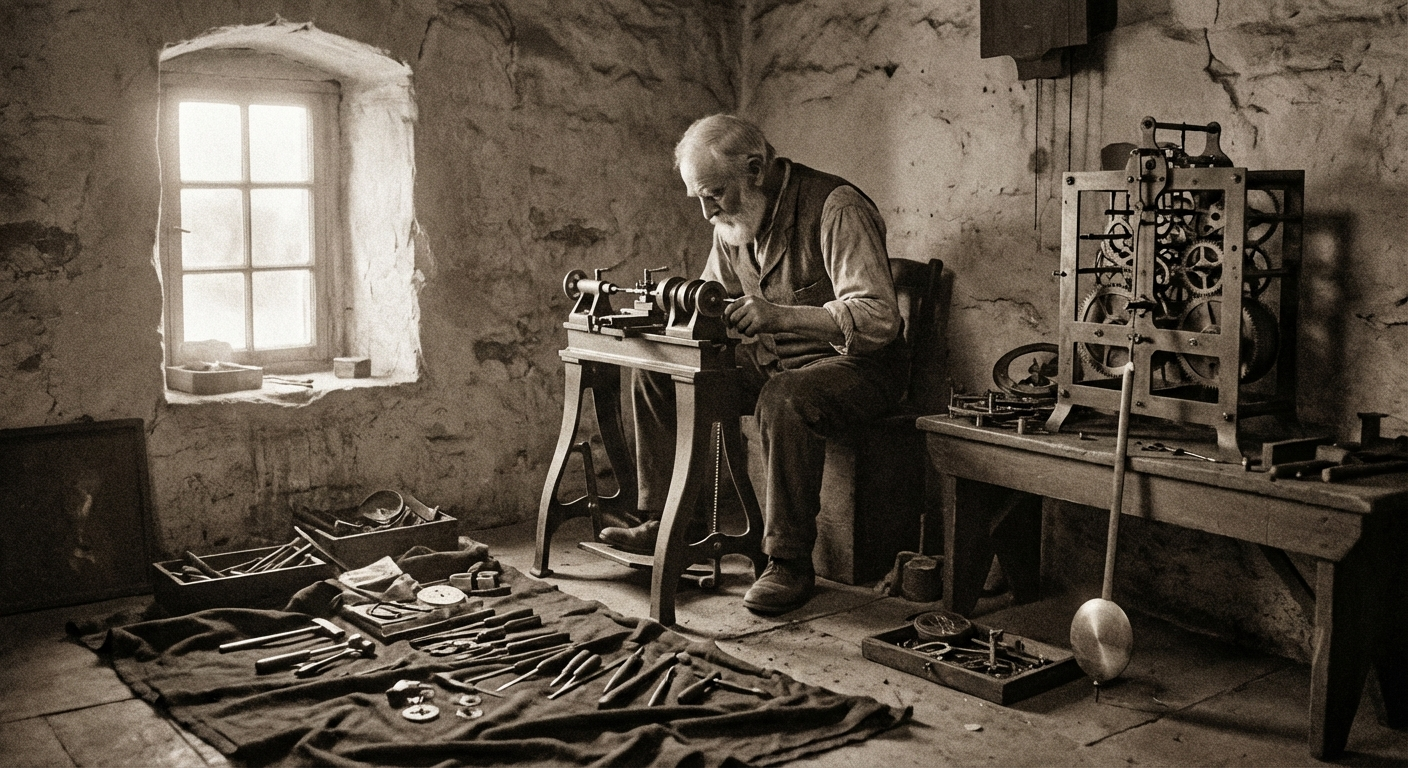
The watchmaker’s lathe arrived first, carried up the seventy-two stone steps of the Municipal Chamber tower in a canvas sling by two municipal porters who had been told only that they were transporting “delicate equipment.” It weighs forty-one pounds. Desmond Quirke, who weighs rather less than he used to, arrived ten minutes later, carrying a leather roll of precision reamers in one hand and a small cardboard box in the other.
“That’s the bushing,” he said, when asked about the box. He opened it briefly at the top of the stairs to show a dull bronze ring approximately two inches in diameter. “Phosphor-bronze. I turned it on Thursday. Took three attempts. The tolerances are not generous.”
It was 7:14 on a Monday morning. The clock above them had not moved since 2:47 PM on Wednesday the eleventh — five days of silence from a mechanism that had kept time without interruption since its installation in 1873.
Mr Quirke, who is seventy-nine and the last living person who understands the Quirke & Bramley escapement, had diagnosed the fault on his visit last Friday: a worn front pivot bearing in the escapement wheel. The bearing, which has rotated approximately 4.7 billion times since installation, had developed sufficient play to allow the wheel to bind against its frame. The fix, in principle, is straightforward: ream out the old bearing seat, press in a new bushing, and re-establish the correct clearance.
In practice, it is rather less simple than that.
“The escapement is original,” Mr Quirke explained, arranging his tools on a cloth laid across the tower floor. “My grandfather machined every part by hand. There are no spares. There is no technical drawing — he kept it all in his head, and I kept it in mine. If I damage the wheel, that is the end of the matter.”
Edgar Lowe, the Municipal Chamber custodian who has wound the great clock every Monday morning for eleven years, watched from the doorway. He had brought tea in a flask and a tin of biscuits. “I offered to assist,” Mr Lowe said. “He told me I could hold the torch.”
The first task, Mr Quirke explained, was to remove the escapement assembly from the movement — a process that required disengaging the pendulum, releasing the mainspring tension, and withdrawing the wheel from its frame without disturbing the adjacent gear train. He estimated this would take most of the morning.
At 8:30, the Municipal Chamber below began to fill with council staff arriving for the working week. Several paused in the corridor beneath the tower, looking up. The clock faces — seven feet of Portland stone, gilded numerals, iron hands — stared back, frozen.
“People keep stopping to look at it,” said Nora Dalton, the Deputy Clerk who first noticed the silence on Wednesday. “You’d think they’d be used to it by now. But I think it’s the quiet that bothers them. You don’t realise how much of the day is structured by that sound until it stops.”
By mid-morning, Mr Quirke had the escapement assembly free. He held the wheel up to the light from the tower’s east window and rotated it slowly between his fingers.
“There,” he said, pointing to a slight wobble invisible to the untrained eye. “That is forty years of wear. The bearing seat has opened by perhaps three-thousandths of an inch. That is all it took.”
He set up the lathe on the tower floor — the first time, he noted, that such a tool had been operated inside the chamber tower. The reaming of the old bearing seat began shortly before eleven o’clock. The sound of metal on metal, precise and rhythmic, drifted down through the stone.
“I will ream to the new diameter today,” Mr Quirke said, pausing to check his work with a gauge. “Tomorrow morning I press the bushing, reassemble, and we see whether the old girl agrees with me.”
He paused, and something like tenderness crossed his face.
“She has been keeping time since before electric light came to this city. Before the trams. Before the telephone. My grandfather built her to outlast everything, and she very nearly has. A new bushing is not much to ask.”
Deputy Treasurer Annabel Whitford, passing through the corridor on her way to a meeting, stopped to listen to the sound from the tower. “Is that him?” she asked. Told that it was, she nodded. “Good,” she said, and walked on.
Mr Quirke expects to work until late afternoon today, completing the reaming and preparing the bushing seat. He will return at first light tomorrow for the final assembly and — if the tolerances hold — the restart.
The clock has not ticked since Wednesday. If Mr Quirke succeeds, it will have been silent for six days. The longest previous silence was four days, during the great storm of 1947.
“Six days is nothing,” Mr Quirke said, not looking up from his work. “She waited twelve years for me last time. She can manage six days.”