
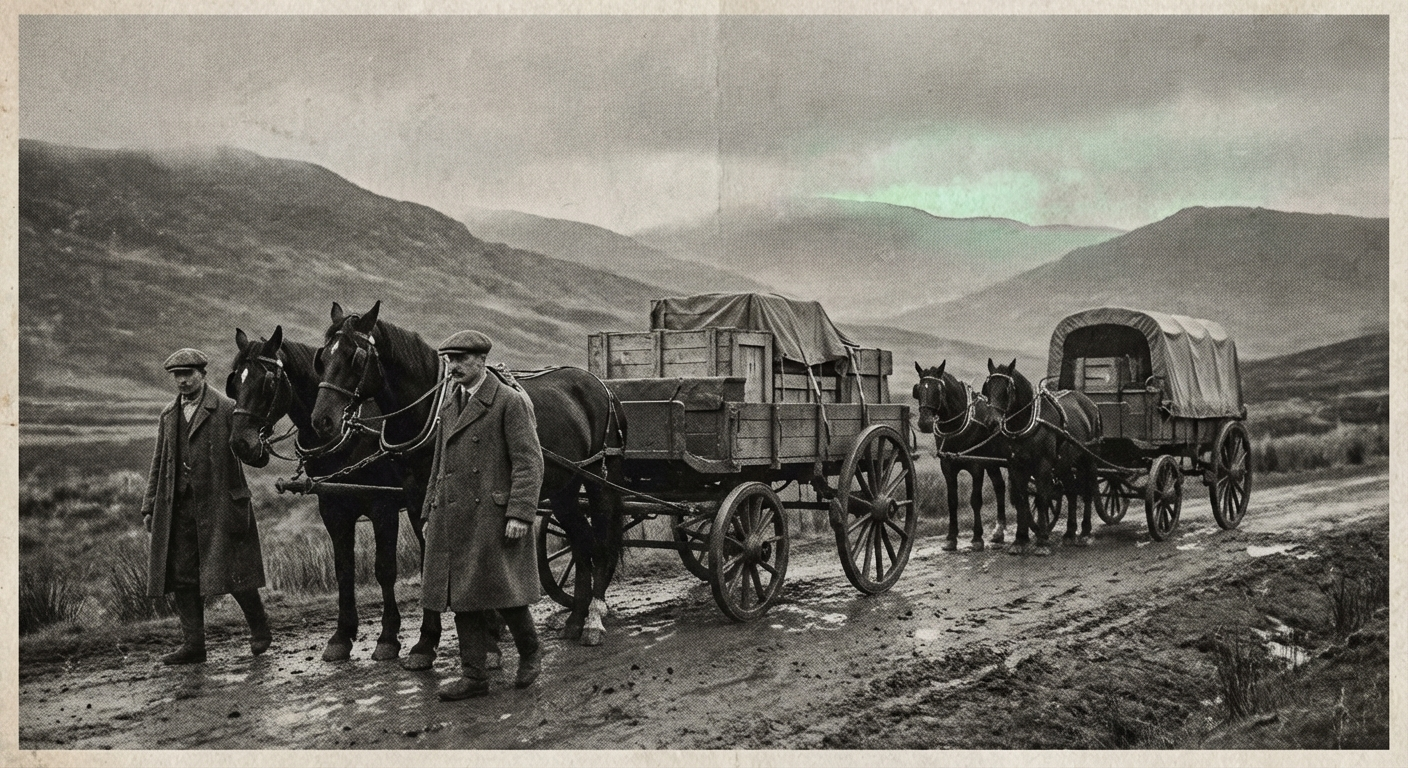
Somewhere on the Edgeminster road this morning, three wagons loaded with scientific instruments are making their way toward a ridge that has been glowing for sixty-four consecutive nights.
The convoy left Northcroft Instruments’ Edgeminster works on Saturday morning: three horse-drawn freight wagons, each padded with wool batting and sprung on leaf suspension designed for the transport of precision equipment. The cargo includes three broadband seismometers capable of recording ground motion to a depth of fifteen metres, two atmospheric gas sampling units calibrated to detect sulphur dioxide and hydrogen sulphide at parts-per-million sensitivity, a meteorological mast with anemometer, barometer, and temperature sensors at three heights, a photometric array for continuous measurement of the glow’s luminosity, battery banks rated for forty-eight hours of autonomous operation, and the components of a wind-rated insulated shelter.
Gerald Northcroft, managing director of the Edgeminster firm, accompanied the first wagon to the town boundary.
“I’ve shipped instruments to observatories, mining operations, and two national weather services,” he said. “I’ve never shipped them to something nobody can explain.”
The convoy is expected to reach the junction of the Dunvale road — the last paved surface before the Greymoor ridge — by Tuesday afternoon. Dr Odette Collis and Dr Maren Ilkley plan to meet it there. The equipment will be inventoried, inspected, and prepared for the final leg of its journey: 2.3 kilometres of ungraded highland terrain to the station site, eight hundred metres northwest of the abandoned meteorological outpost.
There is, however, a difficulty. The road does not exist.
Dr Bernard Coates, County Roads Surveyor, proposed a graded access road in late March — 2.3 kilometres from the Dunvale road to the monitoring station site, at an estimated cost of 45,000 florins and six weeks of construction. The proposal has divided the Works Committee and the two farmers whose land it would cross.
Gareth Penn, whose Highfield Farm sits three miles south of the central emission zone, supports the road. “Science needs a way up the ridge,” he said. “My grandfather mined copper up there. A road is how you get things done.”
Isobel Dallow, who farms sheep at Ridgetop Farm directly on the proposed route, does not.
“A road brings traffic,” she said, repeating the position she stated at the March meeting. “And traffic brings people who are not here for the sheep or the science. They are here for the spectacle.”
Alderman George Firth, who chairs the Works Committee, has placed the vote on Wednesday’s agenda — the committee’s first item of business. Sources indicate the committee is evenly divided, with Firth’s own position undeclared.
In the meantime, the equipment will wait at the junction. Collis, who has now filled forty-seven observation notebooks since first documenting the glow on 3 February, is philosophical.
“I have spent two months carrying a notebook and a borrowed spectrometer up that ridge on foot,” she said. “The instruments can manage a day or two at the roadside.”
The glow itself continues to intensify. Photometric readings taken on Saturday night — the 64th consecutive night of observation — show the central emission approximately 33 per cent brighter than the first recorded measurement. The spectral signature remains unchanged: ionised nitrogen and trace sulphur dioxide, consistent with geothermal venting through fractured rock.
Professor Aldous Nettleford of Caldwell University, who will lecture at the Polytechnic on 15 April, arrived in Bobington yesterday. He is expected to visit the ridge with Collis and Ilkley later this week, weather permitting.
“I have seen the spectral data,” Nettleford said. “It is strikingly similar to the Blackmoor vent emissions documented in Edgeminster in 1897. If the comparison holds, we may be looking at the early stages of a geothermal system of considerable significance.”
He paused. “But I should like to see it for myself before saying more.”