
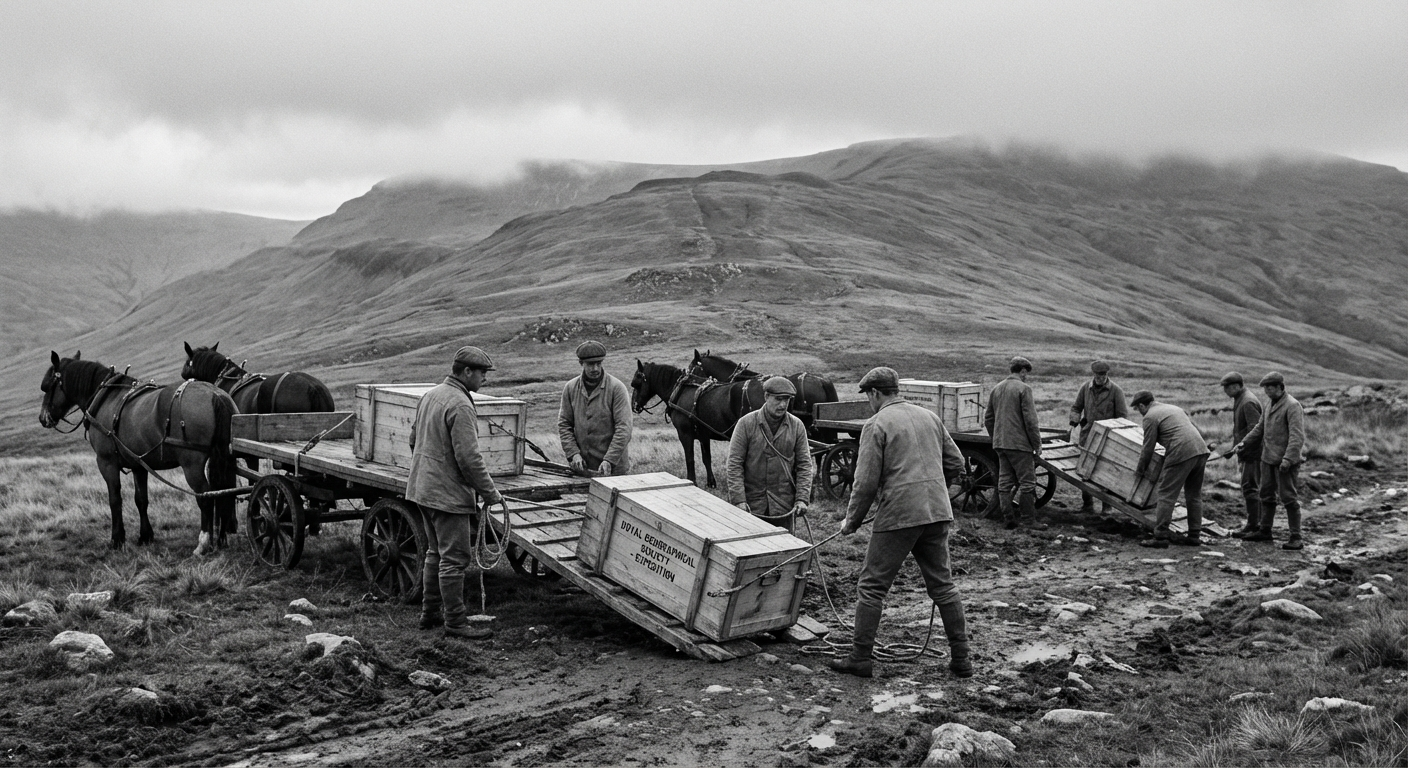
The road is not yet a road. It is a pair of wheel ruts in the peat, cut by three heavily laden wagons on Thursday afternoon as they climbed the last kilometre from the Dunvale junction to the station site on the Greymoor ridge. Gerald Northcroft, managing director of Northcroft Instruments of Edgeminster, rode in the cab of the lead wagon. He had been waiting at the junction for two days while the Works Committee debated his right to proceed.
“I have spent forty years building instruments for people who study the earth,” Northcroft said, stepping down from the wagon at the site. “I have never before required a committee vote to deliver them.”
The site sits approximately 800 metres northwest of the old meteorological outpost, abandoned in the 1950s, above the central emission zone. It is exposed, treeless, and — on Thursday afternoon — extraordinarily beautiful. The ridge runs north-northeast to south-southwest for roughly three kilometres. Below, the Dunvale road winds through the valley. In the distance, Highfield Farm is visible. Gareth Penn’s sheep, as he had predicted, were unbothered.
Installation began Friday morning. The first of three broadband seismometers — cylindrical instruments roughly the size of a milk churn, capable of continuous recording to fifteen metres’ depth — was lowered into a borehole prepared by a Northcroft drilling crew on Saturday. The instrument was sealed, calibrated, and transmitting by Saturday evening.
“It is listening to the earth,” said Dr Odette Collis, who has not slept more than five hours on any night since February. She was standing beside the borehole with her forty-sixth observation notebook. “It will hear things I cannot.”
The second seismometer is scheduled for Wednesday, the third for Friday. Two atmospheric gas sampling units — designed to measure sulphur dioxide, hydrogen sulphide, and carbon dioxide concentrations at parts-per-million sensitivity — will be mounted on a meteorological mast next week. A photometric array for continuous measurement of the glow’s brightness and spectral characteristics is expected by month’s end.
The station is on schedule for operational status by mid-May, at which point the deep geological survey — 250 metres’ depth, 1.65 million florins, the comprehensive assessment mandated by the Copper Review Commission and demanded by the Continental Rating Agency — can begin.
The glow, meanwhile, grows. Monday marked its seventy-second consecutive night. Dr Collis’s photometric measurements indicate brightness approximately thirty-eight percent above her first observation on the third of February. The rate of increase has not slowed. The spectral signature — ionised nitrogen and trace sulphur dioxide, consistent with superheated gases venting through fractured rock — remains unchanged.
“I can see it from Dunvale now without the telescope,” Collis said. “On clear nights, the ridge has a colour. It didn’t have a colour in February.”
Professor Aldous Nettleford, who spent three nights on the ridge last week and assessed the phenomenon as “consistent with a shallow magma intrusion,” lectures at the Polytechnic’s Founders’ Hall tomorrow evening at 7:30 PM. Advance interest has exceeded the hall’s 280-seat capacity. Miriam Aldbury, events coordinator, has arranged for the lecture to be relayed to an adjacent hall via loudspeaker.
“It is not every day,” Aldbury said, “that a professor from Caldwell tells Bobington there is molten rock beneath the hills.”
Nettleford has declined to preview his lecture’s contents but is understood to be recommending an expansion of the survey scope to include additional deep boreholes along the full three-kilometre emission zone — a significant increase in cost and duration.
Dr Maren Ilkley, the Royal Institute spectroscopist who has been measuring the glow since February, will assist Nettleford with the lecture’s visual presentation. She has prepared a spectral comparison between the Greymoor emissions and those recorded at the Blackmoor vents near Edgeminster in 1897 — the most recent documented geothermal event in the country.
The Blackmoor vents glowed for fourteen months before subsiding. The Greymoor glow, at seventy-two nights, is barely beginning.
On the ridge, the first seismometer listens. Below the ridge, something answers.