
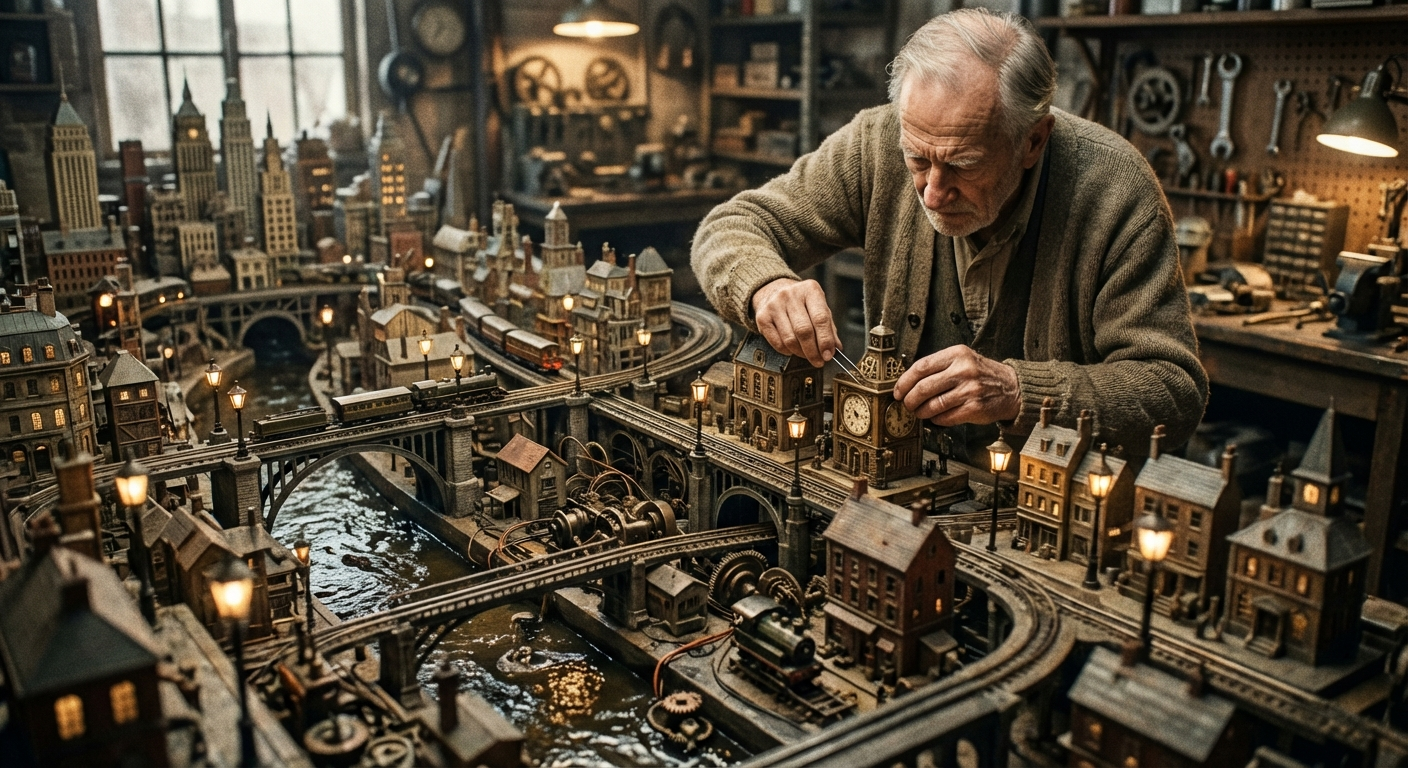
The garage door is seven feet four inches wide. The model is fourteen feet long. This is a problem that Oswin Faraday, 62, retired tram conductor, has been aware of since approximately year three of an eight-year project, and which he has dealt with in the manner of all dedicated craftsmen confronted with inconvenient facts: by ignoring it entirely.
“I always assumed someone would think of something,” he said on Monday, standing in the garage at 14 Laurel Crescent, Thornhill, surrounded by the most detailed mechanical model of Bobington that has ever existed or is ever likely to exist. “I was busy with the streetlamps.”
The model is 14 feet by 9 feet. It contains 2,340 individual buildings, 14 bridges, six clockwork tramlines that actually run, 48 wired streetlamps that actually light, and a representation of the River Ashwater that actually flows, powered by a small aquarium pump concealed beneath the Docklands. It has occupied Faraday’s garage since 2018, when his wife Constance negotiated the territorial terms: he gets the garage; she gets everything else.
The Bobington Historical Preservation Society, under chairwoman Louisa Marchbank, has arranged for the model to be the centrepiece of its spring exhibition, opening 18 April at its premises on Grayling Street. The exhibition hall measures 22 feet by 16. The model will fit. The question has always been: how does it get there?
Marchbank visited the garage on Saturday with two carpenters — Arthur Bayliss, 55, a furniture restorer from Thornhill, and his son James, 28, who assists in the workshop. They spent forty minutes measuring, photographing, and lying on the floor examining the model’s undercarriage.
The solution, which Bayliss arrived at on Saturday afternoon and which has a certain poetic inevitability, is to divide the model at the river.
The Ashwater runs roughly north-south through both the real city and Faraday’s miniature version. The model was built on two sheets of marine plywood, joined at a seam that runs — not quite by design, but not quite by accident — along the river’s course. The plywood can be separated. The river channel, built from a thin copper trough, is bolted rather than glued. The electrical connections (48 streetlamps, 6 tram motors, the pump) cross the seam at twelve points, all of which Faraday wired with plug connectors.
“I didn’t plan it,” Faraday said, when asked about the connectors. “But I used to drive the number 7 route, across the tram bridge at Millgate. You think about the river every day when you cross it twice a shift. I suppose I built the model the way I understood the city — in two halves, joined at the water.”
The first cut is scheduled for Sunday 6 April. Bayliss and his son will separate the northern and southern halves, secure the loose elements with foam padding, and transport each half by van to Grayling Street. Reassembly is expected to take two days, including electrical reconnection and refilling the river channel.
Constance Faraday, who provided tea on Saturday and supervised the proceedings from the kitchen doorway, offered her assessment of the project with the brevity of long marriage.
“Thirty-eight years I’ve tried to get him out of that garage,” she said. “Turns out you just needed a museum.”
Marchbank described the model as “quite simply the most remarkable thing I have seen in forty years of preservation work.” She noted that the Society has received more advance enquiries about the spring exhibition than any since 2019.
Faraday, for his part, is anxious. He has not seen the model outside of his garage in eight years. He has not seen it in natural light. He is concerned about the Midtown district, where several buildings were attached with a fish glue that he now suspects may have been inadequate.
“The Docklands are solid,” he said. “I built those first. The Marches are fine. But the area around Caldecott Square — I was in a hurry in year six. I should have used a better adhesive.”
He looked at the model: its tiny tramlines, its glowing lamps, its flowing river, its 2,340 buildings assembled with eight years of devotion and a retired tram conductor’s encyclopaedic knowledge of every street corner in Bobington.
“It’s not perfect,” he said. “But it’s the city. It’s all of it.”
The spring exhibition opens 18 April. Admission: 2 florins, concessions 1, children free.