
The order was posted at the Port Authority building at 4:15 on Monday afternoon, signed by Harbour Master Cornelius Ashby and countersigned by the chair of the Harbour Authority Board. It runs to eleven pages. The essential provisions occupy three paragraphs.
No vessel may exceed 3 knots within 200 metres of the designated haul-out area on the mudflats below Bramblegate Steps. No recreational swimming within 50 metres of the haul-out area during the protection period. No anchoring, mooring, or deliberate approach by watercraft to within 100 metres of the colony. The protection zone is effective immediately and will remain in place for 90 days, until 30 June 2026, subject to review.
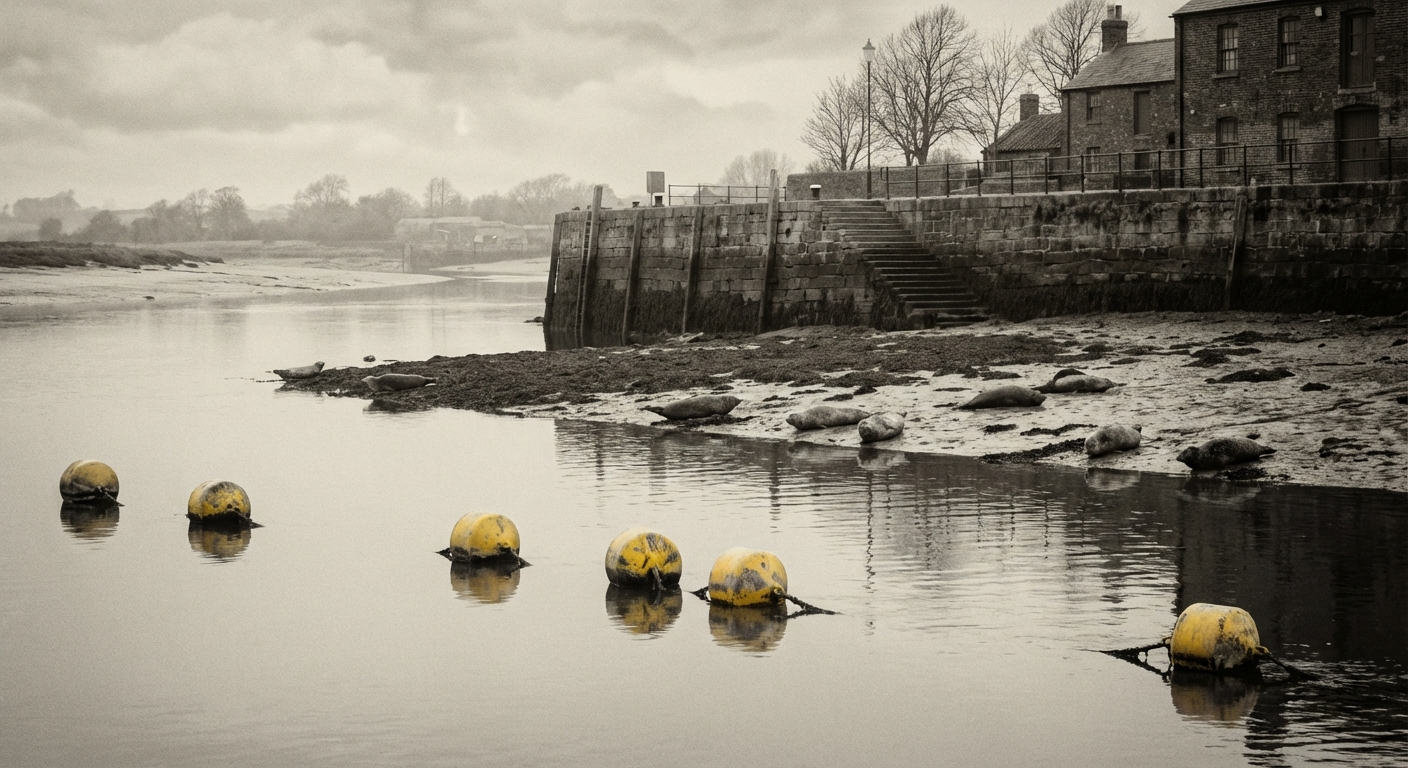
Two yellow marker buoys were set by harbour launch on Tuesday morning.
Dr Annalise Fenn-Coulthard, whose four-week survey of the colony is now in its third week, described the order as “a measured and appropriate response.” The colony remains stable at 10 animals — 7 adults and 3 juveniles, including the pup confirmed born on the mudflats on 27 March. The pup, now five days old, has been observed nursing consistently and appears to be gaining weight. Fenn-Coulthard estimates its current mass at approximately 14 kilograms, up from 12 at first observation.
“The protection zone gives us time,” she said. “Ninety days covers the nursing period and the pup’s transition to independent feeding. After that, we can assess whether a longer-term arrangement is needed.”
She noted that the colony has shown no signs of disturbance from the ferry service, which operates from Bramblegate Steps approximately 150 metres north of the haul-out area. “The ferry is consistent. Seals adapt to consistent stimuli. It is the unpredictable that disturbs them.”
The unpredictable, in this case, includes Alf Burnett.
Mr Burnett, 66, a retired dock crane operator who has swum in the Lower Ashwater at dawn six mornings a week for twenty-two years, received news of the protection zone on Tuesday morning from a harbour officer who found him towelling off — with his chamois leather square, as is his custom — at the old pilings beneath the Lower Ashwater footbridge.
“Ninety days,” he said. “They’ll make it ninety years. You watch. I was in that water before the seals were, and I’ll be in it after.”
He was informed that the zone prohibits swimming within 50 metres of the haul-out area, which effectively excludes his usual route between the pilings and the mudflats. He could, the officer noted, swim north of the footbridge instead.
“North of the footbridge,” Burnett said, “the current runs wrong and the water tastes of the weir. I’d sooner not swim at all.”
Margaret Frost, 71, the retired district nurse who has swum with Burnett since 2009, took the news differently. She was seen on Tuesday morning walking along the footbridge path in her overcoat, watching the colony from above. She did not enter the water.
“I’ve had a good run,” she told this correspondent. “Twenty-two years for Alf, seventeen for me. The seals need it more than I do.” She paused. “I shall miss it terribly, of course. But there are worse reasons to stop swimming than a baby seal.”
Reg Garside, the retired harbour pilot who first spotted the colony from his bench on Harbourfront Parade three weeks ago, expressed satisfaction. “Took them long enough,” he said. “But they got there. The buoys are in the right place. I can see them from here.”
The protection zone represents the first formal wildlife conservation measure applied to the Lower Ashwater in the city’s history. Fenn-Coulthard noted that the last harbour seal colony in these waters — documented by the naturalist Clement Birch in 1891 — disappeared without any protective measures. “We lost them once through indifference,” she said. “This time we have chosen differently.”
The ferry service is unaffected. Captain Aldgate has been briefed on the speed restriction, which applies to a stretch he already transits at reduced speed due to the Bramblegate Steps landing approach. “No change for us,” he said. “The seals and I have an understanding.”
The colony’s future beyond 30 June will depend on Fenn-Coulthard’s survey findings, which are expected to be presented to the Harbour Authority Board in late May. A permanent designation would require council approval and a formal environmental assessment — a process that could take several months.
For now, the mudflats are quiet. The pup was observed on Tuesday afternoon lying beside its mother in the thin spring sunlight, approximately fifteen metres from the conduit outfall, entirely unbothered by the bureaucratic machinery that has been assembled on its behalf.