
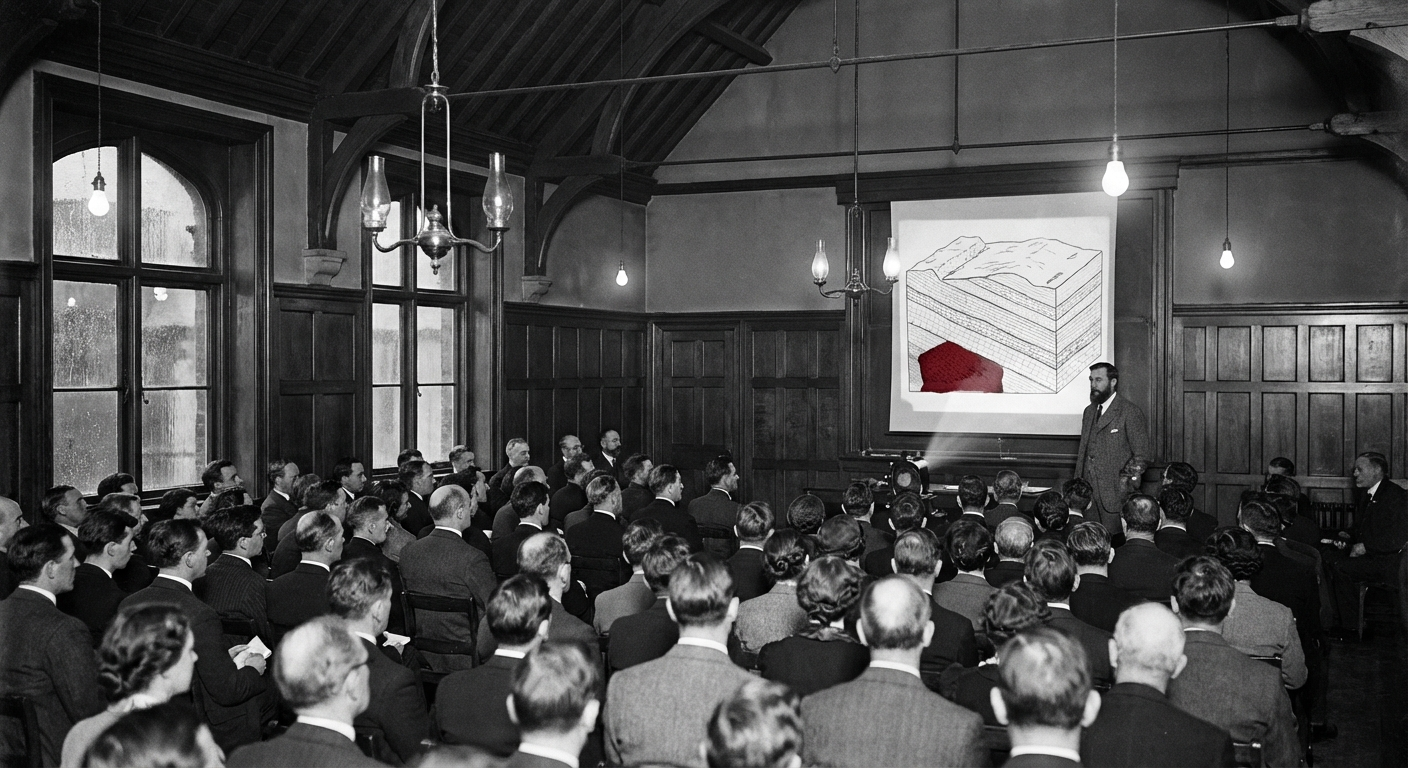
On Tuesday evening, Professor Aldous Nettleford of Caldwell University stood before a capacity audience at Founders’ Hall and explained, in measured and devastating detail, that a body of molten rock has been sitting beneath the Greymoor ridge for centuries.
The audience — 280 seated, 34 standing, plus a dozen more listening from the corridor — sat in a silence that lasted considerably longer than was comfortable.
Nettleford, 63, the author of The Thermal Earth and the leading authority on continental geothermal systems, had spent three consecutive nights on the Greymoor ridge with Dr Odette Collis and Dr Maren Ilkley before delivering his assessment last week: the phenomenon is “consistent with a shallow magma intrusion.” On Tuesday, he explained what that means.
“A shallow magma intrusion,” he said, standing beside a projected cross-section of the ridge drawn in his own hand, “is a body of partially molten rock that has risen from depth and become trapped in the upper crust. It heats the surrounding rock. The heated rock fractures. And through those fractures, ionised gases — nitrogen, sulphur dioxide — escape to the surface and glow.”
He paused.
“This is not a volcano. There is no eruption risk in any meaningful human timeframe. What we have is a thermal engine, buried in the hills, that has likely been operating for centuries — long before anyone noticed the light above the ridge.”
The cross-section showed the ridge in profile, with the estimated position of the intrusion marked in red: roughly 800 metres below the surface, extending approximately 3 kilometres along the ridge axis. Four emission points, identified by Collis and Ilkley during their spectroscopic surveys, were marked at the surface. Nettleford pointed to each in turn.
“Same spectral signature at all four points,” he said. “One system, not four. Connected beneath the rock like the chambers of a heart.”
He showed a second diagram: the historical seismic record of the Greymoor region, reaching back to 1847. The February tremor — the first in eleven years, reported by Nils Haversten of the Miners’ Cooperative — appeared as a single mark near the right edge of the chart.
“One tremor in eleven years is not alarming,” Nettleford said. “But it tells us the system is not dormant. It is adjusting. The glow has brightened roughly forty per cent since Dr Collis first documented it on the third of February. The gas output is increasing. Something is changing, slowly, beneath the ridge.”
He recommended an expanded survey scope: additional boreholes beyond the planned 250-metre depth, magnetotelluric surveys to map the intrusion’s full extent, and continuous thermal monitoring. The Northcroft instruments now installed at the monitoring station, he said, were a good start. The first readings — soil temperature profiles at fifteen metres’ depth — had already confirmed elevated temperatures consistent with a thermal source.
“The first data will be preliminary,” he said. “But it will be real data. Not speculation. Not analogies from other systems. Data from this ridge, about this intrusion, measured by instruments that are there now.”
The question period lasted seventy minutes — longer than the lecture itself. Martha Grieve, 55, a schoolteacher from Dunvale who had driven down for the evening, asked whether the intrusion could affect the water table. Nettleford said it was possible in theory — geothermal heating can alter groundwater flow — but that the monitoring station’s atmospheric sensors would detect changes in surface-level chemistry long before any hydrological effects materialised.
“We will know,” he said, “before the water knows.”
Gareth Penn, the sheep farmer from Highfield Farm who has watched the glow from his kitchen window since February, asked whether there was any risk to livestock. Nettleford said there was not, at current emission levels. Penn nodded and sat back down.
Isobel Dallow, who had opposed the access road and who sat three rows behind Penn, did not ask a question. She listened, and left quickly.
Dr Collis, who attended but did not speak, was observed taking notes throughout. Ilkley sat beside her. Professor Whitstone of the Royal Institute was in the front row. The closing speaker for the lecture series — the final slot on 29 April — remains to be confirmed, though Miriam Aldbury, the Polytechnic’s events coordinator, indicated that Nettleford had been invited to return.
Outside, the rain continued. The glow above the Greymoor ridge — now in its seventy-sixth consecutive night — was not visible through the cloud. But it was there.