
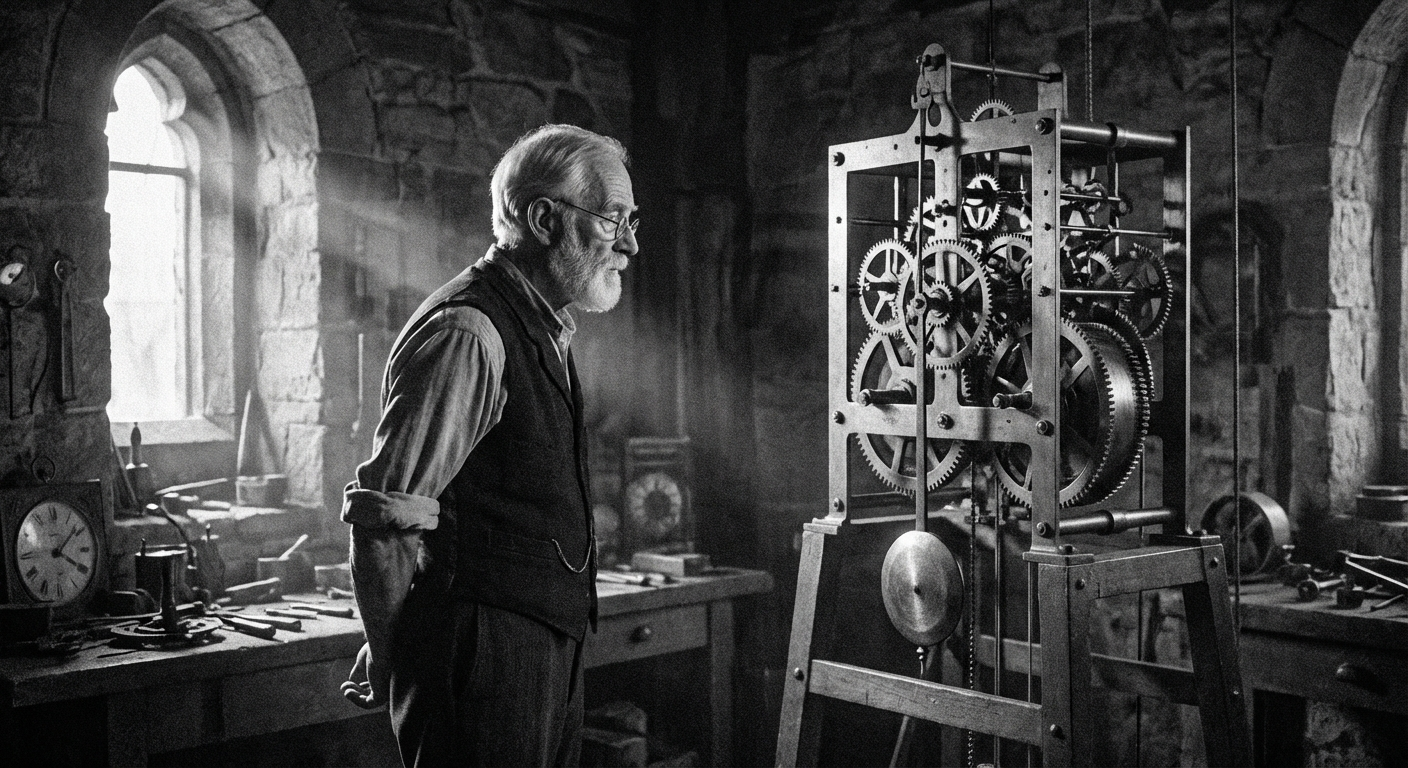
The pendulum is nine feet long and weighs forty-seven pounds. It hangs from a steel suspension spring thinner than a visiting card. When Desmond Quirke released it at 10:14 on Tuesday morning, it swung once to the left, once to the right, and engaged the escapement with a sound that Mr Quirke later described as “the most satisfying click I have heard in twelve years.”
The Municipal Chamber clock was running.
Mr Quirke, who is seventy-nine, who had arrived at the tower at 6:52 that morning — even earlier than Monday’s 7:14 — and who had spent the previous three and a half hours pressing a phosphor-bronze bushing into the reamed bearing seat, reassembling the escapement wheel, and adjusting the clearance with a feeler gauge he has owned since 1971, stood with his hands at his sides and listened.
“Wait,” he said.
Edgar Lowe, the custodian, who had been holding the torch again, held his breath instead.
Tick. Tick. Tick.
“She’s catching,” Mr Quirke said, very quietly. He leaned close to the movement, his ear perhaps four inches from the escapement. For thirty seconds — which felt, Mr Lowe said afterwards, rather longer — the two men stood in the tower and listened to the clock think about whether it wished to continue.
It did.
“The amplitude is good,” Mr Quirke announced. He straightened up. He placed one hand flat against the stone wall of the tower, as if checking for a pulse. “The bushing is seated. The clearance is within tolerance. I would like to stay until the half-hour chime, if that is acceptable.”
It was acceptable. No one was going to ask Desmond Quirke to leave.
At 10:30, the clock struck once. The hammer, driven by the same weight-and-cam mechanism that Aldous Quirke installed in 1873, lifted and fell with the mechanical inevitability of a thing that has been doing its job for a century and a half and sees no reason to stop now.
The sound carried. Below, on Threadneedle Street, a woman with a shopping basket paused. A clerk crossing the Municipal Chamber courtyard looked up. Two pigeons, who had enjoyed seven days of undisturbed roosting on the west-facing clock ledge, departed with some indignation.
“There it is,” said Nora Dalton, the Deputy Clerk, who had come to the base of the tower stairs at 9:30 and had not moved since. “Oh, there it is.”
The repair, in its physical dimensions, was small. Mr Quirke pressed the new bushing — two inches in diameter, phosphor-bronze, turned on the third attempt in his Millhaven workshop — into the bearing seat using a hand arbor press he had brought from home. The operation took eleven minutes. The fit, he said, was “as close to perfect as metallurgy allows.”
Reassembly of the escapement took longer. The wheel, which Mr Quirke had removed on Monday, had to be returned to its frame with the teeth properly meshed with the adjacent gear train. There are forty-two teeth on the escapement wheel. Each must engage its partner within tolerances measured in thousandths of an inch.
“I cannot rush this,” Mr Quirke said at 8:15, when a municipal porter enquired whether the clock would be running by nine. “If I rush this, I will be back in twelve years to fix what I broke. If I do it properly, the next man to open this movement will not be born for another fifty years.”
The winding of the weights — two cast-iron cylinders, each weighing approximately three hundred pounds, suspended on steel cables inside the tower shaft — was performed by Mr Lowe under Mr Quirke’s supervision. It was the first time in seven days that Mr Lowe had performed his Monday duty, and he did so with what he later called “considerable emotion.”
“You wind it every week for eleven years,” Mr Lowe said. “You think it’s routine. Then it stops, and you realise you’ve been keeping a promise.”
At 10:14, with the weights wound, the gear train engaged, and the escapement assembly seated in its new bushing, Mr Quirke asked Mr Lowe to step back. He reached for the pendulum, which had hung motionless since 2:47 PM on Wednesday the eleventh — six days, nineteen hours, and twenty-seven minutes of silence.
“Ready?” he asked.
Mr Lowe nodded.
Mr Quirke released the pendulum.
By noon, word had spread. A small crowd had gathered in the courtyard below the east-facing clock, watching the minute hand advance — a thing it had done without interruption for 153 years until last Wednesday, and which now seemed, to those watching, like a minor miracle of civic persistence.
Mr Quirke descended the seventy-two stone steps at 11:40, carrying his leather tool roll and the arbor press. He had checked the clock’s rate against his pocket watch — a Quirke & Bramley, naturally, dated 1924 — and pronounced it “within two seconds per day, which is better than I expected and better than most clocks half her age.”
At the foot of the stairs, he paused. He looked tired, and pleased, and seventy-nine.
“My grandfather built her to last,” he said. “She has outlasted gas lamps, horse trams, two wars, and a great storm. A new bushing every century or so is not unreasonable. I shall send the city my invoice.”
He was asked whether anyone else could now maintain the clock.
Mr Quirke considered the question.
“Not at present,” he said. “But I have written everything down. Fourteen pages. It is in an envelope in my workshop, addressed to the Municipal Chamber. In case I am not available next time.”
He put on his hat and walked out through the courtyard, past the people looking up at the clock, and turned left onto Threadneedle Street without looking back.
The clock struck noon. Twelve clear notes, unhurried, exactly as they had sounded every day at noon for a hundred and fifty-three years. A man at a café table on Threadneedle Street — a regular, the waiter said, who had sat in the same chair every Tuesday for six years — put down his newspaper and listened to every one.
“I didn’t realise I’d missed it,” he said, “until it came back.”