
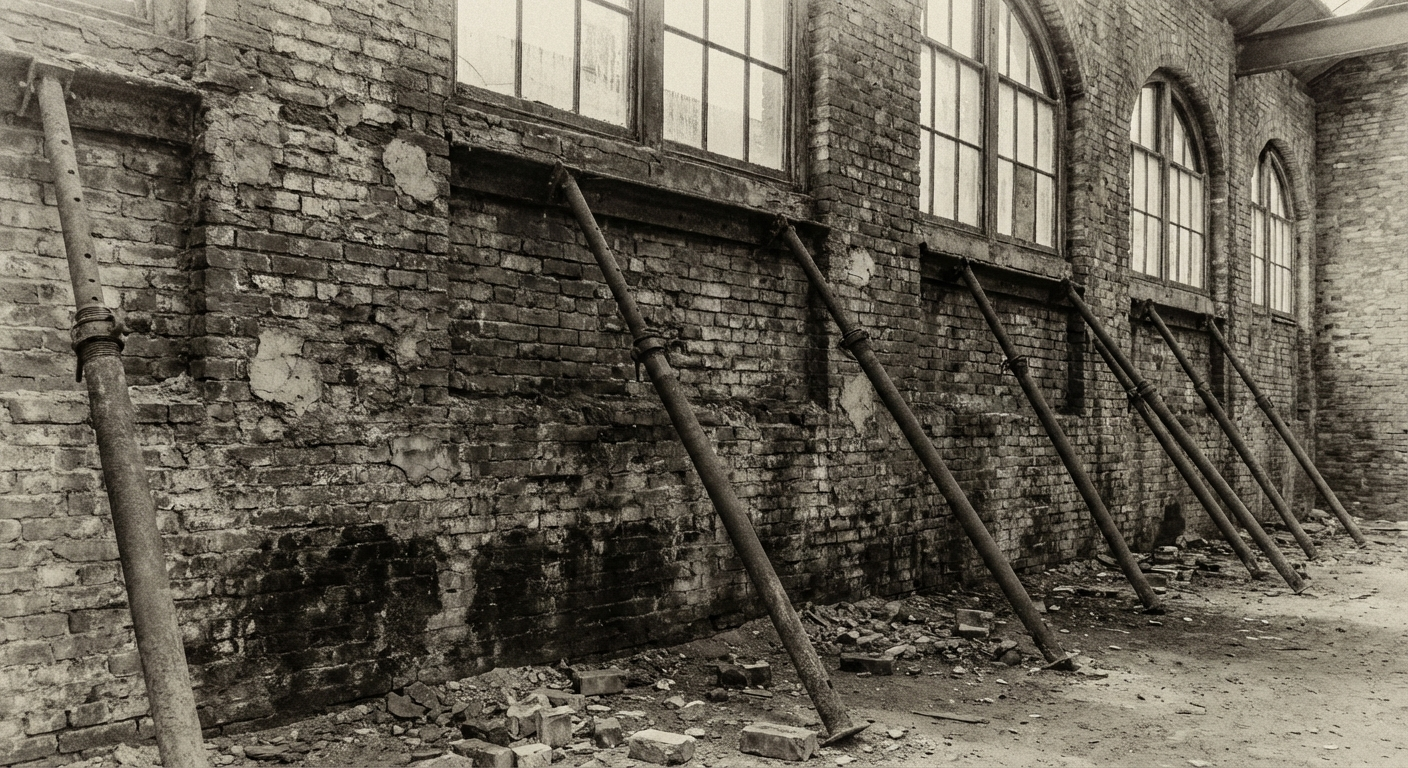
The wall is not failing yet. But it has, according to the structural engineer who spent four hours examining it on Monday, lost a meaningful portion of its capacity to do the one thing a load-bearing wall is supposed to do.
Helen Draper, a structural engineer at Hallam & Stroud with fifteen years of experience in commercial building assessment, was commissioned by the Municipal Works Office to conduct an emergency examination of the eastern wall of a warehouse on Harbourfront Parade — one of seventy-two properties assessed during the comprehensive Greystone Wharf audit completed last week. The audit had flagged the warehouse for “significant water damage to the eastern load-bearing wall” and recommended an emergency structural assessment.
Ms Draper’s findings, submitted to the Works Office on Tuesday morning, are more severe than the audit suggested.
“The wall has been subject to sustained water infiltration for what I would estimate is a minimum of four to five years,” Ms Draper said. “The mortar in the lower courses has deteriorated significantly. There is active spalling in the brickwork between ground level and the first floor. The wall is still load-bearing, but its factor of safety has been reduced to a level I would describe as inadequate.”
In practical terms: the wall is holding up the building, but it is doing so with less margin than any engineer would consider acceptable. A severe storm, a seismic event, or continued deterioration could result in partial collapse.
Ms Draper has recommended immediate shoring of the eastern wall — the installation of temporary steel supports to redistribute the load while permanent repairs are planned. She has also recommended that the two properties sharing party walls with the affected warehouse be notified and inspected.
“The risk of sudden failure is low but not negligible,” she said. “Shoring is precautionary, but in a building of this age and condition, precaution is not optional.”
The warehouse is one of several properties on lower Harbourfront Parade that were acquired by various holding companies in the years following the decline of the commercial wharf district. It is currently listed as vacant. The registered owner is a limited company whose sole director, according to municipal records, is based in Caldwell.
The building’s condition is, in many respects, a case study in the kind of neglect that the Greystone Wharf audit was designed to uncover. The audit — which assessed all seventy-two commercial and industrial properties in the wharf district over a three-week period — found eighteen irregularities, including five lapsed safety certificates, four properties with no documentation whatsoever, three falsified certificates, and two with structural or maintenance concerns.
This warehouse falls into the last category. It also falls into a broader pattern that has emerged from the audit: absentee ownership, deferred maintenance, and a vacancy levy system that, critics argue, provides insufficient incentive for owners to maintain their buildings.
The audit’s preliminary report is expected to reach the City Council by Thursday. It will recommend a mandatory annual inspection regime for all vacant commercial properties — a significant expansion of the city’s current inspection framework, which relies largely on self-certification.
Solicitor Edmond Crayle, whose firm represents property developer Gerald Ashcroft in a related matter, declined to comment on the structural findings. Mr Ashcroft’s 2.35-million-florin vacancy levy penalty, levied in connection with Greystone Wharf, remains under appeal before the Municipal Tribunal.
Chief Municipal Engineer Dorothea Kinnear confirmed that the Works Office would arrange shoring “within the week” and that inspections of the adjacent properties would begin immediately.
“The audit exists for precisely this reason,” Ms Kinnear said. “We cannot inspect what we do not know about, and we cannot repair what we do not inspect. This building has been failing quietly for years. Now we know.”