
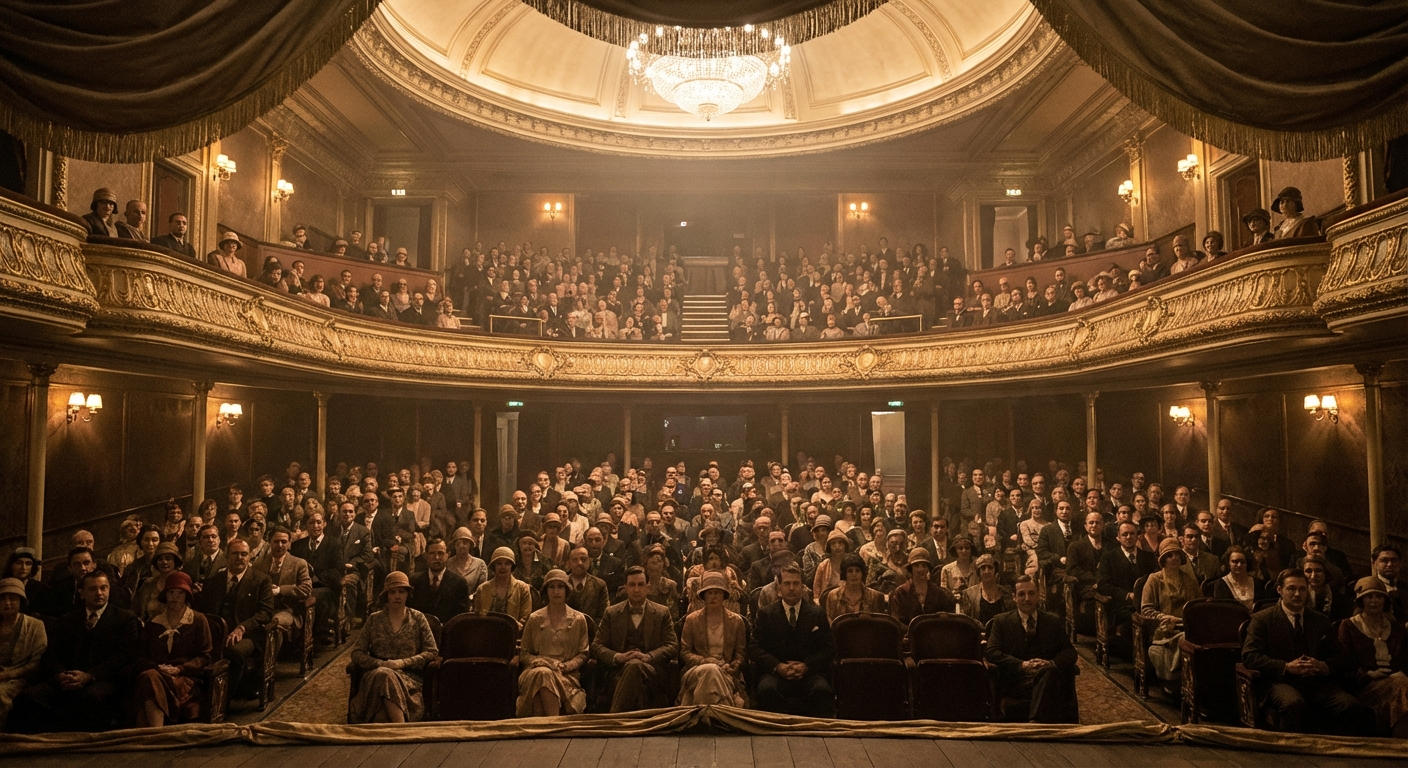
There is a moment in Act II of The Lamplighter’s Oath — Augustin Fell’s first play, which opened last night at the Bellvue Theatre to a sold-out house of 380 — when Thomas Ashworth, playing Edmund Vale, walks across a darkened stage and lights the first of seven model gas lamps with a match.
No electrical trickery. No hidden mechanism. A real flame, in a real theatre, lit by a man playing another man who believed that light was not a luxury but a right.
The audience went silent. Not the polite silence of attention. The silence of recognition.
It held for what felt like a full minute. Ashworth crossed the stage, lamp by lamp, and by the third flame I understood what Fell had spent eighteen months writing toward: that the act of bringing light is itself the argument. Vale did not need to persuade the council. He needed to show them the dark.
Felix Wainwright, who rewired the Bellvue’s entire lighting rig for this production — replacing fourteen of twenty-eight stage lanterns and reconfiguring every colour filter — earned the effect. The Act II lamplighting is his triumph as much as Ashworth’s. When the seventh lamp caught, the stage was bathed in a warm amber glow that felt less like a scene and more like a memory. Wainwright, watching from the flies, was seen to press his hands together once.
But the evening’s revelation was Nessa Holloway.
This critic has watched Holloway develop through months of rehearsal coverage, and nothing prepared me for what she delivered last night. Her Clara — Vale’s daughter, the woman who continues his work after his death — is not the loyal inheritor the script might have produced in lesser hands. Holloway plays Clara as a woman who disagrees with her father’s methods while refusing to abandon his cause. In their Act I argument — the only scene in which father and daughter appear together — Holloway matched Ashworth line for line. She did not yield to his authority. She complicated it.
Ashworth, it must be said, was superb. His Vale has a worn patience that feels entirely authentic — a man who has been refused so many times that his persistence has hardened into something beyond stubbornness. The Act III council address, which this newspaper has previously reported on in rehearsal terms, arrived last night fully formed. Ashworth did not raise his voice. He did not need to. By the time he said, “I am not asking you to light the Docklands. I am asking you to stop pretending it is not dark,” the woman beside me had stopped breathing.
The supporting cast of eleven gave Fell’s script the depth of a lived world. Particularly fine were the aldermen of the council — played with oily condescension that drew knowing laughter from an audience that reads this newspaper’s City Hall coverage.
Ruth Kirby’s stage management was, as always, invisible in the best sense. Line seven — the temperamental fly-tower counterweight that has been unreliable since 2019, and which must operate flawlessly for the Act III council chamber reveal — held. Kirby was seen backstage afterwards accepting a cup of tea with the expression of a woman who has survived something.
Ruben Glass sat in the front-row aisle seat that Fell had reserved for him. He arrived quietly, through the side entrance, and spoke to no one before the performance. At the curtain call, he stood with the rest of the house. He did not stay for the reception. He left as he came — through the side door, into the Marchmont Street evening.
The seat beside his — reserved for Fell’s aunt Constance, who ran the Bellvue from 1971 until her death in 2006 — held a single programme, unopened.
The standing ovation lasted four minutes and twelve seconds. I timed it. Ashworth came forward twice and gestured to Holloway, who came forward once and gestured to no one, because she did not know what to do, and that was perfect.
Edgar Tilney, a retired schoolteacher of 81 who sat in the upper gallery, said afterwards: “I haven’t been to the Bellvue since 1987. I came because the city came.”
Fell appeared briefly at the stage door. He was red-eyed and holding a pencil. Someone asked if he was pleased.
“I have notes,” he said.
The Thurston Brothers arrive on 2 May to begin fly tower repairs. Twenty-one performances are scheduled before then. Tickets for the first week are sold out. The box office opens at nine o’clock this morning for weeks two and three.
The Lamplighter’s Oath plays at the Bellvue Theatre, Marchmont Street, through 30 April. Evening performances Tuesday through Saturday at 7:30 PM. Matinée Saturday at 2:30 PM. Tickets: 8 florins (stalls), 5 florins (gallery). Box office or by post.