Seven hours of negotiation at the Foreign Office on Chancery Row concluded at 5:32 PM this evening with the initialling of the fourth and final technical annexe to the Kaelmar Transit Corridor Framework. A formal signing ceremony is scheduled for Tuesday 24 March.
Undersecretary Helena Marchetti read the joint statement from the Foreign Office steps at 6:15 PM, in fading afternoon light, to a small gathering of correspondents and a rather larger crowd of passers-by who had noticed the unusual number of diplomatic vehicles on Chancery Row.
“The delegations have today completed the technical annexes to the Transit Corridor Framework,” Marchetti read. “All instruments are now in agreed form and will be presented to the respective governments for formal authorisation. The parties have agreed that a signing ceremony will take place at this office on Tuesday 24 March.”
The statement was 68 words long — the shortest of any session. It did not need to be longer.
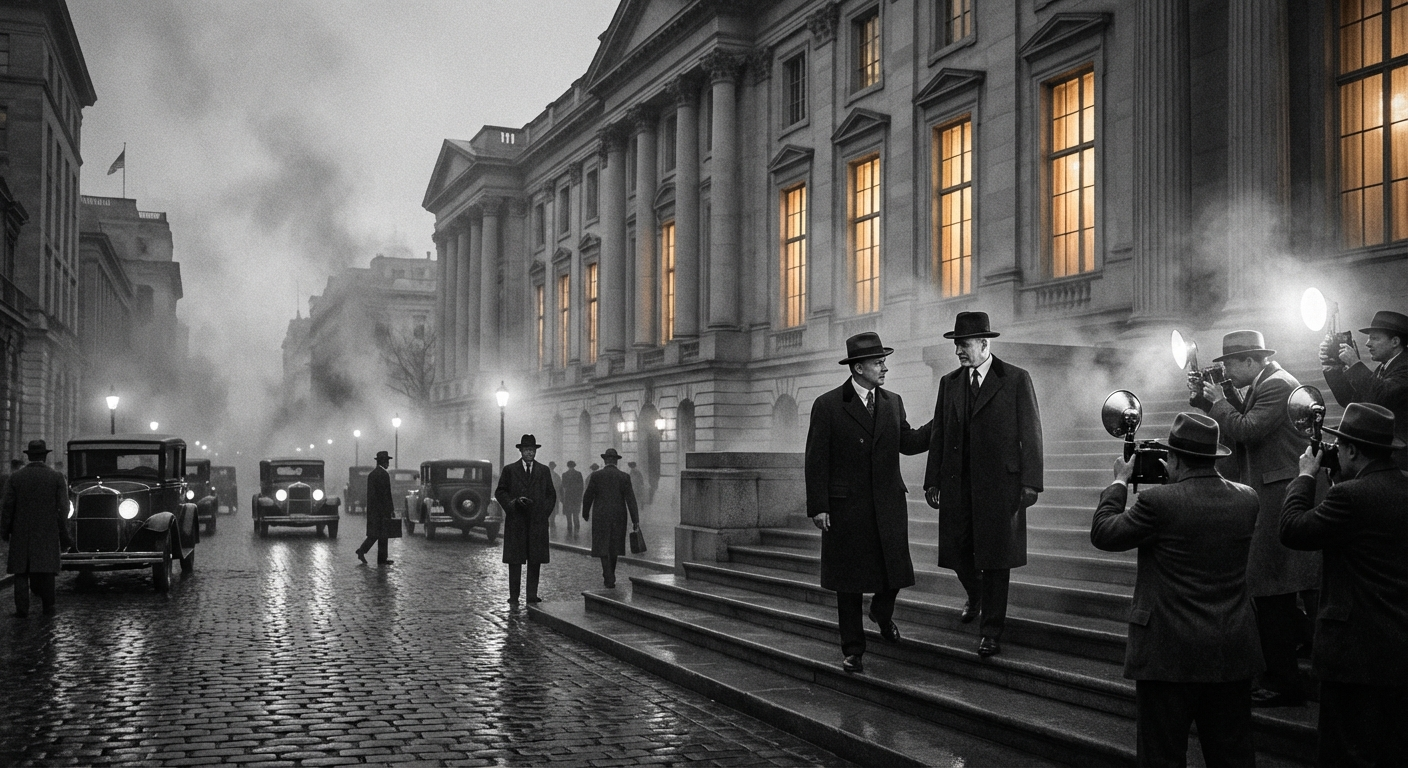
Sir Duncan Hale and Count Viktor Soren left the building together through the main entrance, as they did after the fourth session on 12 March. They paused briefly on the steps — long enough to be photographed, short enough to suggest they were not performing — and walked to separate vehicles. Hale said nothing. Soren nodded to a reporter from this newspaper and said, in accented but precise Bobingtonian: “A good day’s work.”
The fifth session began at 10 AM with three of the four annexes already in substantially agreed form. The vessel classification tables, signalling protocols, and inspection commission rules were initialled by midday. The fourth annexe — the insurance schedules — proved, as expected, the most contentious.
Sources close to the negotiations describe a two-hour discussion on premium escalation clauses: what happens after the three-month trial period expires and the 140 per cent premium cap lifts. The Delvarian delegation pressed for an automatic extension if transit volumes exceed a threshold. The Thessarine side argued that any extension must be subject to bilateral review. The compromise — an automatic six-month extension triggered by volume, subject to review at the midpoint — was described by one official as “elegant, if you like that sort of thing.”
Consul Pehr Lindqvist was not seen at the Foreign Office but was observed arriving at the Delvarian consulate on Ashbury Lane at approximately 4 PM, an hour and a half before the session concluded. Consul Elara Miren entered the Foreign Office through the east entrance at 5:45 PM, thirteen minutes after the session ended.
Professor Elias Thornbury, reached at his office at the Institute for Foreign Affairs, offered the assessment this newspaper has come to rely upon.
“This is not a beginning,” Thornbury said. “This is the end of the beginning. The difficult part starts now — making it work. A framework is a set of promises. The strait will test every one of them.”
He paused. “But it is a very good set of promises.”
Copper fell to 778 florins per tonne in late trading — the seventeenth consecutive daily decline and the lowest price since 22 January, three weeks before the Delvarian naval buildup that precipitated the crisis. The Eastern Spice Index closed at 287, its lowest level since 8 February.
The Bobington Insurance Exchange is expected to issue its preliminary statement of terms tomorrow, following Wednesday’s closed session. The 140 per cent premium cap agreed in the annexes provides the framework within which the Exchange’s fourteen member firms will now write their policies.
What remains unclear is the Northern Fleet. Sources in Thessara report that Delvarian naval activity near the northern channel approaches has diminished over the past 48 hours, though the Ministry of External Affairs in Kharstad has issued no formal statement regarding the fleet’s disposition. The Kharstad Gazette ran a 12-line item on the session’s conclusion on its evening edition’s third page, beneath an article about spring barley prices.
Thornbury noted this. “When the Gazette buries good news,” he said, “it means the good news is real.”
The signing on Tuesday will be attended by Hale and Soren, with Marchetti presiding. Both governments are expected to dispatch senior officials to witness the ceremony. First commercial transits through the Kaelmar Strait are expected two to three weeks after the signing — dependent on the insurance market’s readiness and the inspection commission’s activation.
Thirty-four days have passed since Sir Duncan Hale arrived in Thessara on 17 February. In that time, the copper price has fallen from 891 to 778 florins per tonne, the Eastern Spice Index has returned from crisis levels to below its pre-crisis baseline, and two nations that were conducting live-fire exercises in a shared waterway have agreed on the terms under which their ships will share it peacefully.
“A good day’s work,” Count Soren said. It was, perhaps, an understatement.