
On the evening that The Lamplighter’s Oath opens at the Bellvue Theatre — a play about Edmund Vale, the man who brought gas lighting to Bobington in the 1840s — it seems worth mentioning that there is one gas lamp left in the city.
It stands at the end of Pendle Alley.
Pendle Alley is a dead-end lane off Cooperage Lane, in the old brewery district south of the Docklands. Twelve houses, cobblestones, no through traffic. The sort of street that appears on no tourist map, features in no planning document, and which the city, in its relentless electrification of the past seven decades, appears to have simply forgotten.
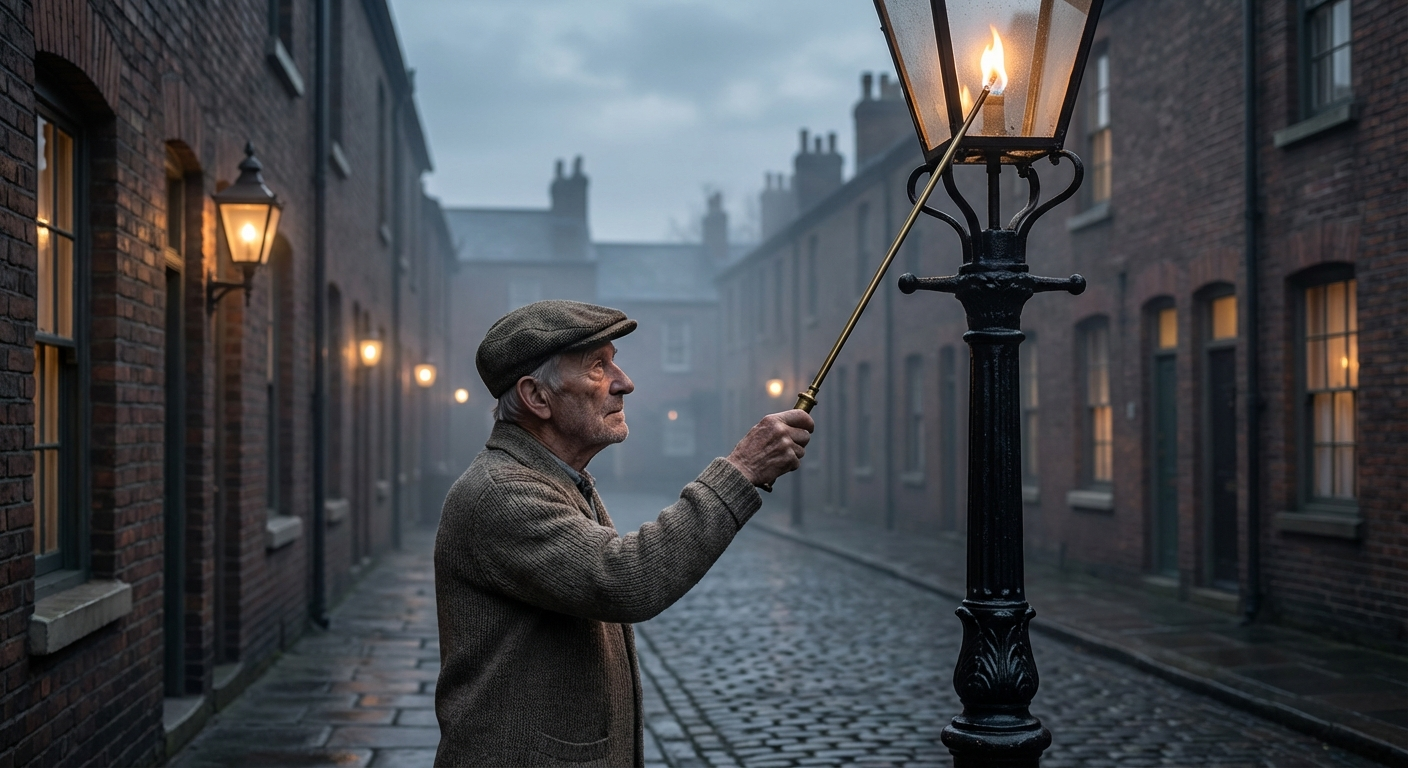
The lamp is cast iron, about three metres tall, with a hexagonal glass housing and a cross-bar bracket. Municipal pattern, circa 1880. The glass is clean. The metalwork is painted. The lamp works.
It has been lit every evening at dusk and extinguished every morning at dawn for fifty-two years by Horace Critchley, who lives at number 2.
Critchley is 77. His father, Edwin Critchley, was one of the last municipal lamplighters employed by the Bobington Lamplighting Office, which was abolished in 1958 when the final phase of the city’s conversion to electric street lighting was completed. Edwin walked a round of fourteen lamps in the brewery district. When the office closed, the lamps were removed — all except the one at the end of Pendle Alley, which was, as far as anyone can determine, overlooked.
Edwin continued to light it. When he died in 1974, Horace took over.
“He didn’t ask me to,” said Critchley, standing at his front door in a cardigan and slippers. “He didn’t need to. The lamp was there. Someone had to light it.”
Critchley pays for the gas himself. He has a supply account with the Municipal Gas Office — an arrangement he describes as “an understanding” that has apparently persisted, unexamined, for decades. The cost, he says, is modest. “Less than a florin a week. More in winter, when the nights are long.”
He uses his father’s brass lighter — a long-handled tool with a spring mechanism, designed for reaching the lamp’s interior valve without a ladder. Edwin Critchley carried it on his round. It hangs on a hook by the front door, next to a raincoat.
“I light it at dusk,” Critchley said. “I put it out at dawn. I’ve never missed a night.”
This claim is, on the face of it, extraordinary. Fifty-two years is 18,980 evenings. Critchley was asked about illness, holidays, inclement weather.
“I don’t take holidays,” he said. “And I’ve not been ill enough to stay in bed since 1991. The lamp doesn’t take holidays either.”
The neighbours on Pendle Alley are aware of the lamp, in the way that one is aware of a thing that has always been there. Mrs Edith Coyne, 69, who has lived at number 8 since 1983, said she had never thought about it.
“It’s Horace’s lamp,” she said. “It’s always been Horace’s lamp. I suppose I assumed the council paid for it.”
They do not.
Critchley has not seen The Lamplighter’s Oath. He has not been to the theatre. He was told that the play is about Edmund Vale, the city’s first superintendent of lamps.
“I know who Vale was,” he said. “My father talked about him. Vale believed everyone deserved a light outside their door. My father believed the same thing.”
He paused.
“So do I.”
The lamp on Pendle Alley will be lit this evening, as it is every evening. The play at the Bellvue will begin at seven thirty. Neither event is aware of the other, but they are, in a sense, about the same thing.