
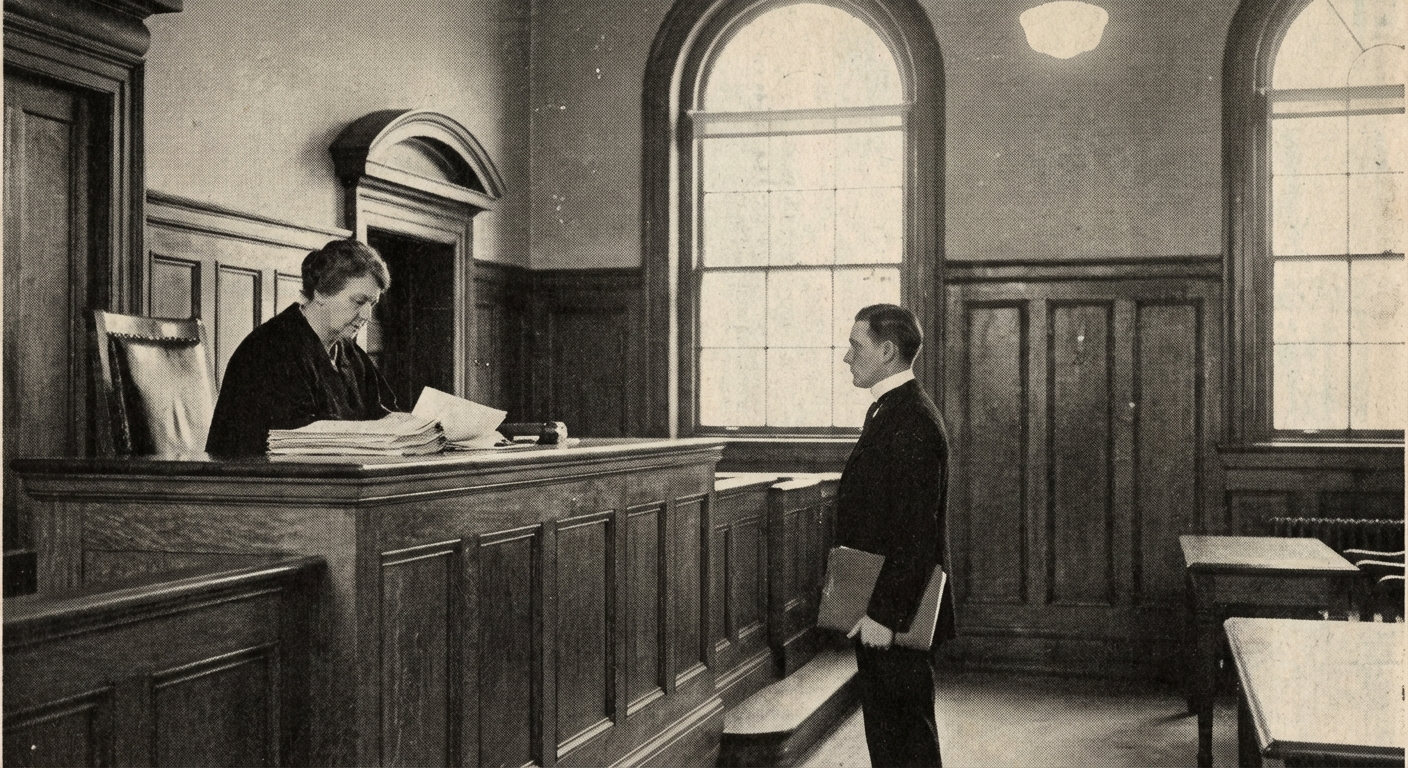
The judgment arrived at 10:14 AM on Monday, delivered by Magistrate Constance Hathaway from the same bench where, nine days earlier, she had listened to four hours of argument and said she would think about it. She had thought about it. The result was thirty-one pages, bound in grey card, placed on the tribunal table by the clerk at precisely the moment Hathaway reached for it.
The courtroom was busier than it had been for the hearing. The Revenue Office sent two senior assessors. Edmond Crayle sat alone — Tobias Wainscott was elsewhere, perhaps carrying files — and read the judgment as Hathaway delivered the summary from the bench.
The summary took eleven minutes. The arithmetic, when it was finished, looked like this: of the original demand of approximately 2.35 million florins, Hathaway reduced the figure to approximately 2.28 million. She accepted Crayle’s argument on a single additional property — a warehouse on Old Harbour Road where Ashcroft had demonstrably engaged an architect in September 2025 and filed preliminary sketches with the Planning Office in January 2026. The warehouse was reclassified from “vacant” to “pending renovation,” reducing the levy by approximately 67,000 florins.
On the remaining properties, the judgment was comprehensive and pointed.
“The appellant argues that a building in which a development plan is being formulated is not vacant,” Hathaway wrote. “This Tribunal accepts the proposition in principle. However, the formulation of a development plan requires evidence of formulation. Correspondence with an architectural firm is evidence. A site assessment is evidence. A building permit is evidence. The absence of all three is not evidence of planning. It is evidence of inactivity.”
The phrase that Alcott expects to be quoted most often came on page fourteen: “A property that has been empty for twenty-six months, that has consumed no water, generated no waste, and drawn no electricity is, by any definition available to this Tribunal, vacant. The fact that its owner intends, at some unspecified future date, to make it less vacant does not alter its present condition.”
Crayle had argued procedural irregularity — that the Revenue Office had acted under political pressure following the Greystone Wharf fire and the Docklands safety audit. Hathaway addressed this directly.
“The timing of a demand does not determine its validity,” she wrote. “If the audit revealed that the levy was owed, the appropriate response was to demand it. The alternative — to have discovered the debt and declined to collect it — would itself have been an irregularity.”
The penalties were the final question. Crayle had sought an interim order suspending the 1.5-per-cent monthly penalty while the appeal was heard. Hathaway declined. Penalties accrued during the appeal period — approximately 103,000 florins — stand. Going forward, new penalties begin accruing on 1 May.
The total obligation: approximately 2.28 million florins in levy, plus approximately 103,000 in accrued penalties, with 1.5 per cent per month compounding from May.
Crayle left the tribunal by the main entrance at 10:31 AM. He paused on the steps long enough to say: “My client is reviewing the judgment in full and will consider its options, including the possibility of further proceedings.” He did not take questions.
The Revenue Office released a statement at 11:00 AM describing the ruling as “a clear endorsement of the principle that all property owners, regardless of size, are subject to the same obligations under the Municipal Levy Act.” It thanked the tribunal for its “thorough and careful analysis.”
Councilwoman Ida Pryce, who initiated the Docklands safety audit that led to the reassessment, was brief: “The audit was right. The levy was right. The law is clear.”
The judgment has broader implications. Ashcroft Property Group currently holds eleven commercial properties in the Docklands, of which seven are classified as vacant or undergoing renovation. The Revenue Office has indicated it will now apply Hathaway’s reasoning — that vacancy is determined by evidence of activity, not declarations of intent — to its assessment of all properties in the district.
Councilman Aldric Voss, reached by telephone, was characteristically measured: “It is a sound judgment. The question now is whether it is paid.”
If Ashcroft does not pay by 1 May, the Revenue Office may initiate enforcement proceedings after ninety days — a process that could include liens on property, seizure orders, or referral to the Municipal Tribunal for contempt. The earliest such proceedings could begin would be late July.
In the gallery, Patrick Seldon sat with two other DWA members. He had not been called as a witness. He had not spoken. Asked afterwards why he attended, he said: “Because this is about who pays and who doesn’t. That matters to my members.”
The Municipal Chamber clock, which Desmond Quirke restored in March, struck the quarter-hour as Crayle descended the tribunal steps. The sound carried across Grayling Street and into the morning air, which smelled of rain and overdue obligations.