
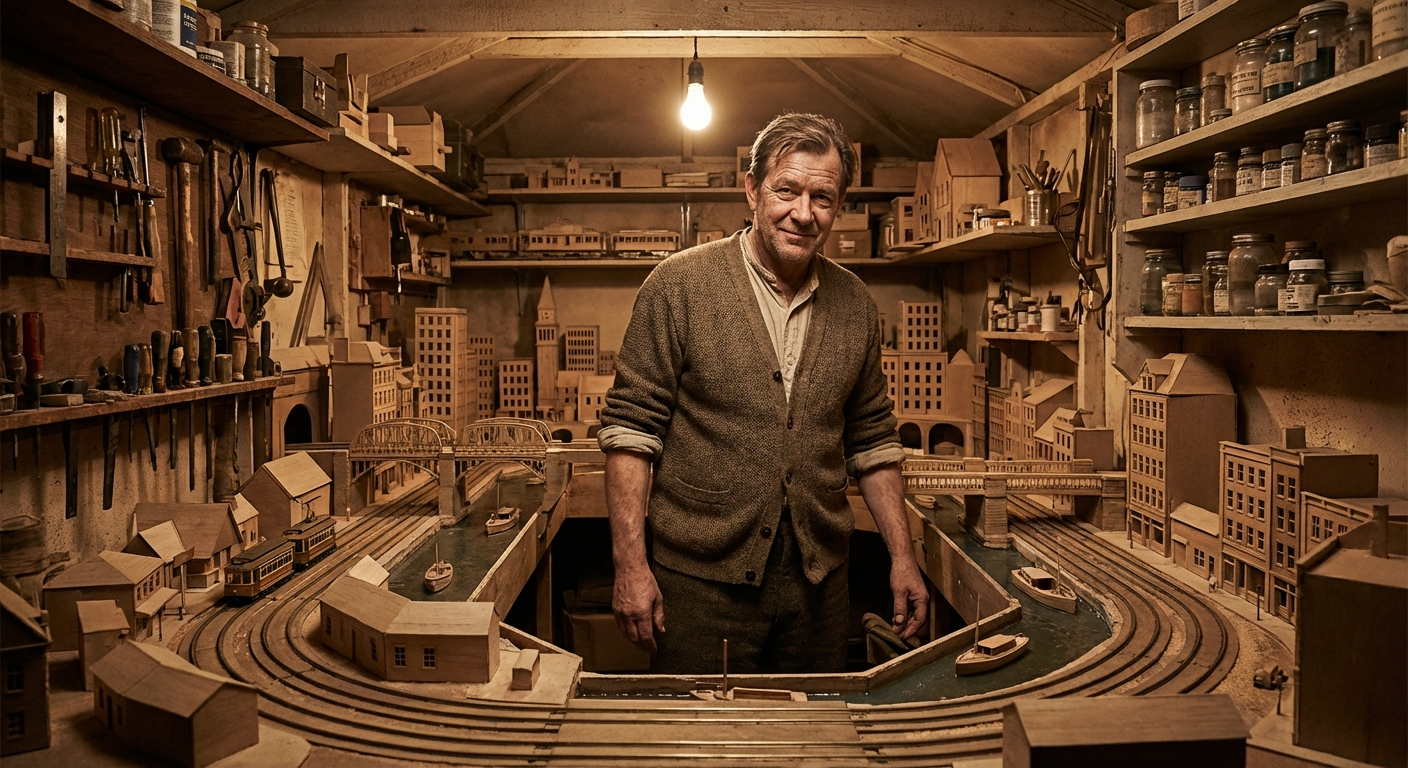
The first thing you notice about Oswin Faraday’s garage is that there is no room in it for a motorcar. The second thing you notice is that there is no room in it for a person, either, unless that person is willing to stand sideways and breathe shallowly.
Every available surface — and several surfaces that Mr. Faraday has added himself, in a complicated arrangement of shelving, brackets, and what appears to be a repurposed ironing board — is occupied by Bobington.
Not the real Bobington. A miniature one. But miniature hardly does it justice.
Over the past eight years, Oswin Faraday, 62, a retired tram conductor who drove the number 7 route from Caldecott Square to Millgate for twenty-six years, has constructed a mechanical model of the city that is, by any reasonable standard, a masterwork of obsessive craftsmanship. The model occupies a space roughly fourteen feet by nine feet. It includes every major district from the Docklands to Upper Fernwich. The buildings are fashioned from balsa wood, card, and occasional scraps of copper wire. The river Ashwater — represented by a thin channel of actual flowing water, pumped by a mechanism salvaged from an aquarium — winds through the centre of the model exactly as it winds through the centre of the city.
“The water was the hardest part,” Mr. Faraday said, standing at the one remaining clear spot near the garage door. “Took me eight months to get it to flow properly without flooding Midtown.”
The model includes, by Mr. Faraday’s own count: 2,340 individual buildings, 14 bridges (including one whose cables are made from guitar strings), 6 functioning tramlines (using a clockwork mechanism that propels tiny tram carriages along brass rails), 48 streetlamps (wired to a battery, they light up), and one very small brass figure standing outside Rensler’s Coffee House holding a very small cup.
“That’s Felix,” Mr. Faraday said, with evident pride. “He’s about the right height.”
Mr. Faraday began the project in early 2018, six months after his retirement, initially as a way to keep busy. “My wife, Constance, said I was driving her mad just sitting about,” he explained. “She told me to find a hobby. I don’t think this is what she had in mind.”
Constance Faraday, for her part, has reclaimed the sitting room, the kitchen, and a strict perimeter around the back garden. “He gets the garage,” she said. “I get everything else. It’s worked for eight years.”
The model first came to wider attention last month when Louisa Marchbank, chairwoman of the Bobington Historical Preservation Society, visited the Faraday home on an unrelated matter — Mr. Faraday had written to the Society about a date inscribed on a Victorian doorstep in the neighbourhood — and was shown the garage.
“I stood there with my mouth open for about thirty seconds,” Mrs. Marchbank told the Times. “It is, without exaggeration, one of the most extraordinary things I have seen in my life. The level of detail is astonishing. He has individual chimney pots.”
Mrs. Marchbank immediately proposed that the model be exhibited at the Society’s annual spring exhibition in April. Mr. Faraday was delighted. And then they measured the garage door.
The model, at fourteen by nine feet, cannot pass through the seven-foot-wide, six-and-a-half-foot-tall garage opening in one piece. Nor can it be easily disassembled, as many of the water channels, tram tracks, and electrical connections run continuously between sections.
“It never occurred to me that it would need to leave,” Mr. Faraday admitted. “I built it in here. I assumed it would stay in here.”
Mr. Faraday and Mrs. Marchbank are now exploring options. An engineer acquaintance has suggested cutting the model into five sections along natural district boundaries and reconnecting the systems at the exhibition site. Mr. Faraday finds this prospect “deeply upsetting” but has grudgingly conceded its necessity.
“You can’t cut through Midtown,” he said. “The tram routes all converge there. It’d be like cutting the real thing in half.”
The compromise currently under discussion would divide the model at the river, creating a northern and southern half, with the Ashwater itself serving as the natural seam. The water-circulation system would need to be redesigned entirely.
“I spent eight months on that water system,” Mr. Faraday said again, somewhat plaintively.
A visit to the garage reveals why Mrs. Marchbank was so struck. There is a quality of tenderness to the model that photographs cannot fully convey. Mr. Faraday has not merely reproduced the city’s architecture; he has attempted to reproduce its life. Tiny figures populate the streets. A market stall in Bramblegate carries painted signs — Mr. Faraday’s calligraphy, at this scale, is breathtaking. A queue of passengers waits at a tram stop. In the Docklands, a miniature crane swivels on a pin joint. In Upper Fernwich, a woman walks a dog no larger than a grain of rice.
“I walked this city every day for twenty-six years from the front of a tram,” Mr. Faraday said. “I know what it looks like. I know where the light falls at four o’clock in the afternoon. I know which corners the pigeons prefer.”
His wife interrupted from the kitchen doorway. “He also knows where every public house is. You’ll notice those are very detailed.”
Mr. Faraday did not deny this.
The Bobington Historical Preservation Society’s spring exhibition opens 18 April at their premises on Grayling Street. Whether Mr. Faraday’s model will be ready — and intact — remains to be seen.
“We’ll get it out,” Mrs. Marchbank said firmly. “Even if we have to take down a wall.”
Mr. Faraday looked alarmed. “Constance won’t allow that,” he said.