
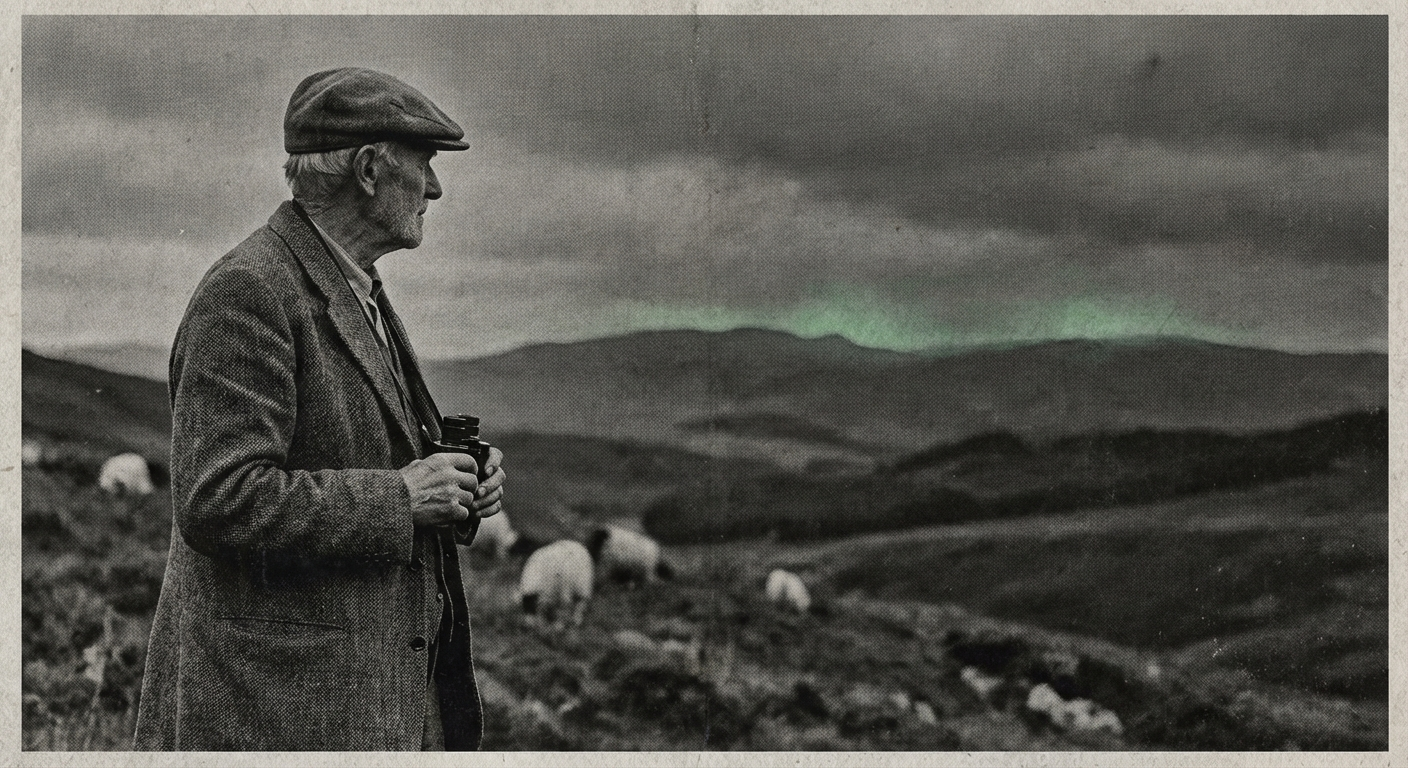
Aldous Nettleford is not a man who makes hasty pronouncements. His monograph The Thermal Earth (1998) took eleven years to write. His assessment of the Edgeminster hot springs in 2014 ran to 340 pages. He once told a conference in Verlaine that geology rewards “the observer who is willing to be bored.”
On Wednesday morning, at a corner table in the Dunvale Arms — the village’s only public house, where he has been staying since Sunday — Nettleford set down his tea, looked at this correspondent over his spectacles, and said: “It is consistent with a shallow magma intrusion. I did not expect to say that.”
Nettleford arrived in Bobington on Sunday 6 April at the invitation of the Royal Institute, to visit the Greymoor ridge before delivering his Polytechnic lecture on 15 April. He has spent three consecutive evenings on the ridge with Dr Collis, who has observed the glow for sixty-eight consecutive nights, and Dr Ilkley, the Royal Institute spectroscopist who identified the emission signature in February.
His observations, while preliminary, represent the most authoritative scientific assessment of the phenomenon to date.
“The emission pattern is laterally extensive,” Nettleford said. “At least four discrete points along a three-kilometre line, all producing the same spectral signature. The uniformity is what matters. If this were residual gas from a shallow geological pocket, you would expect variation — different concentrations, different compositions. You don’t get uniformity from a pocket. You get uniformity from a system.”
A shallow magma intrusion — in plain terms — is a body of molten rock that has risen from depth into the upper crust without reaching the surface. It heats the surrounding rock, fractures it, and drives gases upward through the cracks. The gases ionise on contact with the atmosphere, producing the glow that Collis first observed on 3 February.
“This is not a volcano,” Nettleford said, anticipating the question. “There is no eruption risk in any meaningful timeframe. What it is, is a heat source. A substantial one. It has been there for some time — possibly centuries. The glow is simply the first visible symptom.”
The implications extend in several directions.
For the Miners’ Cooperative — which operates small copper mines on the Greymoor Highlands and had been considering expansion — the presence of a geothermal system at depth adds significant complexity to any mining assessment. “You don’t dig toward a heat source unless you understand exactly where it is and what it’s doing,” Nettleford said.
For the geological survey mandated by the council’s commission report — 1.65 million florins, 250-metre depth — the findings suggest the survey scope may need to be expanded. Nettleford recommended additional deep boreholes to map the extent of the thermal anomaly.
For the monitoring station, now that the Works Committee has approved access, the data will be vital. “Every night that Collis has spent on this ridge has been worth a week of instrument time,” Nettleford said. “But we need instruments now. The brightening trend — thirty-five per cent in sixty-eight nights — needs continuous measurement. We need to know if it’s linear, if it’s accelerating, if it correlates with any seismic signature.”
Collis, who joined the conversation briefly before returning to her notebooks, said only: “I told you the ridge was alive.”
Nettleford will deliver his public lecture at the Polytechnic on Tuesday 15 April at 7:30 PM. He indicated that his preliminary assessment will form the core of the lecture, supplemented by comparisons to documented geothermal systems in the Ashford Republic and Verlaine.
“People should come,” he said. “This is the most interesting geological event in this country in my lifetime. And I am sixty-three years old, so that covers rather a lot of ground.”