
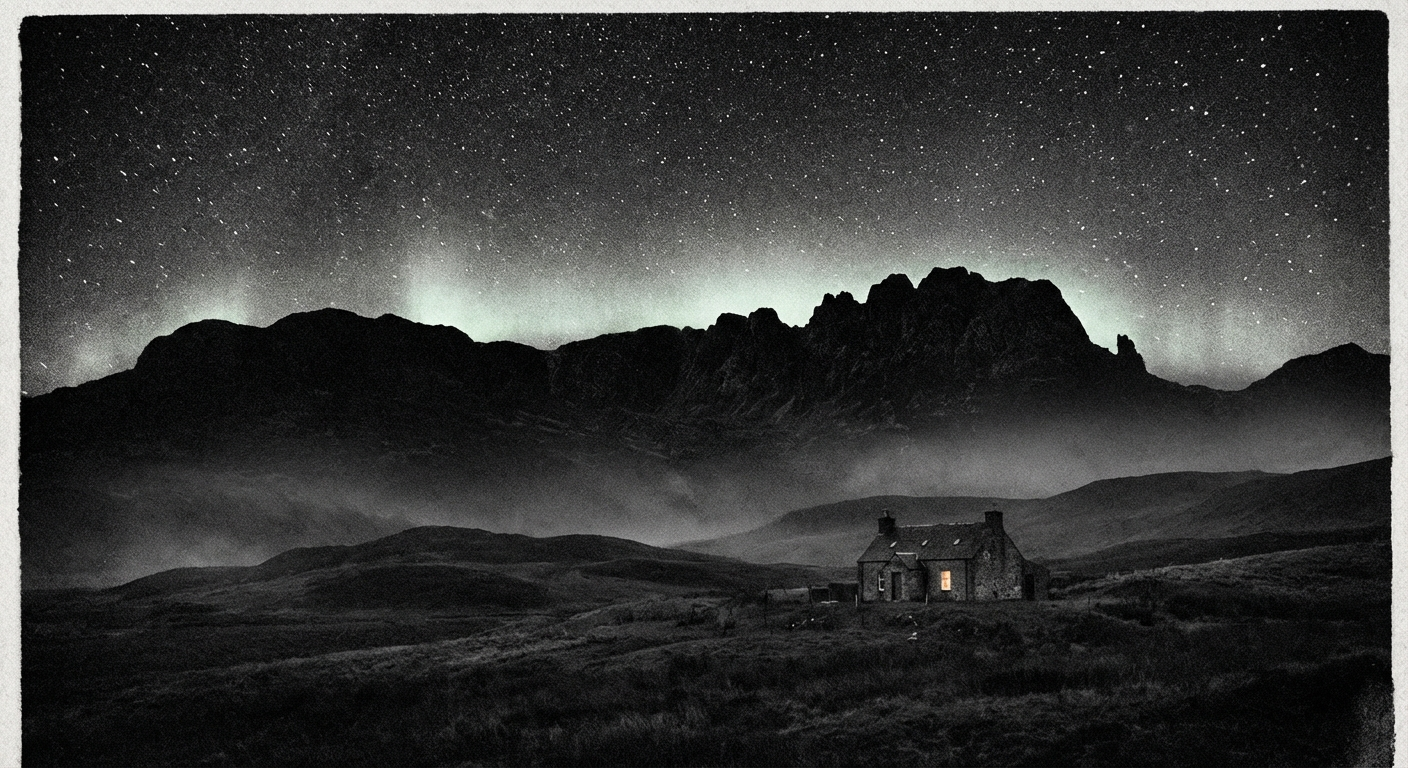
The luminous phenomenon above the Greymoor Highlands has now been observed on thirty-eight consecutive clear nights and is approximately twenty per cent brighter than when Dr Odette Collis first documented it on 3 February. The rate of brightening has not slowed.
Dr Collis and Dr Maren Ilkley of the Royal Institute confirmed the figure on Wednesday evening, following their latest session on the ridge with the portable spectrometer that has become as much a part of their routine as the notebooks Collis has filled for decades.
“Twenty per cent in forty-four days,” Collis said. “The spectral signature has not changed — ionised nitrogen and trace sulphur dioxide, consistent with geothermal venting. But the intensity has increased steadily, without a single night of reversal.”
She paused, in the way she does when choosing between what she knows and what she suspects. “Something beneath the ridge is growing.”
The observation is not merely academic. Equipment tenders for the permanent Greymoor monitoring station close on Saturday at noon. The station — approved at 195,000 florins with 48,000 florins per year in operating costs — will house three broadband seismometers, two atmospheric gas sampling units, a meteorological mast, and a photometric array for continuous measurement of the glow. It will be the first sustained scientific presence on the Greymoor ridge since the 1950s meteorological outpost was abandoned.
The site, approximately 800 metres northwest of the old met outpost above the central emission zone, is accessible only by pack track from the Dunvale road. Construction is expected to begin in April, with the station operational by mid-May — in time for the deep geological survey that the Copper Review Commission mandated on 28 February.
Professor Elara Whitstone, president of the Royal Institute and the architect of the survey programme, described the twenty per cent figure as “significant but not alarming.”
“The glow is a symptom,” Whitstone said. “It tells us that gas is escaping through fractured rock under thermal pressure. A twenty per cent increase in brightness suggests a twenty per cent increase in gas flux. Whether that represents a stable process that is gradually reaching equilibrium, or an accelerating one, is precisely what the monitoring station will determine.”
The glow is not visible from Bobington. But it is visible from Dunvale, and from the scattered farms and shepherds’ cottages along the ridge.
Gareth Penn, who has kept sheep on the Greymoor uplands for thirty-one years, can see it from his kitchen window at Highfield Farm, three miles south of the central emission zone. He has been watching it since early February.
“First few nights, I thought it was Dunvale village,” Penn said. “Then I realised it was the wrong direction. It’s not bright enough to read by, mind. But it’s there. Every clear night. And it’s brighter now than it was.”
He was asked whether it concerned him. “The sheep don’t care,” he said. “I’ve learned to take my lead from the sheep.”
Penn, 62, is the third generation of his family to farm the Greymoor uplands. His grandfather mined copper at the same ridge in the 1920s and 1930s. His father switched to sheep after the smaller mines closed. The land beneath his farm is among the zones identified in the 1970s surveys as containing deep copper deposits — the same deposits that the geological survey will assess.
“If there’s copper under my sheep,” Penn said, “I’d like to know about it before anyone starts digging.”
The deep geological survey — budgeted at 1.65 million florins, expected to probe to 250 metres — is a prerequisite for any expansion of domestic copper production. The Miners’ Cooperative of Greymoor, chaired by Nils Haversten, currently produces approximately 2,000 tonnes per year from shallow workings. The tramway expansion requires 5,200 tonnes for Phase 1 alone.
Whether the geothermal system that produces the glow complicates or enhances the mining prospect is an open question. Geothermal heat can fracture rock — useful for extraction but hazardous for tunnel stability. The survey will need to map both the mineral deposits and the thermal system that shares the same geology.
“We must know what we are building upon,” Whitstone said. “That has been the principle from the beginning.”
The ridge, for its part, continues to glow.