
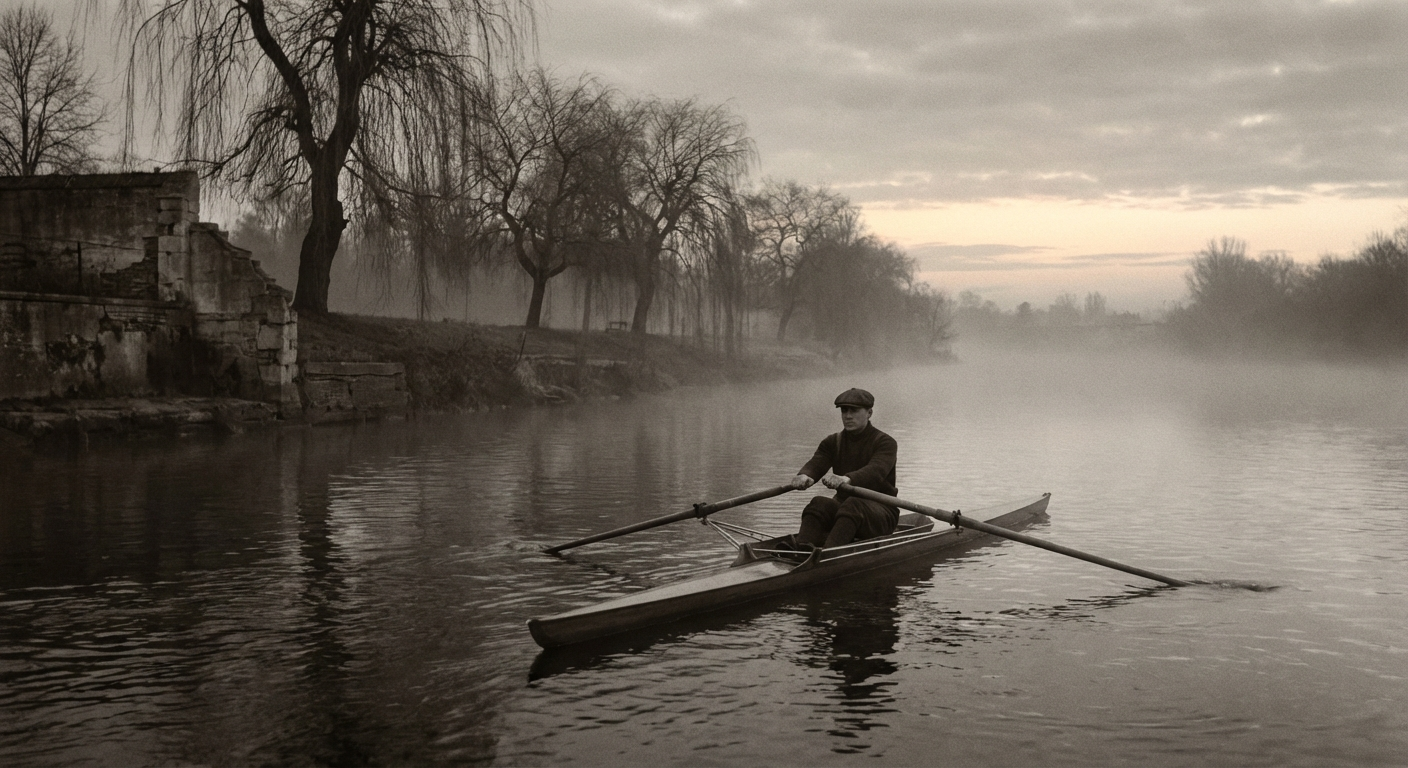
The alarm goes off at quarter to five. She does not need it. She has not needed it for thirty years. But it is Stanley’s clock — a brass carriage clock he bought at a jumble sale in 1991 for two florins — and the sound of it is part of the morning, the way the river is part of the morning, the way the cold is part of the morning.
Edith Wren, 58, of Thornhill, eats half a slice of toast with butter and drinks one cup of tea, standing at the kitchen counter. She puts on three layers: wool vest, long-sleeved cotton, the blue waterproof that has outlasted four zippers. She walks to the boathouse on the Lower Ashwater in twelve minutes. She has counted.
Early Post is where she left it, upside down on the rack, hull freshly sealed this week with linseed oil and marine varnish. It is a single scull, 7.4 metres, cedarwood over ash ribs, built in her back garden in 1999. Stanley helped with the steam bending and offered encouragement that was, by her account, more enthusiastic than useful. The boat has carried her approximately 22,000 kilometres in twenty-seven years. She has never capsized.
She launches at 5:15. The river is black and still. The protection zone buoys — new as of Monday — glow faintly to the south, marking the edge of the seal colony’s territory. Wren enters the water well north of the zone, rowing south along the Bramblegate side before turning at the footbridge and working back upstream toward Millgate. The round trip is 3.6 kilometres. She does it twice.
The first pass is warm-up: long, slow strokes, the oar handles just below shoulder height, blade work clean and quiet. She can hear the seals sometimes — a soft barking from the mudflats, the sound of something living that was not there a month ago. The pup, she says, is visible at dawn if the tide is low. A small grey shape. She does not disturb them.
The second pass is race pace. The Veterans’ Championship at Caldwell — the National Veterans’ Sculling Championship, held at the Caldwell Rowing Basin on the River Lenn — is in seventeen days. The course is 2,000 metres, a straight sprint. Wren’s qualifying time at the regional trial was 6 minutes 42 seconds, three seconds inside the standard. She needs to be faster. The field at Caldwell will include former national-level competitors.
“I’m not going to win,” she says, towelling off at the boathouse at 6:20, steam rising from her arms in the cold air. “I know that. I’ve seen the entry list. There’s a woman from Port Caravel who was in the national eight. There’s a Caldwell sculler who’s won this three times.”
She pauses.
“But I’m going to race well. I’m going to race like someone who’s been on this river for thirty years and built her own boat and never missed a morning. That’s not nothing.”
Gareth Toll, commodore of the Ashwater Sculling Club, has watched Wren’s preparation with quiet admiration. “The cleanest stroke on the Ashwater,” he said. “No wasted movement. No splash. She rows like someone who’s had a long conversation with the water and they’ve come to an agreement.”
He noted that Wren’s second-pass split times this week have been consistently under 7 minutes over 2,000 metres — a significant improvement from the 7:12 she averaged in February. “The regional qualifier sharpened her,” he said. “She knows what race pace feels like now. That changes everything.”
Stanley Wren would have turned 63 on Tuesday. He died in 2019, after 22 years of standing on the riverbank every morning with a thermos of tea and a wave. He could not swim. He came anyway.
Wren rowed on Tuesday morning as she rows every morning. She passed the spot on the bank where Stanley used to stand — a slight indentation in the path between two willows, worn by years of the same man’s shoes. She did not slow down. She does not slow down.
“He’d have been ridiculous about Caldwell,” she said. “He’d have wanted to come. He’d have brought a banner. He’d have embarrassed me completely.”
She looked at the river.
“I wish he could embarrass me completely.”
The National Veterans’ Sculling Championship is on 18 April at the Caldwell Rowing Basin. Wren will travel by train on the 17th, carrying Early Post in a specially built canvas cradle that Stanley sewed in 2004. The Ashwater Sculling Club has contributed 40 florins toward her travel expenses. The Bobington Ladies’ Sculling Club — of which Wren is not a member but is considered an honorary friend — has offered an additional 25 florins.
Seventeen days. Twelve minutes of walking. Seven minutes of racing. Twenty-seven years of practice.
The alarm goes off at quarter to five. She does not need it. But it is Stanley’s clock.