
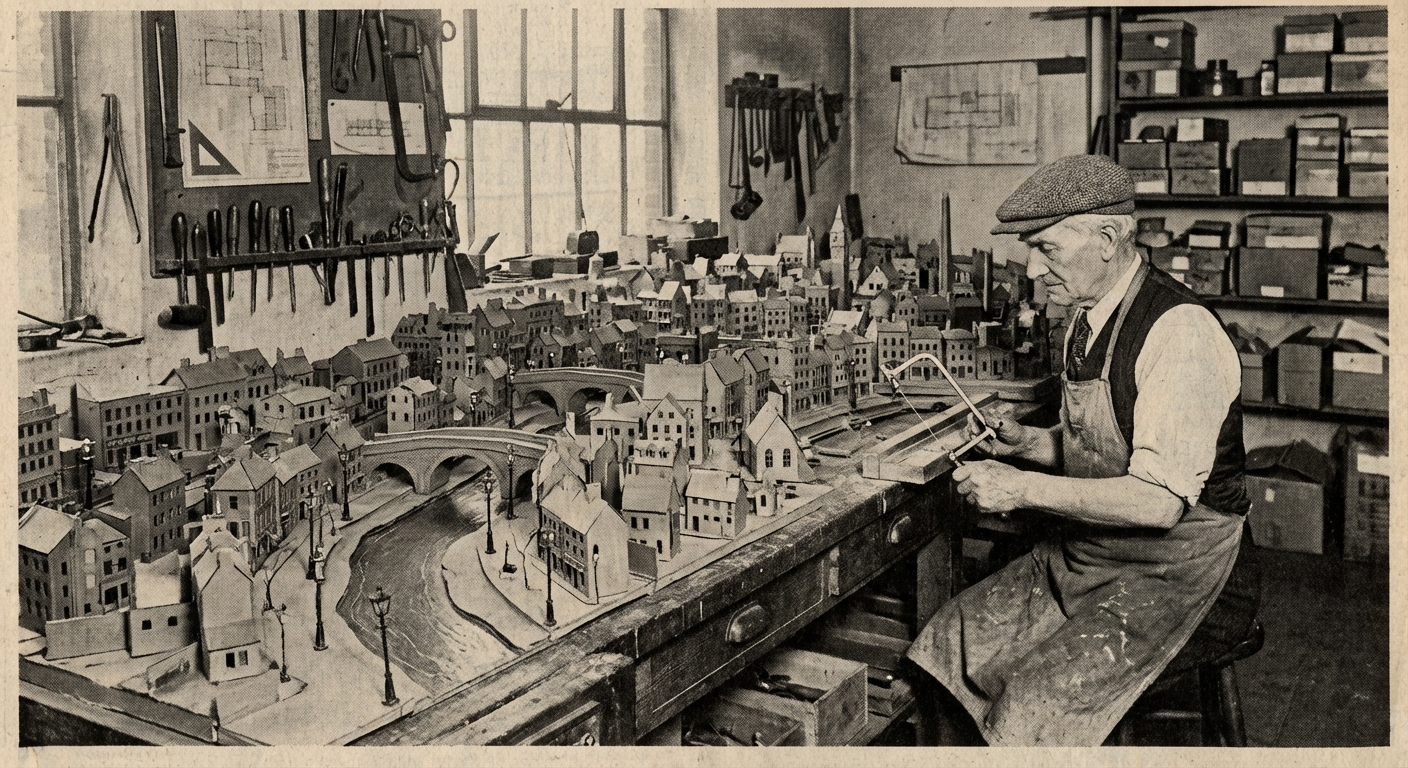
At half-past eight on Sunday morning, in a garage in Thornhill that smelled of machine oil and fresh plywood, Arthur Bayliss knelt beside a miniature river and picked up a saw.
Eight years of Oswin Faraday’s life lay on the workbench before him — 2,340 buildings, 14 bridges, six clockwork tramlines, 48 wired streetlamps, and one aquarium pump feeding real water through a channel no wider than a man’s thumb. The mechanical model of Bobington, in all its preposterous, magnificent detail, was about to be cut in half.
The problem, as readers of this newspaper will recall, was architectural. The model is fourteen feet long and nine feet wide. Faraday’s garage door is seven feet across. The model was built inside the garage, and it had never occurred to Faraday, during eight years of construction, that it would ever need to leave.
“I wasn’t building it to go anywhere,” he said, standing in the driveway with his wife Constance and watching through the open door. “I was building it to be here.”
But here is not where it is going. The Bobington Historical Preservation Society has offered the model pride of place in its spring exhibition, opening 18 April on Grayling Street, and Faraday — after what Constance describes as “a week of silences and one very long conversation” — agreed.
The solution was the river. The model’s representation of the Ashwater runs east-west across the centre of the piece, and the join between the northern and southern halves follows the waterline exactly. Twelve brass plug connectors — designed, it must be said, with considerable foresight by Faraday himself — link the electrical circuits across the divide. The water system, fed by the aquarium pump in the model’s northwest corner, drains into a reservoir concealed beneath the Docklands.
Bayliss, a furniture restorer from Thornhill with thirty years’ experience in the care of objects that other people might reasonably consider too fragile to move, surveyed the divide with his son James. The plywood seam had been reinforced with pine battens. The connectors were labelled. The tramlines could be uncoupled at the bridge points.
“It’s well built,” Bayliss said. “That’s what makes it possible.”
He began at 9 AM. Each connector was disconnected and wrapped in cotton batting. The water was drained — James held a towel beneath the Bramblegate Steps outfall, a detail so precise that one could almost expect seals on the mudflat below. The tramlines were uncoupled at Fernwick Bridge (itself a small heartbreak). The saw work took eleven minutes. The river held.
The northern half — Thornhill, Upper Fernwich, the Marches — was lifted onto a padded trestle by four pairs of hands and carried through the garage door with perhaps three inches to spare on either side. The southern half — the Docklands, Bramblegate, Midtown — followed twenty minutes later. Both halves were loaded onto a furniture wagon, separated by quilted blankets, and driven at walking pace to Grayling Street.
By three o’clock, both halves were inside the exhibition hall. Reassembly begins tomorrow. Faraday will reconnect the electrics himself.
Constance Faraday watched the entire operation from the driveway, a cup of tea growing cold in her hands. When the wagon pulled away, she said: “I have my garage back.”
She paused.
“I’ll miss the trams.”