
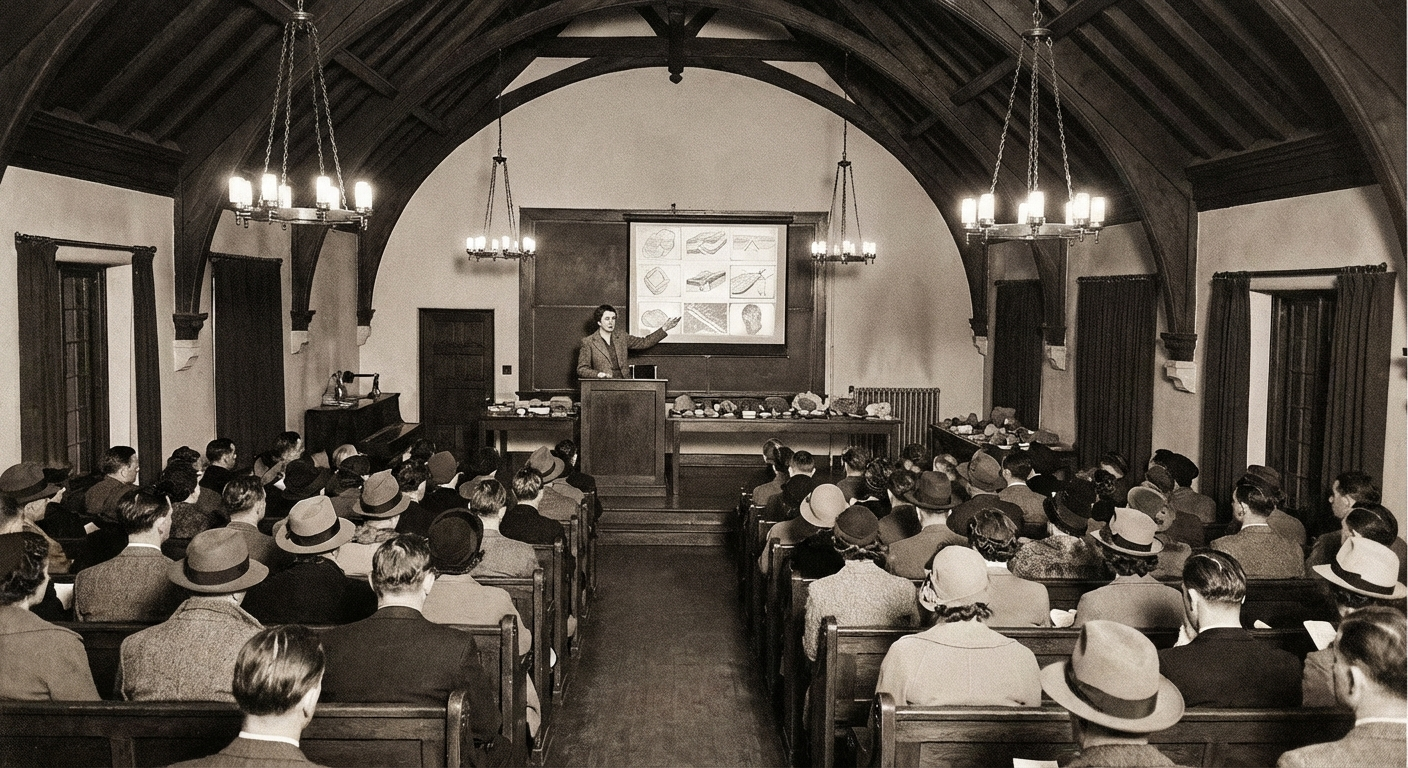
The fourth lecture in the Bobington Polytechnic spring series filled Founders’ Hall to its 280 seats and added another forty standing at the back. Dr Maren Huxley, lecturer in archaeology at the Polytechnic, stood behind the same podium where Professor Nettleford had described the fire beneath the ridge a week earlier, and she described the people who lived above it.
The lecture was titled “The Shepherd’s Country: Archaeology, Memory, and the Dunvale Ridge.” It lasted fifty-five minutes. No one left early.
Huxley began with what was known. On 19 March, construction workers excavating a drainage trench at the Dunvale memorial site had unearthed human skeletal remains approximately twelve metres east of the sealed mine entrance. Bone dating placed the burial between 1680 and 1710. Parish records from St Cuthbert’s Church identified the individual as Thomas Garland, a shepherd, buried in 1698. The remains were left in place per Garland’s recorded wishes — “burial where he could see the vale.”
“That much you know,” Huxley said. “What you may not know is what we found around him.”
After the remains were identified in March, Huxley’s team — two Polytechnic graduate students and foreman Callum Sayer’s crew — conducted a systematic survey of the area within a twenty-metre radius of the burial site. What they found was not dramatic. It was, Huxley said, “the kind of evidence that only accumulates through sustained occupation.”
Seventeen pottery shards, consistent with late seventeenth-century domestic stoneware. A hand-forged iron knife, heavily corroded, approximately fifteen centimetres in length. Charcoal deposits concentrated in two distinct areas, suggesting repeated fire use. And, most significantly, a pattern of six post-holes arranged in a rough rectangle, approximately three metres by two, consistent with a small seasonal shelter — the kind of structure a shepherd might erect in spring and dismantle before the first snows.
“Thomas Garland was not alone on the ridge,” Huxley said. “He was part of a community — small, seasonal, and entirely invisible to the historical record until now.”
She showed a projected slide of the post-hole pattern, overlaid with the known burial location and a reconstruction of what the shelter might have looked like: low-walled, open-fronted, oriented south-east to shelter from the prevailing wind. The kind of building that would leave almost no trace within a generation of its abandonment.
Leonard Hewitt was in the third row. The retired mathematics teacher, who has researched the 1859 Bobington fever independently for thirty years, had attended the Furness lecture a fortnight earlier with folders of transcribed parish data. He had come back with more.
Hewitt rose during the question period and presented, with the precision of a man who has spent three decades counting the dead, a summary of St Cuthbert’s burial records for the Dunvale parish between 1680 and 1740. Seven recorded burials. Of these, four were identified by name and occupation: Garland (shepherd, 1698), Agnes Hewitt — no relation, Leonard noted, to quiet laughter — (shepherd’s wife, 1703), an unnamed man described as “a traveller from the south” (1703), and William Dallow (shepherd, 1738).
“Dallow,” said Isobel Dallow from the fifth row, and the hall went still.
Huxley recovered first. “Do you have a connection to the name?”
“My husband’s family has farmed the Greymoor ridge since the 1780s,” said Dallow, who had opposed the access road and attended the lecture, she said later, “because I wanted to know what they’d found.” She had not known about the 1738 burial. “My husband died in 2014. His name was William.”
Huxley paused, then said: “The ridge remembers its people, even when the people forget.”
The lecture drew its broadest conclusion in the final fifteen minutes. Huxley argued that the Greymoor Highlands, conventionally understood as empty upland before the copper mines opened in the 1840s, had in fact supported a small but persistent pastoral population for at least sixty years prior. The mines did not open the ridge. They displaced a way of life that was already there.
“When we build the Dunvale memorial,” Huxley said, “we will remember the forty-one miners who died in 1963. We should also remember what the ridge was before the mines — and what it has been since.”
Eleanor Birdsall, who teaches at the Dunvale Village Primary School, had brought fourteen students in a hired coach. They sat in the front two rows with notebooks. “They live on the ridge,” Birdsall said afterward. “They should know what’s beneath it.”
The closing lecture in the Polytechnic spring series is scheduled for 29 April. Professor Nettleford has been invited to return. His topic, if he accepts, has not been announced. Miriam Aldbury, the series coordinator, said only: “We are hopeful.”