
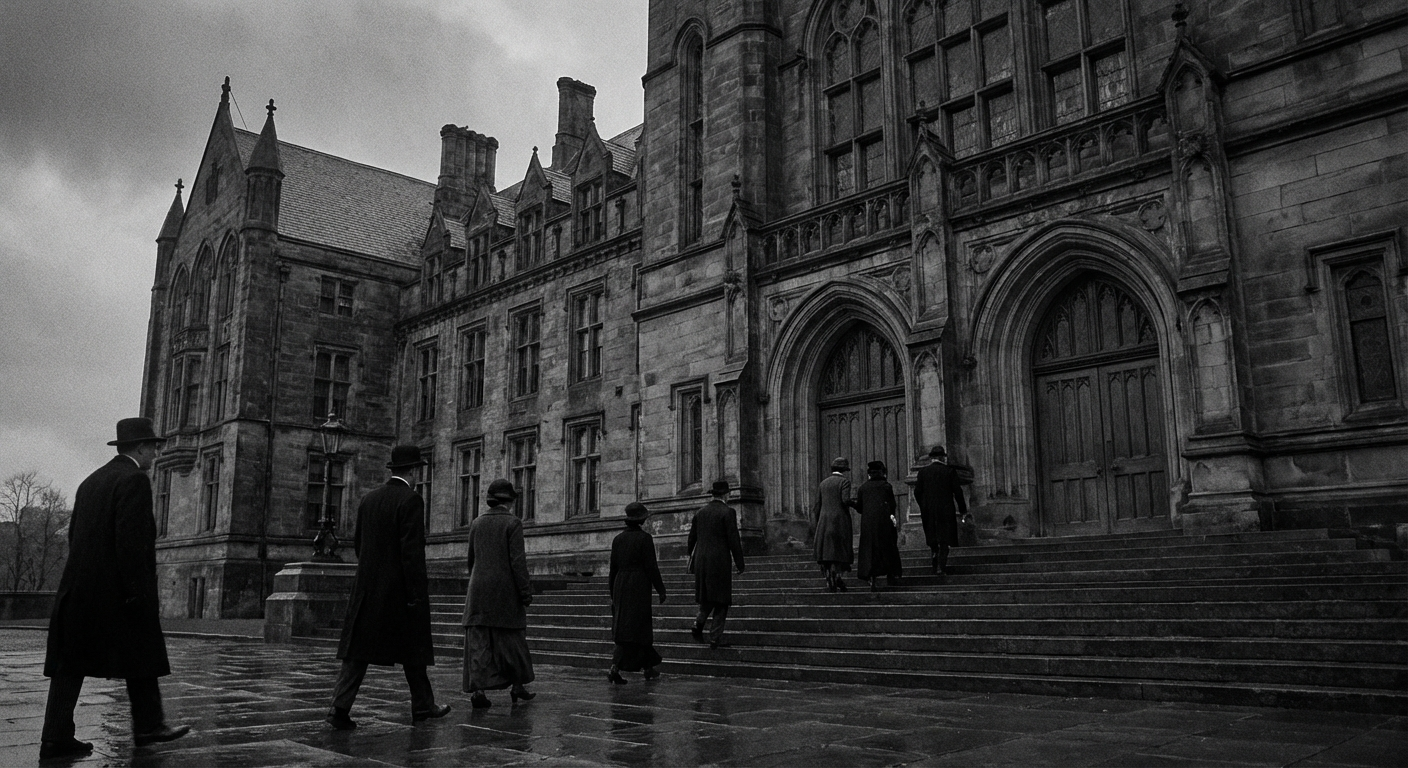
The case number was 2026-MTR-0417. The room was the old magistrates’ court on Grayling Street — high-ceilinged, oak-panelled, and lit by windows that have not been cleaned since the autumn. The bench was occupied by Magistrate Constance Hathaway, sixty-four years old and nineteen years on the tribunal. She arrived at 9:48 AM. She did not smile.
Edmond Crayle rose first, as the appellant. He was accompanied by Tobias Wainscott, a junior solicitor at Crayle, Whitford & Associates who appeared to be experiencing the most significant morning of his career thus far. Wainscott carried four lever-arch files. Crayle carried none.
The appeal concerned the Municipal Revenue Office’s demand of approximately 2.35 million florins in outstanding vacant building levy against Ashcroft Property Group, covering the period January 2024 to February 2026, plus penalties accrued since the original fourteen-day deadline expired in March.
Crayle opened with procedure. The original demand, he argued, had been issued “in haste and under political pressure” following the Greystone Wharf fire investigation and the Docklands safety audit. The Revenue Office had applied a blanket classification of “vacant” to properties that Ashcroft maintained were undergoing preparation for renovation or redevelopment.
“The Revenue Office has confused inactivity with vacancy,” Crayle said. “A building in which a development plan is being formulated is not vacant. It is waiting.”
Magistrate Hathaway asked how long a building may wait before it becomes vacant in the eyes of the levy.
“That,” Crayle said, “is precisely the question the Revenue Office failed to ask before issuing its demand.”
He spent forty minutes on the Harbourfront Parade warehouse — the one property where the Revenue Office had partially upheld Ashcroft’s dispute, reducing the levy by approximately 120,000 florins after a building permit filed in November 2025 reclassified the building as “pending renovation.” Crayle argued that the same logic applied to at least four additional properties where Ashcroft could demonstrate “active consideration” of redevelopment — planning consultations, architectural correspondence, and site assessments.
Wainscott opened one of the lever-arch files and produced a letter from an architect dated September 2024 regarding a property on Chandler’s Row. Hathaway examined it for two minutes.
“This letter,” she said, “is an acknowledgement of a preliminary inquiry. It commits neither party to anything.”
The Revenue Office was represented by Margaret Poynton, a senior enforcement solicitor who has appeared before the tribunal more often than most magistrates. She was concise. The buildings, she said, were empty. No utility consumption consistent with occupation had been recorded. No construction activity had been observed. No formal planning applications — as distinct from preliminary inquiries — had been submitted for any property other than the Harbourfront Parade warehouse.
“The levy exists because vacant commercial properties impose costs on the city,” Poynton said. “Costs of policing, fire risk, structural deterioration, and civic neglect. Mr Ashcroft’s buildings have imposed all four.”
She paused.
“One of them caught fire.”
Crayle objected. Hathaway noted the objection and invited Poynton to confine herself to the tax matter before the tribunal.
The central dispute came down to timing. Crayle argued that the Revenue Office had accelerated its assessment process in response to the Docklands audit — that the demand had been issued “on the back of a political exercise, not a fiscal one.” He pointed to the fact that the demand arrived within days of the 47-page audit report being presented to council.
Poynton responded that the audit had revealed precisely the sort of neglect that the vacant building levy was designed to address. “The timeline is not suspicious,” she said. “It is appropriate.”
The penalty question occupied the final hour. The Revenue Office had applied the standard 1.5 percent monthly surcharge from the date of non-payment — approximately 34,700 florins for the first month alone. Crayle argued that the penalties should be suspended pending the appeal, citing a 2019 tribunal ruling in which penalties were stayed during contested proceedings.
Hathaway noted that the 2019 case involved a disputed property classification, not a disputed demand. She asked Crayle whether his client disputed that the buildings were, in fact, empty.
“We dispute that emptiness and vacancy are the same thing,” Crayle said.
“That,” Hathaway replied, “is a distinction that may or may not survive this tribunal.”
The hearing adjourned at 1:52 PM. Judgment has been reserved. Hathaway indicated a written decision within ten days.
Outside the tribunal, Crayle told reporters that his client was confident the decision would recognise the procedural irregularities. Wainscott stood behind him holding the lever-arch files. One of them appeared to have lost a ring.
At City Hall, Councilwoman Pryce — who introduced the inspection motion that followed the Docklands audit — declined to comment on a matter before the tribunal. Councilman Voss observed that 2.35 million florins, if collected, would fund “approximately four months of the geological survey, or one-sixth of a bridge repair.”
The Revenue Office, through a spokeswoman, said it was confident in the lawfulness of the demand and the penalties, and would await the magistrate’s decision.
The city will wait with it.