
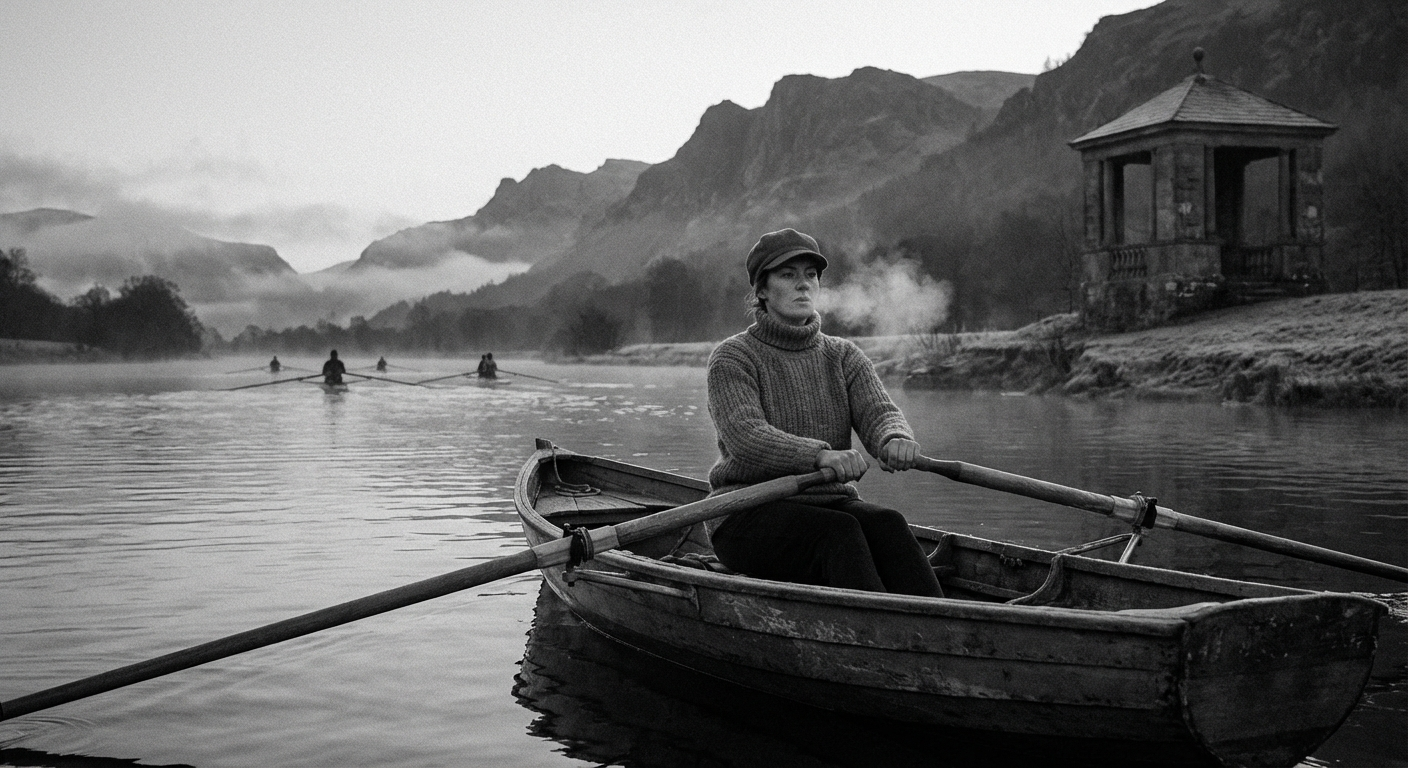
On a cold, clear morning at the Caldwell Rowing Basin, Edith Wren took her place at the start line of the National Veterans’ Sculling Championship alongside seven other competitors in the over-55 category.
She was the oldest in her race. She had the oldest boat. She had come the farthest.
Wren, 58, a retired postal worker from Thornhill, rowed Early Post — the wooden scull she built in her garden shed in 1999 — down the 2,000-metre course on the River Lenn in 8 minutes and 12 seconds. It was her personal best, 4 seconds faster than her qualifying time at Coldharbour Reach. She finished fourth, 1.3 seconds behind the third-place finisher and 6.1 seconds behind the winner.
She did not cry at the finish line, though Vera Duncombe, who had travelled up from Bobington with four members of the Ashwater Sculling Club, did.
“Fourth is fourth,” Wren said, breathing hard, her hands still on the oars. “I’ll be back.”
Captain Glyn Ashmore, 72, the race convener and a former national-level competitor who has organised the Veterans’ Championship at Caldwell for eleven years, presented the medals at the basin pavilion. He made a point of shaking Wren’s hand. “A self-built boat, a self-taught stroke, and a personal best at her first national championship,” he said afterwards. “I’ve seen people with better equipment do worse.”
Forty-two scullers competed across five age categories on a morning that began at 4 degrees and never quite reached 10. The basin, a purpose-built course on the River Lenn, ran mirror-flat for most of the morning, though a crosswind developed in the final two heats.
Wren trained for this race six mornings a week on the Ashwater, where her late husband Stanley watched from the bank every morning for twenty-two years until his death in 2019. She has not missed a morning since.
The championship was won, in the over-55 class, by Anneke Lindström of Caldwell, in 7 minutes 51 seconds — a course record. But it was Wren who received the longest applause from the small crowd gathered along the basin wall.
Duncombe, who coaches the Bobington Ladies’ Sculling Club and who has known Wren for three decades, said: “She’ll come home and she’ll be on the river tomorrow at six. That’s who she is.”
Wren packed Early Post onto a borrowed trailer, drank a cup of tea from a flask, and began the drive back to Bobington.