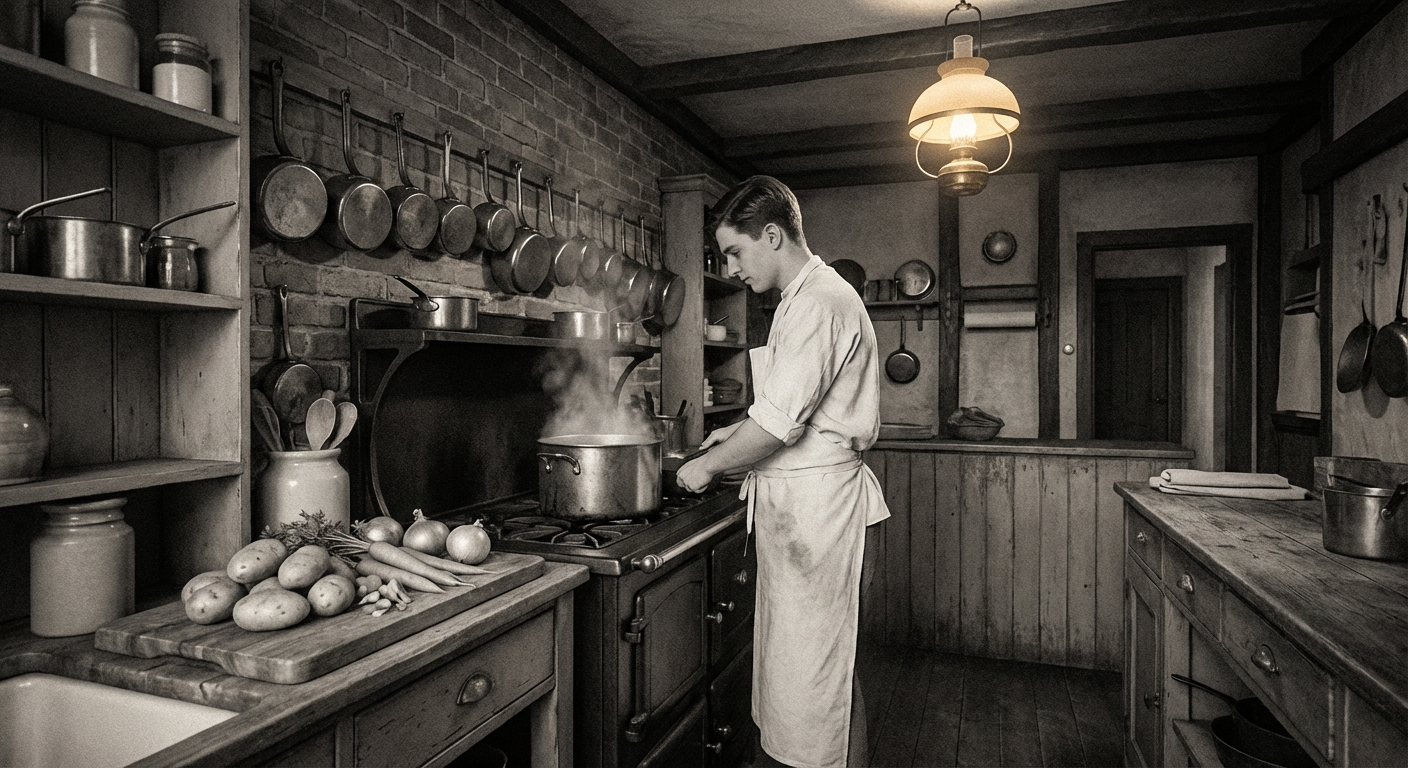
In a converted cobbler’s shop at 14b Threadneedle Street — wedged between a tobacconist and the side entrance to Rensler’s coffee house — a 26-year-old chef is conducting what amounts to a culinary experiment with commercial implications.
Arlo Kessling opened The Thirty-Mile Table three weeks ago with a premise that is either charmingly simple or stubbornly impractical, depending on one’s appetite for principle: every ingredient on his menu is sourced from within thirty miles of Bobington. No eastern spices. No Thessarine salt cod. No Verlainese cream. Nothing that arrives by rail from further than Edgeminster or by cart from further than the Greymoor uplands. Just what the Ashwater Valley, the hill farms, and the market gardens between here and the horizon can provide.
The restaurant seats eighteen. It is open four nights a week — Wednesday through Saturday — and does not accept bookings. Kessling cooks alone, with a single helper who washes dishes and, by Kessling’s account, occasionally weeps.
The Meal
On the Thursday evening this reporter visited — temperature hovering near freezing, a queue of eleven people already formed at the door by half past six — the menu, handwritten on a chalkboard and subject to alteration without notice, offered:
Cured Ashwater river trout with pickled turnip and watercress. A broth of root vegetables, barley, and smoked ham hock from a farm outside Millhaven. Roast guinea fowl with braised cabbage and a sauce of reduced cider from an orchard near Edgeminster. A pudding of stewed pears with oat crumble and fresh cream from Pennock’s dairy, also Millhaven.
The meal cost twelve florins, wine not included. This is roughly what Verlaine’s charges for a starter.
“The thirty-mile rule isn’t a gimmick,” Kessling said during a brief pause between courses, his apron carrying the full archaeological record of the evening’s work. “It’s a discipline. You learn what’s actually here, what’s in season, what the soil gives you. Most of us have no idea what grows fifteen miles from the city. I didn’t, until I started looking.”
A Fortunate Moment
The timing of his venture has been, to put it mildly, convenient. With the Eastern Spice Index at a record 348 and restaurants across Bobington scrambling to reformulate menus stripped of velveroot, cardamon, and saffron bark, Kessling is the only chef in the city with no supply-chain problem whatsoever. His suppliers are a network of farms and smallholdings that he has personally visited, most of them within cycling distance.
“I’d be lying if I said I planned it,” he admitted. “I opened because I was ready, not because of the strait. But I’d also be lying if I said it wasn’t satisfying to watch half of Threadneedle Street panic over spice shipments while my biggest concern is whether the turnips are the right size.”
The queue at his door, which three weeks ago did not exist, has grown steadily. On Saturday evenings, Kessling said, he turns away as many as he seats.
The Economics
Whether The Thirty-Mile Table represents a viable business model is a question that Kessling answers with the breezy confidence of someone who has not yet had to face a bad quarter.
The economics are constrained. Small-batch suppliers cannot match wholesale prices, and the thirty-mile rule eliminates bulk purchasing from the commodity markets that feed every other restaurant kitchen in the city. Kessling estimated his food costs at roughly 55 per cent of revenue — high by any standard. The industry norm hovers around 30 to 35 per cent.
“I’m aware of the numbers,” he said. “I did work in professional kitchens. I can do arithmetic.”
His rent is low — the cobbler’s shop was vacant for two years and the landlord, he said, was “grateful for anyone who wasn’t going to turn it into another tobacconist.” His labour costs are minimal, primarily because he does not sleep enough and does not employ enough people.
“It’s not scalable,” he conceded. “But I’m not trying to scale it. Eighteen seats, four nights a week. That’s enough. I don’t want a dining empire. I want people to eat well and know where it came from.”
From The Willow Table to the Cobbler’s Shop
Kessling trained at The Willow Table under Simeon Kade — widely respected as one of Bobington’s most thoughtful restaurateurs — before spending two years working in kitchens in Caldwell. He returned to Bobington last autumn with limited savings and what he described as a growing conviction that the city’s food culture had become “disconnected from its own landscape.”
“We import everything,” he said. “And there’s nothing wrong with that — trade is wonderful, markets are wonderful. But somewhere along the way we forgot that there are farmers fifteen miles from here growing extraordinary things, and nobody in the city knows their names.”
He rattled off several: Pennock’s dairy in Millhaven (the cream and butter), the Threlfall family smallholding near Edgeminster (poultry and eggs), a woman named Greta Solvay who keeps bees and grows herbs on a half-acre plot just south of the Ashwater Valley.
“Greta’s rosemary is better than anything you’ll find at Bramblegate Market,” he said. “She doesn’t sell wholesale. She sells to me, and to two other people, and that’s it.”
Kade, his former employer, offered a measured endorsement when contacted.
“Arlo is talented and stubborn in roughly equal measure,” Kade said. “Those are not bad qualities in a chef. Whether the city is ready for what he’s offering — that, I cannot tell you. But the food is honest, and in a time when half of Midtown is serving apologies where their signature dishes used to be, honesty is not a small thing.”
What It Means
The Thirty-Mile Table will not solve Bobington’s supply-chain anxieties. It seats eighteen people. It is one restaurant in a city of restaurants, and its model depends on precisely the kind of small-scale, relationship-driven sourcing that cannot be replicated across an industry built on volume.
But it raises a question that the spice crisis has made suddenly urgent: what does Bobington’s own countryside actually produce, and why don’t more people know?
Kessling, scrubbing a pan at the end of the evening with the focused energy of someone who has no one else to do it, offered a parting thought.
“People keep telling me I’m doing something radical. I’m not. I’m cooking dinner with what’s nearby. That used to be the only way anyone cooked. It’s the importing everything from six thousand miles away that’s radical — we just forgot.”
The Thirty-Mile Table is at 14b Threadneedle Street. No bookings. Doors open at seven. Bring patience and twelve florins.