
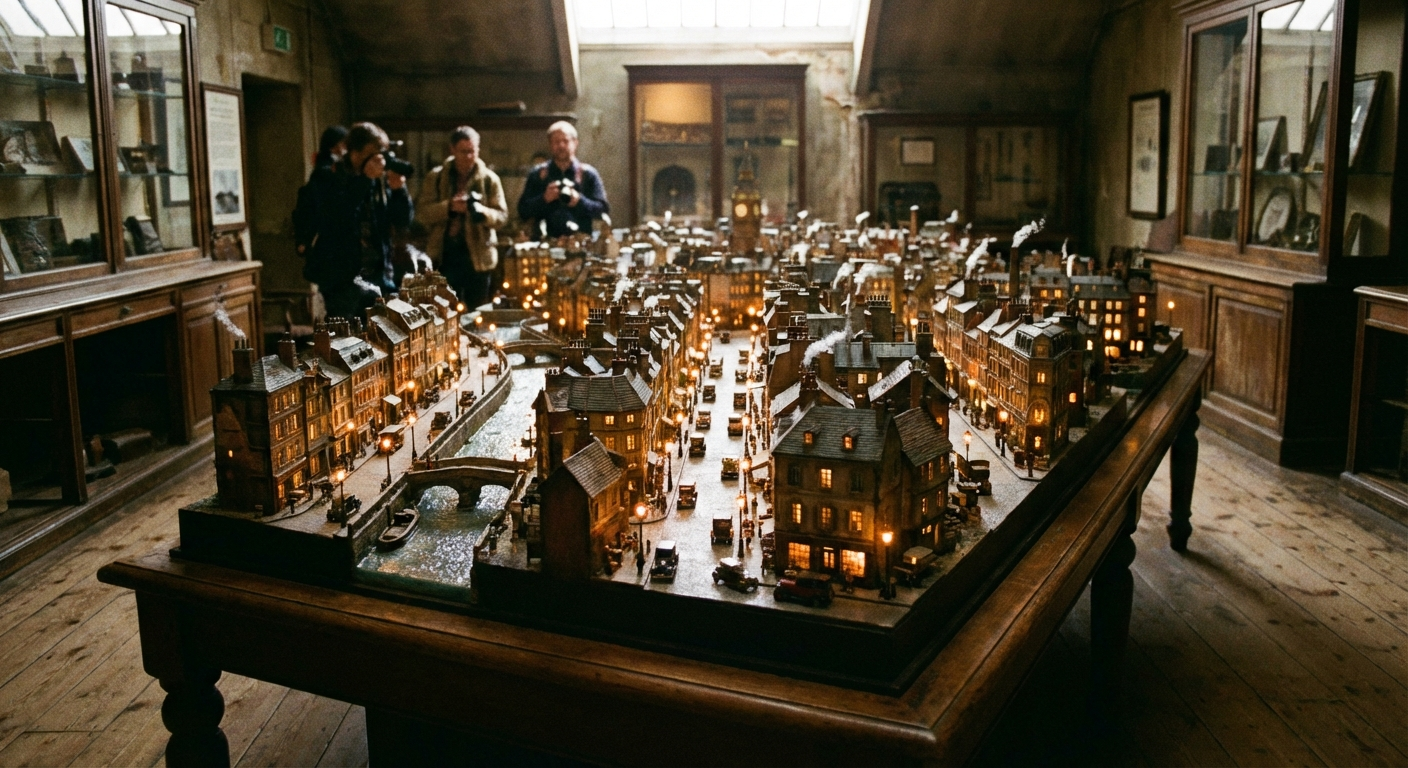
The model arrived in two halves. It is leaving in one piece.
Arthur Bayliss, fifty-five, furniture restorer, and his son James, twenty-eight, have been working in the upstairs gallery of the Historical Preservation Society since Tuesday the eighth of April. They began with twelve severed mechanical connectors — the points where Oswin Faraday’s model of Bobington was divided at the river to fit through his garage door in Thornhill. Ten are now restored. Two remain: the Millgate tram bridge, whose tiny copper contact points must be aligned to within a fraction of a millimetre, and the Lower Ashwater footbridge, whose pedestrian mechanism (eighteen moving figures on a ratchet) requires a tension that James describes as “somewhere between a watch spring and a prayer.”
The electrical system has been the greater challenge. Forty-eight miniature streetlamps illuminate the model — each one wired individually to a central battery concealed beneath the Docklands district. When the model was divided, sixteen wires were cut. James has been working through them methodically, soldering connections so fine they require a jeweller’s loupe. Thirty-two lamps are now lit. Sixteen remain.
“Father does the wood and the mechanics,” James said, without looking up from a wire thinner than a human hair. “I do the fiddly bits.”
The model is extraordinary. Your correspondent has visited twice this week and can report that even in its current state — two connectors incomplete, sixteen lamps dark, the aquarium pump temporarily disconnected — it is one of the most remarkable things in Bobington.
The northern half is fully operational. The number 7 tramline runs from Caldecott Square to Millgate on a clockwork mechanism that Faraday wound before the model left his garage. It will run for approximately fourteen hours before requiring rewinding. The tram itself is eleven millimetres long. It stops at six stations. It is, as far as this critic can determine, on time.
The southern half is being connected. The Docklands district — Harbourfront Parade, Chandler’s Row, Pilot’s Alley, the wharves — is complete in miniature at a level of detail that borders on the obsessive. Faraday has included the tarred canvas patch on the Bramblegate Market roof, the shoring props on the Harbourfront Parade warehouse, and a tiny handcart on Cooperage Lane with books on it.
“He updates it,” Arthur Bayliss said. “He was still adding things the week before we took it apart.”
Louisa Marchbank, chairwoman of the Historical Preservation Society, visited the gallery on Monday morning and stood in front of the model for eleven minutes without speaking.
“It is not a model,” she said finally. “It is a portrait. The city has been sitting for this portrait for eight years and did not know it.”
The exhibition opens Friday the eighteenth of April. The gallery will be open Tuesday through Sunday, 10 AM to 5 PM, with extended hours on Fridays until 8 PM. Admission is free — Faraday insisted. He will not attend the opening.
“I’ve seen it,” he said, when asked. “I built it. I know what it looks like.”
Constance Faraday, his wife, will attend in his place. She has been invited to cut a ribbon.
“I have been invited to cut a ribbon at an exhibition of something that was in my garage for eight years,” she said. “The irony is not lost on me.”
Two connectors remain. Sixteen lamps. Four days.
James Bayliss reached for another wire.