
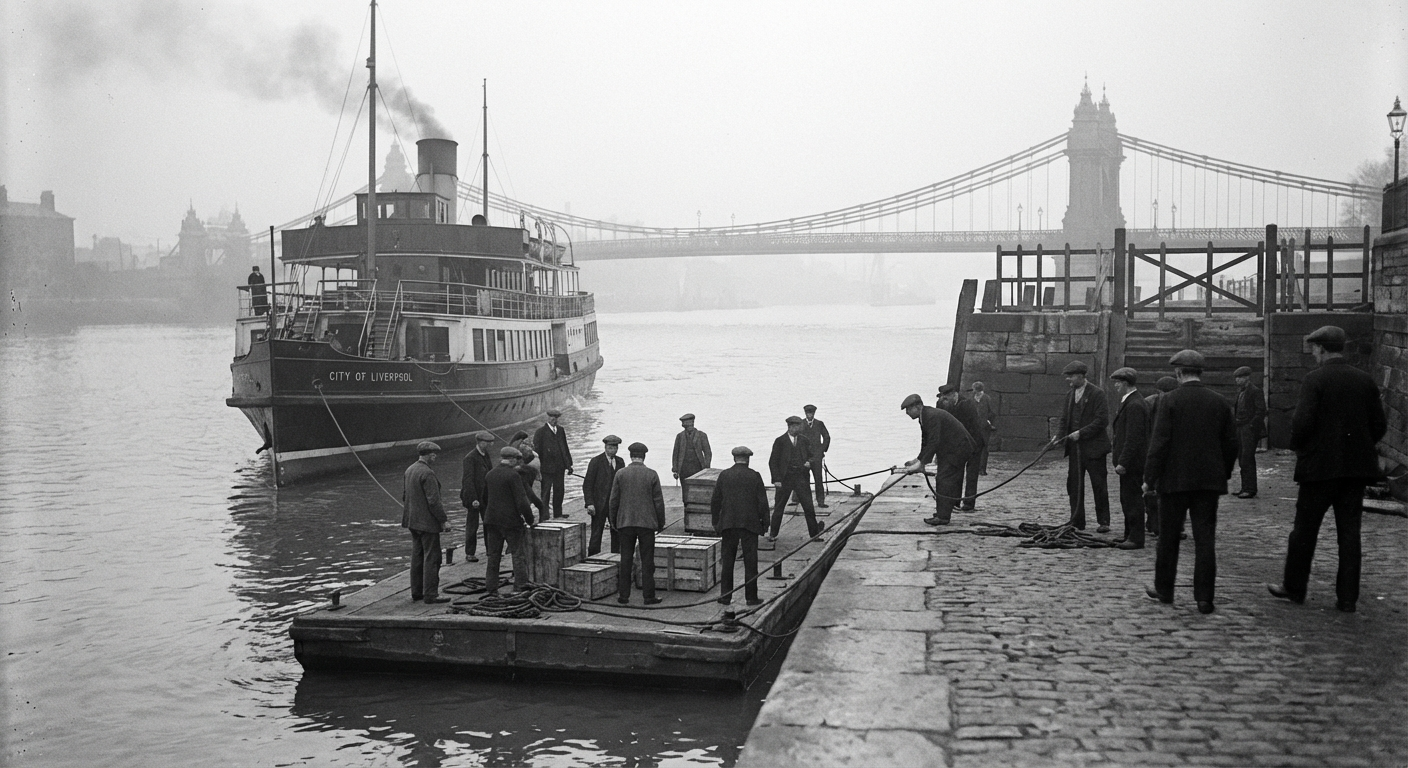
The Thornhill Star sat low in the water at Thornhill Reach on Sunday morning, her crew running boarding drills with sandbag passengers while engineers on the opposite bank bolted the last sections of a temporary floating pontoon to the ancient stone steps at Bramblegate.
Five days from now, if all proceeds to schedule, fourteen thousand daily commuters who have spent the past ten days navigating a five-mile detour via Coldharbour Viaduct will have a new way across the Ashwater. It will be slower than a bridge. It will be colder than a bridge. But it will, at thirty centimes a crossing, get them to work.
“She’s ready,” said Gwen Alderly, managing director of Ashwater River Services, watching her crew rehearse the process of loading and unloading two hundred passengers in under four minutes. “Or she will be by Friday. We’ve got four days of drills left.”
The Route
The service will run between Thornhill Reach — the embankment just north of the stricken Fernwick Bridge — and Bramblegate Steps, a set of stone river stairs that have served as an informal landing point since before the bridge was built in 1914. The crossing is approximately 180 metres and should take, in calm conditions, roughly six minutes.
Service will operate every fifteen minutes from six in the morning until ten at night, seven days a week. The Thornhill Star will handle the regular schedule; the backup vessel Bramblegate Belle will cover maintenance windows and, if demand warrants, run a supplementary service during the morning and evening peak.
The Infrastructure
The Thornhill side has required relatively modest work — a gangway extension and a temporary waiting shelter have been erected along the embankment path. The Bramblegate side has been more challenging. The historic stone steps, worn smooth by two centuries of river traffic, provide a picturesque but impractical boarding point. The floating pontoon, anchored to the riverbed and connected to the steps by an articulated ramp, adds the stability and height that a modern passenger vessel requires.
Municipal Works crews have been on site since Wednesday. The pontoon, fabricated at a yard in the Docklands and floated downstream on Saturday, was secured in position by early Sunday morning. Chief Municipal Engineer Dorothea Kinnear inspected the installation on Sunday afternoon and pronounced it “adequate for the purpose, if not elegant.”
The Commuters
For the fourteen thousand people who used Fernwick Bridge daily — clerks, factory workers, teachers, shopkeepers, students — the past ten days have been an exercise in frustrated patience. The Coldharbour Viaduct detour adds approximately twenty-five minutes to the crossing in each direction, and the viaduct itself, designed for eight thousand daily crossings, has been visibly strained by the additional traffic.
Estelle Danforth, a bookkeeper who commutes from the Docklands to Upper Fernwich, has been rising forty-five minutes earlier since the bridge closure. “The ferry won’t be as fast as the bridge,” she said. “But I’ll take cold and wet over another hour on the viaduct.”
Monthly passes — twelve florins, subsidised by the emergency infrastructure committee — go on sale at the Thornhill Reach kiosk and the Bramblegate Post Office from Wednesday.
Fernwick Bridge itself remains closed for comprehensive cable replacement. The repair is estimated at eight to twelve months and fifty-five to sixty-five million florins. Hallam & Stroud engineers are currently stripping the old cables and assessing the condition of the bridge towers.
Until then, the Thornhill Star will carry the city across the water.