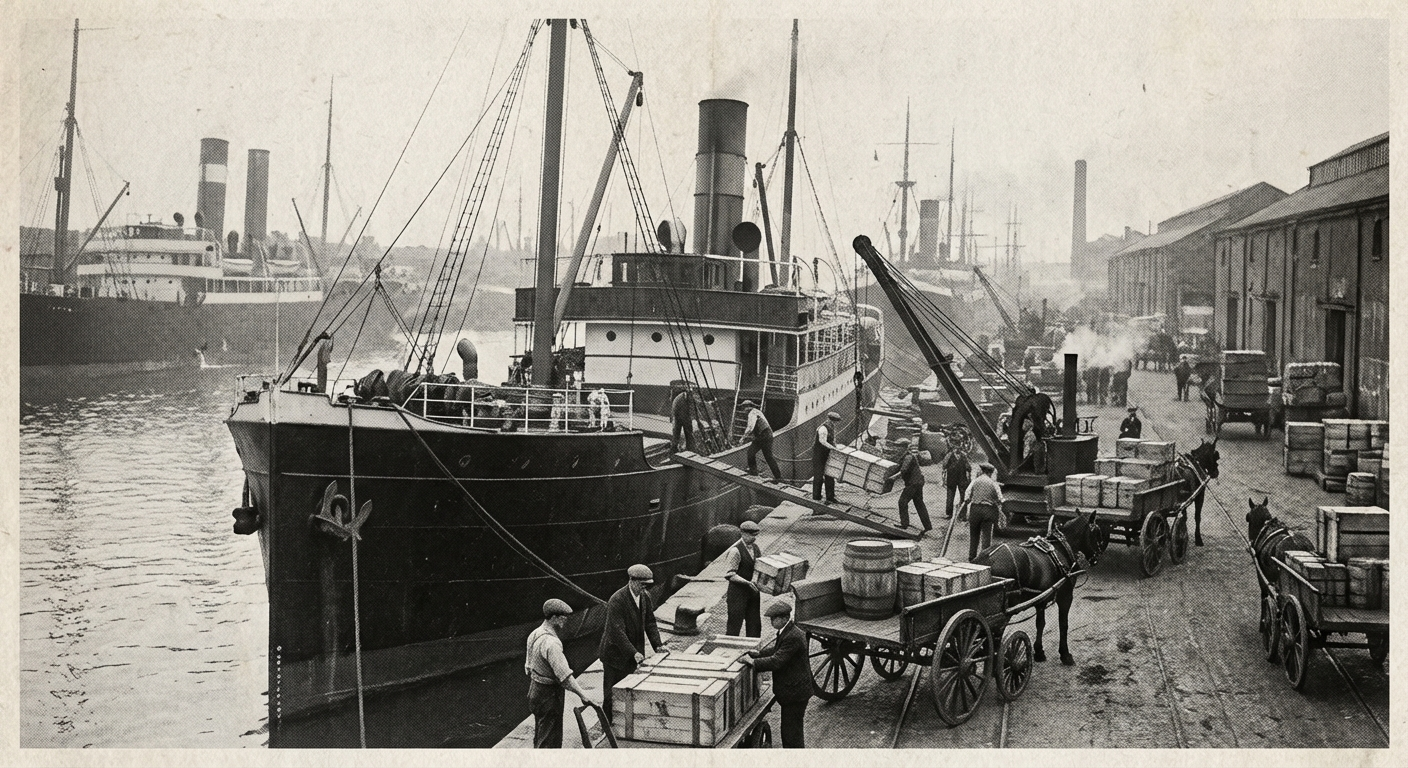
The Kestrel was made fast at Thessara’s eastern cargo terminal at 7:18 on Wednesday morning, six days and fourteen hours after departing Port Caravel. Captain Viggo Hagen, who has been characteristically sparing with his radio throughout the passage, sent his final transmission at 6:51 AM Thessarine time: “Approaching eastern berths. Request pilot. Hagen.”
Thessarine port authorities assigned pilot vessel Horizon to guide the Kestrel through the harbour approach. By 8:30, stevedores were offloading the first pallets of machine parts from the forward hold. By midday, the first of twelve hundred tonnes of timber, grain, and manufactured goods had begun moving through the Thessarine customs hall — cargo that, three weeks ago, would have been routed an additional twelve to fifteen days around the Cape of Sarenne.
It is, in the language of trade, an unremarkable event. A ship arrives. Cargo is unloaded. Bills of lading are stamped. Customs officers inspect crates. Stevedores drink tea between loads.
That it is unremarkable is precisely the point.
“The framework was designed to make the extraordinary ordinary,” said Professor Elias Thornbury of the Bobington Institute for Foreign Affairs. “A ship passed through contested waters under an agreed protocol, and nothing happened. That is what success looks like.”
The Joint Maritime Inspection Commission — three Delvarian, three Thessarine, one Ashford Republic observer — reviewed the Kestrel’s manifest by telegram before departure and raised no objections. The vessel transited the designated corridor through the northern channel on Monday without incident, maintaining the required speed and signalling protocols. No inspection was requested.
Fairweather & Chalk, who underwrote the Kestrel’s insurance policy — the first Kaelmar-route policy in six weeks — confirmed no claims have been filed.
The corridor, it appears, works.
Two More Keels
The Kestrel will not be alone for long. The Thessarine-flagged Nørdvik, under Captain Nils Eriksen, departed Port Caravel on Tuesday carrying copper ingots and refined sugar westbound for Edgeminster. The Ashford Republic vessel Adelheid, under Captain Gerda Voss, filed her transit manifest on Wednesday morning for an eastbound passage carrying manufactured goods and textiles.
“If three vessels transit without incident within a fortnight, the corridor becomes a fact rather than an experiment,” Thornbury observed. “Insurance firms will notice. Shipping companies will notice. And the premium structures will follow.”
Copper closed Thursday at 703 florins per tonne — the twenty-sixth consecutive daily decline. The Eastern Spice Index settled at 241, its lowest reading since early January.
At the Bobington Foreign Office, Undersecretary Helena Marchetti was brief: “We note with satisfaction that the framework is functioning as intended.”
At the Delvarian consulate on Ashbury Lane, Consul Pehr Lindqvist was briefer still. His office confirmed receipt of the transit report and offered no further comment.
In Thessara, the Kestrel’s cargo — timber from the northern forests, grain from the central provinces, machine parts for the Thessarine textile industry — was cleared through customs by early afternoon. Captain Hagen, according to port records, went ashore at 2 PM. His destination was not recorded.
Twelve hundred tonnes. One corridor. Three nations watching.
The ordinary has never been so carefully observed.