
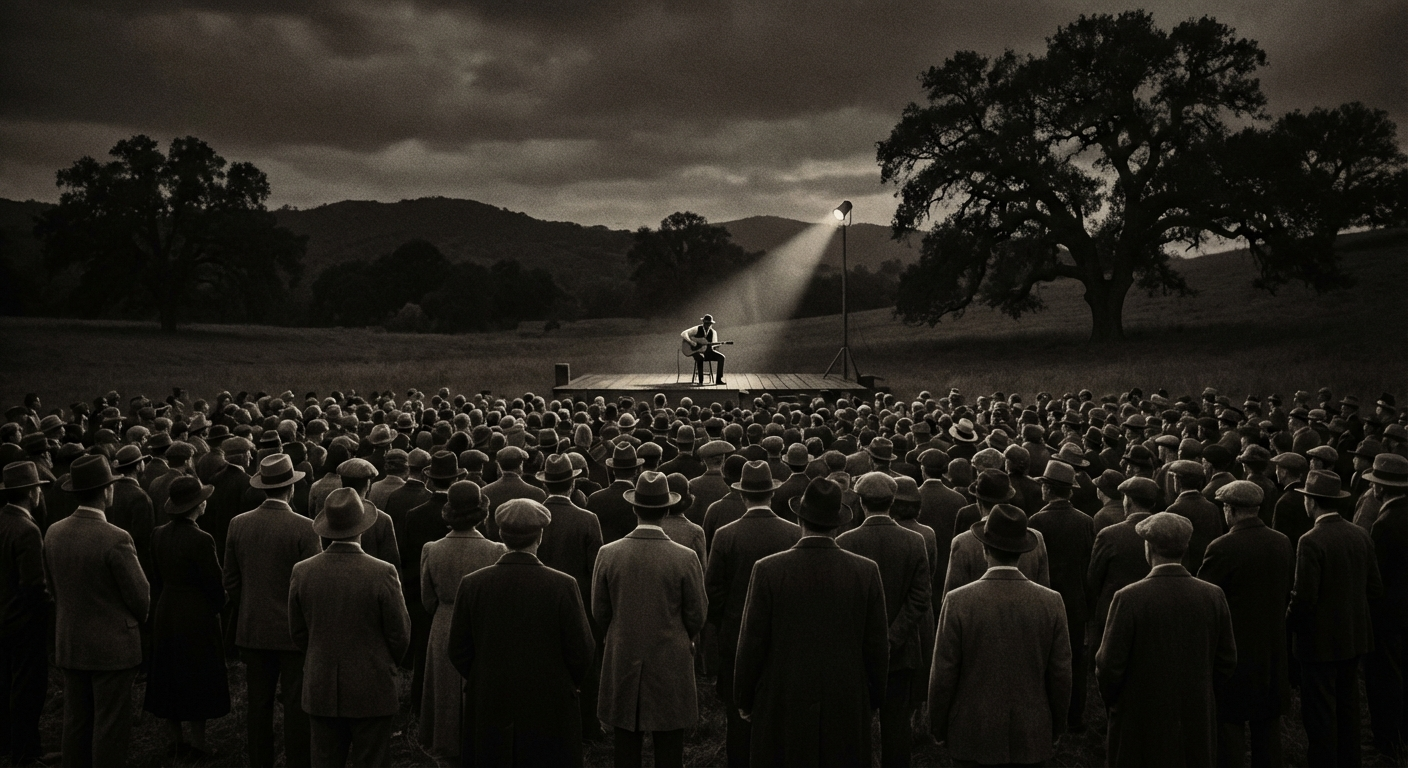
There is a particular quality of silence that descends on a field of ten thousand people when something extraordinary is happening and everyone knows it. It is not the silence of absence. It is the silence of attention — the sound of thousands of people deciding, collectively and without consultation, to stop talking.
It happened on Saturday night at Windhallow, at approximately twenty past eleven, when Luma Sable walked onto the Ashwater Stage with nothing but her twin-strung vielle, sat on a wooden stool, and began to play.
What followed was forty minutes of solo resonance work so precise, so emotionally direct, and so utterly unlike anything else heard over the festival’s three days that it retroactively reorganised the entire weekend around itself. Everything that came before was prologue. Everything after was epilogue. The festival had its moment, and everyone present knew exactly when it was.
The Festival
The 27th Windhallow Festival occupies a sprawling site in the Ashwater Valley, about twelve kilometres south of Bobington, where the river bends through a natural amphitheatre of low hills and oak woodland. It is, by a considerable margin, the nation’s largest annual gathering of live music, and it wears its age well — old enough to have traditions (the Friday-night bonfire, the Sunday-morning brass procession, the vendor who has sold the same pickled-egg-and-mustard rolls from the same cart since 1999) and young enough to still surprise.
This year’s programme ran across four stages and featured some 90 acts over three days. The range was characteristic: driftwork ensembles from the Sarenne coast played alongside Caldwell chamber orchestras; street-tone crews from the Docklands shared billing with Verlainese harmonic choirs; and the perpetually muddy Woodland Stage hosted everything from solo bellows players to the twelve-piece percussion troupe known, for reasons nobody can satisfactorily explain, as the Adequate Badgers.
Friday’s opening was dampened — literally — by a five-hour downpour that turned the main field into a landscape more suited to rice cultivation than recreation. The Millgate Resonance Collective, who opened the Ashwater Stage, played to a crowd that was enthusiastic but visibly sinking. By evening the rain had stopped but the mud had not, and the festival took on the cheerful, filthy character that its regulars insist is essential to the experience and its newcomers insist is grounds for legal action.
Saturday’s Highlights
Saturday brought sun and, with it, the festival’s strongest day.
The afternoon belonged to the Caulfield Ensemble — four players from Edgeminster whose chamber-drift work has been gathering attention in the smaller concert halls for two years. Their set on the River Stage was a masterclass in layered tension: twin vielles weaving around a bone-flute melody while the low drone of a bellows held the entire structure together like a spine. The crowd — perhaps 4,000 — was rapt. Celeste Caulfield, who leads the group with an authority that belies her twenty-eight years, introduced their final piece as “something we wrote on the train this morning.” If true, it was the finest piece of rail-based composition since the Verlaine Accords.
The Dockside Chorus, a street-tone group from Bobington’s own waterfront, drew a boisterous mid-afternoon crowd to the Woodland Stage. Street-tone has always been divisive — its admirers call it the authentic voice of working Bobington; its detractors call it shouting with rhythm — but the Chorus made a persuasive case on Saturday, their twelve voices building harmonic towers of startling complexity from what began as a simple stevedore’s chant. When lead caller Ivo Brennick (no relation to the Rovers midfielder, though the name prompted inevitable jokes) launched into “The Ashwater Running,” the crowd sang back the response lines with a fervour that suggested half of them had grown up hearing it.
Sable’s Set
And then, Saturday night, Luma Sable.
Sable is forty-one, from Thessara, and has been living in Bobington for a decade. She is a resonance player — which is to say she works in the tradition that treats the vielle not as a melodic instrument but as a generator of overtones, using the twin strings to produce harmonic interference patterns that the ear hears as a third, phantom voice emerging from the space between the two. In the hands of a competent player, it is interesting. In the hands of Sable, it is devastating.
Her Windhallow set was unaccompanied. No drone, no percussion, no bellows. Just the vielle, the stool, and the dark. She began with a piece that those familiar with her work recognised as a variation on the Thessarine mourning mode — a slow, deliberate exploration of a narrow interval that gradually widened until the overtones began to shimmer and the air above the field seemed to thicken.
Nobody moved. Nobody spoke. A baby cried once, briefly, and was silently forgiven.
The set built through four movements — the second faster and more percussive, using the bow’s wood against the bridge to produce a clicking rhythm beneath the drone; the third almost unbearably quiet; and the fourth a cascading resolution that drew together threads from everything that had come before. When it ended, the silence held for perhaps five seconds before the applause began — not the whooping of a festival crowd but something deeper and more sustained, the sound of people expressing gratitude.
“I play what the strings give me,” Sable said afterward, backstage, with a cup of tea and a blanket. She does not give interviews willingly. “Tonight they gave generously.”
Sunday and the Sum
Sunday was gentler, as Windhallow Sundays tend to be. The brass procession — a tradition since the festival’s third year — wound through the camping fields at eight in the morning, waking the dead and the merely hungover with equal efficiency. The Verlainese Harmonic Choir performed a glacially beautiful set on the Ashwater Stage that served as a kind of collective recovery. And the Adequate Badgers closed the Woodland Stage with an hour of percussion that was, by their own admission, “adequate.”
The 27th Windhallow drew an estimated 35,000 over three days — a slight increase on last year. Festival director Eamon Gallis announced that next year’s event would expand the Woodland Stage and add a fifth stage dedicated to emerging artists. “Windhallow has always been a place where people come to hear what they haven’t heard before,” Gallis said. “We need more room for the unknown.”
He is right. And if the unknown sounds anything like Luma Sable on a Saturday night in the Ashwater Valley, there will be no shortage of people willing to stand in the mud and listen.